We use Google Analytics to understand how visitors use this site. Analytics cookies are only activated with your consent. For details, read our Privacy Policy.
Profile lensThe same player, read from a different angle.
Athletic77
Acceleration
75
Pace
73
Agility
77
Strength
81
Balance
78
Jumping
83
Stamina
65
Fitness
84
Technical43
Dribbling
53
Short Passing
58
Long Passing
59
Shot Accuracy
44
Shot Power
77
Shooting Technique
42
Heading
55
Free Kick
45
Penalties
40
First Touch
43
Mental86
Composure
85
Consistency
87
Leadership
87
Goalkeeping92
Reflexes
97
Positioning
95
Handling
91
Kicking
86
Goalkeeping92
Reflexes
97
Positioning
95
Handling
91
Kicking
86
Attacking50
Heading Accuracy
55
Shot Accuracy
44
Technique50
Dribbling
53
Free Kick
45
Short Passing
58
Long Passing
59
First Touch
43
Shot Technique
42
Physicality78
Shot Power
77
Jumping
83
Stamina
65
Strength
81
Fitness
84
Movement76
Acceleration
75
Pace
73
Agility
77
Balance
78
Mentality & Game Reading75
Composure
85
Penalties
40
Leadership
87
Consistency
87
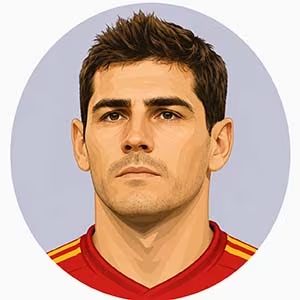
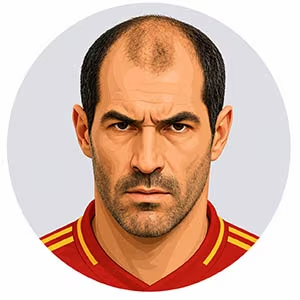
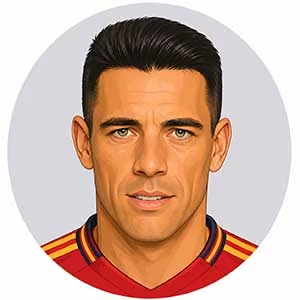
Spain - GoalkeeperCasillas, Iker
In Johannesburg on 11 July 2010, Arjen Robben broke through the centre of Spain’s defence and ran alone towards Iker Casillas. The goalkeeper advanced, stayed upright long enough to prevent Robben from choosing early and then extended his right leg as the shot arrived, diverting the ball wide. Spain eventually won the World Cup final in extra time. The save captured Casillas at his best because the action left almost no time for conscious reconstruction: recognise the angle, close the distance, delay commitment, react. Similar interventions had defined his career since adolescence. At Real Madrid he became first choice extraordinarily young, and in the 2002 Champions League final he entered from the bench after César Sánchez was injured and made a sequence of late saves against Bayer Leverkusen to preserve a 2–1 victory. Acute danger did not require Casillas to become a different goalkeeper. When the problem was immediate and technically legible, his reactions could become exceptionally decisive.
Casillas was a compact, explosive goalkeeper whose greatest strengths were reflexes, foot speed and one-on-one intervention. At around 1.82 metres he lacked the reach of larger elite goalkeepers, so he compensated by moving rapidly across the goal and reacting after the striker had committed. His ability to save with feet as well as hands made him particularly strong at close range, where conventional diving mechanics were often too slow. He could leave the line quickly to reduce angles and possessed enough anticipation to intervene before a forward fully controlled the ball. These qualities helped him accumulate 725 competitive appearances for Real Madrid, five league titles and three Champions Leagues, while his 167 Spanish internationals included the captaincy of the sides that won Euro 2008, the 2010 World Cup and Euro 2012. His technical profile was less complete in other areas. Casillas was functional with the ball at his feet rather than an elite build-up goalkeeper, and his authority over high crosses was less convincing than his shot-stopping. Under sustained aerial traffic he could punch rather than dominate the ball cleanly, particularly when bodies crowded his path.
Those weaknesses became more significant as the game changed and his athletic margin narrowed. Casillas’s relative lack of height reduced his natural coverage on crosses, while aggressive attempts to compensate could expose timing errors. His distribution was adequate for the structures in which he developed but became a more visible limitation as elite teams increasingly demanded goalkeepers capable of participating continuously in possession. Age also reduced some of the explosive reactions that had allowed him to rescue situations after imperfect positioning. The later Real Madrid period therefore contained genuine technical decline as well as institutional conflict, and the two should not be collapsed into a single explanation. José Mourinho first dropped him for Antonio Adán in December 2012, publicly describing the decision as technical. After Casillas subsequently broke a hand, Diego López established himself as first choice, and Carlo Ancelotti later divided competitions between them. Casillas could still produce excellent performances, but the old assumption that reflex superiority would automatically restore his position no longer held.
Psychologically, Casillas is best defined by **relationally mediated self-trust combined with strong acute-action confidence**. The Mourinho conflict is particularly valuable because it developed gradually rather than through one explosive incident. In 2011 Casillas publicly described disagreement with Mourinho as compatible with a good relationship and defended the coach repeatedly. He also acted independently as captain when he believed the wider group required repair, contacting Xavi and Carles Puyol after the increasingly hostile sequence of Clásicos. That conciliatory intervention itself became part of the tension surrounding his relationship with Mourinho. By late 2012 and 2013, contemporary reporting documented direct arguments over the public treatment of players and Casillas’s insistence that criticism should be handled internally; while injured, he even travelled to Barcelona independently to remain with the squad and argued that excluded teammates should accompany the group. Yet he did not immediately respond to losing his place by leaving. Months later, despite being restricted largely to cup competitions, he told Pepe Reina that departure still did not feel right. This was neither passive compliance nor simple fragility. Casillas could defend institutional cohesion against his own coach, absorb prolonged loss of status and continue competing, while the deterioration of trust around him increasingly complicated a position whose performance depended heavily on instinctive certainty. Evidence for retaliatory aggression or systematic referee confrontation is weak. His sharper contradiction is this: **immediate competitive danger often clarified him; prolonged ambiguity about trust, hierarchy and belonging could make the environment around those instincts far less stable**.