We use Google Analytics to understand how visitors use this site. Analytics cookies are only activated with your consent. For details, read our Privacy Policy.
Profile lensThe same player, read from a different angle.
Athletic83
Acceleration
83
Pace
82
Agility
81
Strength
81
Balance
79
Jumping
95
Stamina
80
Fitness
81
Technical85
Dribbling
79
Short Passing
81
Long Passing
75
Finishing
91
Shot Accuracy
93
Shot Power
80
Shooting Technique
88
Heading
98
Tackling
48
Crossing
70
Free Kick
68
Penalties
88
First Touch
82
Mental81
Composure
88
Aggression
78
Consistency
78
Creativity
77
Leadership
77
Work Rate
77
Tactical84
Vision
76
Off the Ball
92
Defensive Positioning
38
Teamwork
77
Anticipation
90
Marking
37
Player Traits
Attacking89
Crossing
70
Finishing
91
Heading Accuracy
98
Shot Accuracy
93
Off the Ball
92
Technique79
Dribbling
79
Free Kick
68
Short Passing
81
Long Passing
75
First Touch
82
Shot Technique
88
Movement81
Acceleration
83
Pace
82
Agility
81
Balance
79
Physicality83
Shot Power
80
Jumping
95
Stamina
80
Strength
81
Fitness
81
Defending41
Marking
37
Tackling
48
Def. Positioning
38
Mentality & Game Reading81
Aggression
78
Composure
88
Penalties
88
Vision
76
Leadership
77
Work Rate
77
Teamwork
77
Anticipation
90
Consistency
78
Creativity
77
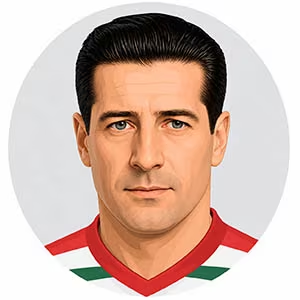
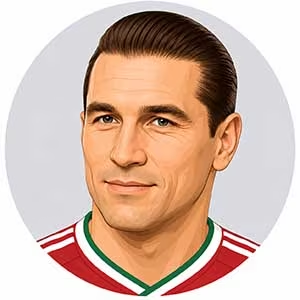
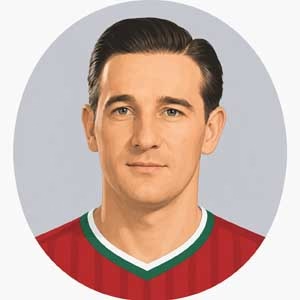
Hungary - StrikerKocsis, Sándor
Sándor Kocsis seemed to hang above defenders rather than simply jump against them. The impression came from timing more than raw elevation: he began his movement while the cross was still being shaped, arrived at its trajectory before the marker had established leverage and then redirected the ball with unusual control rather than merely striking it forward. His nickname, “Golden Head”, reduced an extraordinary scoring repertoire to its most visible weapon, but the heading itself reveals something broader. Kocsis understood where an attack was going before the final delivery existed. At the 1954 World Cup that anticipation produced eleven goals in five matches. Against Uruguay in the semi-final, with Hungary having surrendered a two-goal lead and the match entering extra time, Kocsis scored twice with headers to turn a collapsing advantage into a 4–2 victory. His effectiveness did not require the match to remain orderly or psychologically comfortable.
Kocsis was an inside-forward and centre-forward rather than a static aerial target. Within Hungary’s fluid attacking structure he could move away from the central defender, exchange short passes and then reappear in the penalty area once another attacker had displaced the defensive reference. He finished efficiently with both feet and possessed enough technical security to combine at speed, while his exceptional aerial ability expanded the types of delivery from which Hungary could score. His international record—75 goals in 68 appearances—was built through far more than crosses. With Honvéd he operated inside the core of the Mighty Magyars before the political upheaval of 1956 led him away from Hungary. After a period outside organised elite football he eventually joined Barcelona, where he had to reconstruct his career in a different league and tactical environment. Even there his scoring remained substantial, and in the 1961 European Cup final he headed Barcelona into the lead against Benfica. His game therefore survived both tactical migration and a major interruption in competitive continuity.
There were nevertheless limits. Kocsis was not a long-distance transition forward whose principal threat came from outrunning an entire defensive line, and his greatest influence remained concentrated around the final third. He could participate in combinations but was not the primary organiser responsible for carrying possession from deep. Teams forced to defend for long periods naturally reduced the frequency with which his movement could become finishing opportunity, although describing him as easily neutralised without wide service is too narrow: Hungary generated chances centrally as well as from crosses, and Kocsis could finish loose balls and combinations with his feet. His later Barcelona years were also affected by physical problems, and the accumulated demands of a long career reduced mobility before technical instinct disappeared. The more accurate degradation condition is therefore territorial: move the game persistently away from the attacking zones in which he could anticipate the final action, and his comparative advantage decreased sharply.
Psychologically, Kocsis is best defined by **score-state persistence rather than emotional invulnerability**. The 1954 World Cup provides unusually strong behavioural evidence. Hungary led Uruguay 2–0 in the semi-final, conceded twice and entered extra time having lost an advantage that had appeared decisive. Kocsis did not become less available as the match deteriorated; he scored both extra-time goals. Earlier in the tournament he had continued scoring through matches of radically different competitive states, including four against West Germany and two in the quarter-final victory over Brazil. The final supplies the necessary contradiction. Hungary led West Germany 2–0, lost 3–2 and Kocsis did not rescue them. High persistence therefore did not guarantee decisive output, and the defeat should not be rewritten either as psychological collapse or as proof that pressure never affected him. His post-1956 career offers another form of persistence: after leaving Hungary amid political upheaval and spending a prolonged period outside his established football environment, he rebuilt an elite career at Barcelona rather than returning to the security of his former status. Evidence for referee conflict, retaliation, teammate blame or individual provocation is insufficient and should remain unknown. Nor is there reliable behavioural evidence for the old claims of competitive self-doubt or mood-driven disappearance. The stronger conclusion is simpler: **when the score moved against his team, Kocsis continued to behave as though the next scoring action remained available to him, even after the previous match state had collapsed**.