We use Google Analytics to understand how visitors use this site. Analytics cookies are only activated with your consent. For details, read our Privacy Policy.
Profile lensThe same player, read from a different angle.
Athletic81
Acceleration
90
Pace
88
Agility
90
Strength
68
Balance
73
Jumping
78
Stamina
80
Fitness
78
Technical85
Dribbling
90
Short Passing
81
Long Passing
84
Finishing
88
Shot Accuracy
87
Shot Power
84
Shooting Technique
80
Heading
72
Tackling
44
Crossing
89
Free Kick
74
Penalties
76
First Touch
87
Mental77
Composure
82
Aggression
80
Consistency
74
Creativity
86
Leadership
73
Work Rate
75
Tactical79
Vision
79
Off the Ball
88
Defensive Positioning
47
Teamwork
77
Anticipation
81
Marking
38
Attacking85
Crossing
89
Finishing
88
Heading Accuracy
72
Shot Accuracy
87
Off the Ball
88
Technique83
Dribbling
90
Free Kick
74
Short Passing
81
Long Passing
84
First Touch
87
Shot Technique
80
Movement85
Acceleration
90
Pace
88
Agility
90
Balance
73
Physicality78
Shot Power
84
Jumping
78
Stamina
80
Strength
68
Fitness
78
Defending43
Marking
38
Tackling
44
Def. Positioning
47
Mentality & Game Reading78
Aggression
80
Composure
82
Penalties
76
Vision
79
Leadership
73
Work Rate
75
Teamwork
77
Anticipation
81
Consistency
74
Creativity
86
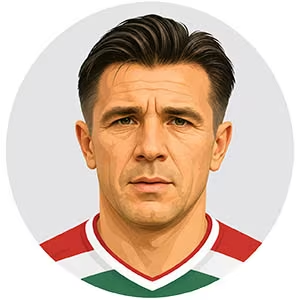
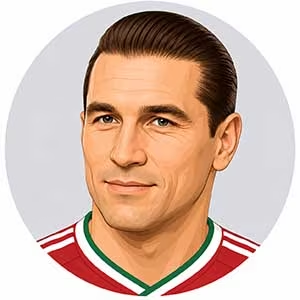
Hungary - Left WingerCzibor, Zoltán
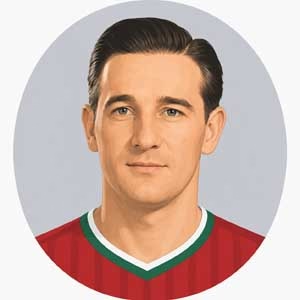
Czibor was principally a left winger, but the fixed positional label understates how freely he interpreted the role. Fast, exceptionally agile and technically adventurous, he attacked defenders with abrupt changes of rhythm and direction rather than following predictable straight-line patterns. His dribbling could look almost mechanically irregular: body and ball seemed temporarily disconnected before another touch took him away from his marker. His background in athletics, particularly the high jump, contributed to an unusual spring and acrobatic quality for a wide player. He could stay outside and deliver, cut toward goal, exchange positions with the other Hungarian forwards or arrive unexpectedly in scoring areas. This mobility made him difficult to assign to a single defender and also explains his unusually high scoring output for a winger. He emerged with Ferencváros, scoring heavily as the club won the Hungarian championship in 1949, later played for Csepel and joined Honvéd in 1953, winning further league titles in 1954 and 1955. He was a central component of the Hungary side that won Olympic gold in 1952, defeated England 6–3 at Wembley in 1953 and reached the 1954 World Cup final. After the Hungarian uprising of 1956, Honvéd were abroad for their European Cup tie with Athletic Bilbao and the team did not immediately return home. In the second leg in Brussels, an injury to goalkeeper Lajos Faragó forced Czibor himself into goal because substitutions were unavailable. He subsequently remained outside Hungary and eventually joined Barcelona in 1958. There he scored 58 goals in 93 appearances, winning two Spanish league titles, the Spanish Cup and the Inter-Cities Fairs Cup before later playing for Espanyol and several other clubs. His Hungarian international career ended in 1956 after 43 appearances; contemporary Hungarian records disagree between 17 and 18 goals.
Czibor’s freedom was also a limitation. His game depended on improvisation, acceleration and permission to abandon conventional positioning, which could make him less naturally suited to structures demanding rigid occupation of the flank or repetitive defensive positioning. His unpredictability did not guarantee efficiency: adventurous dribbling inevitably surrendered possession, and his nervous energy could produce a more erratic rhythm than teammates whose decisions were built around controlled circulation. Physically he was mobile and explosive rather than imposing, so defenders who prevented him turning and repeatedly engaged him before he could accelerate could reduce his space for invention. Most importantly, Czibor was not naturally compliant. A system could benefit enormously from his independence while simultaneously having to accommodate it. That distinction matters: restricting his freedom risked removing part of what made him exceptional, whereas granting it required teammates and structure capable of absorbing his positional deviations.
The behavioural evidence supports that independence far more strongly than any neat personality label. Hungarian football’s own historical account describes Czibor as self-directed, and even within the unusually fluid national side he changed position more frequently than any of his celebrated teammates. Barcelona remembered both the brilliance and the nervous mannerisms that produced his Spanish nickname, Pájaro Loco. His emotional baseline therefore appears more activated and restless than detached, but that restlessness should not be confused with fragility under pressure. He scored in the 1954 World Cup final and again in the 1961 European Cup final, while the hostile significance of Wembley in 1953 did not prevent him functioning within one of Hungary’s defining performances. Major occasions did not make him disappear. The aftermath of 1956 reveals something still more useful. With Soviet intervention transforming conditions at home, Czibor and several Honvéd teammates remained abroad despite opposition from Hungarian football authorities; the team continued with an unauthorised international tour, including matches in Western Europe and South America. Czibor then chose not to return to Hungary, accepting the destruction of his international career and a period of considerable professional uncertainty. His proposed move to Roma collapsed amid football restrictions, leaving him without a stable elite club before Barcelona eventually provided a route back. Whatever mixture of political fear, personal conviction and opportunity informed the decision, the observable behaviour is clear: institutional pressure did not automatically produce compliance, and uncertainty did not make him reverse course. The Brussels match supplies a smaller version of the same adaptability. When Honvéd lost their goalkeeper and could not make a substitution, Czibor abandoned his normal attacking role and went into goal rather than allowing the emergency to paralyse the side. There is less reliable evidence for how he routinely reacted to refereeing decisions, deliberate fouls or teammates’ mistakes, so assigning him a specific retaliation or disciplinary profile would be invention. What can be said is that external restriction appears more psychologically relevant than physical intimidation. His career repeatedly shows movement away from imposed structures — positional, institutional and ultimately national — while competitive pressure itself often coincided with decisive actions. Even his reflection on Bern was direct rather than evasive: Hungary had been extraordinary, had lost only once in fifty matches, and had lost the one that mattered most. Czibor did not need to diminish the importance of the defeat to live with it. His instability was therefore not straightforward unreliability. It was the instability of an intensely activated, autonomous player whose best football required room to behave unpredictably.