We use Google Analytics to understand how visitors use this site. Analytics cookies are only activated with your consent. For details, read our Privacy Policy.
Profile lensThe same player, read from a different angle.
Athletic84
Acceleration
94
Pace
90
Agility
90
Strength
76
Balance
82
Jumping
73
Stamina
83
Fitness
82
Technical85
Dribbling
93
Short Passing
82
Long Passing
85
Finishing
82
Shot Accuracy
82
Shot Power
84
Shooting Technique
83
Heading
68
Tackling
44
Crossing
86
Free Kick
83
Penalties
78
First Touch
90
Mental80
Composure
83
Aggression
80
Consistency
76
Creativity
91
Leadership
82
Work Rate
74
Tactical79
Vision
85
Off the Ball
87
Defensive Positioning
48
Teamwork
77
Anticipation
77
Marking
48
Player Traits
Attacking81
Crossing
86
Finishing
82
Heading Accuracy
68
Shot Accuracy
82
Off the Ball
87
Technique86
Dribbling
93
Free Kick
83
Short Passing
82
Long Passing
85
First Touch
90
Shot Technique
83
Movement89
Acceleration
94
Pace
90
Agility
90
Balance
82
Physicality80
Shot Power
84
Jumping
73
Stamina
83
Strength
76
Fitness
82
Defending47
Marking
48
Tackling
44
Def. Positioning
48
Mentality & Game Reading80
Aggression
80
Composure
83
Penalties
78
Vision
85
Leadership
82
Work Rate
74
Teamwork
77
Anticipation
77
Consistency
76
Creativity
91
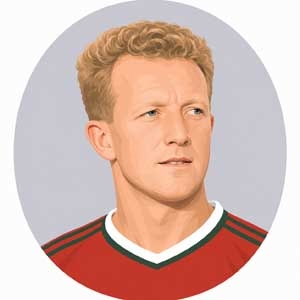
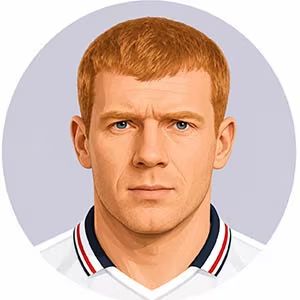
Wales - Left WingerGiggs, Ryan
At Old Trafford on 14 April 1999, Manchester United and Arsenal were still level deep into extra time of their FA Cup semi-final replay when Ryan Giggs intercepted Patrick Vieira’s misplaced pass inside his own half. He accelerated immediately. Lee Dixon retreated, Giggs carried towards him, shifted inside, escaped another challenge and continued through a defensive line that had been organised only seconds earlier. He beat David Seaman at the near post and removed his shirt as he ran towards the crowd. United were playing with ten men, Peter Schmeichel had saved a late Dennis Bergkamp penalty and defeat would have ended their treble attempt. Giggs’s response to that environment was not caution. He accepted possession nearly seventy metres from goal and progressively increased the risk of the action until he had taken responsibility for finishing it himself. The goal became the defining image of his explosive years, but his career is more revealing because the player capable of producing it eventually had to survive after that version of himself disappeared.
Giggs began as an unusually fluid left winger: rapid acceleration, exceptional balance while running, close control at speed and the ability to change direction without visibly interrupting his stride. He could attack outside the full-back, move diagonally towards goal or combine before continuing his run, while his crossing gave width a productive endpoint. Under Alex Ferguson his tactical responsibilities gradually expanded. As acceleration declined, Giggs became less dependent on repeated isolation against full-backs and increasingly useful between lines and in central midfield. Ferguson later described how Giggs and Paul Scholes could control matches through experience after their physical peaks had passed, and Giggs himself acknowledged having to change because he could no longer perform the repeated runs of his youth. That transformation extended his Manchester United career to 963 competitive appearances and 34 major trophies, including 13 Premier League titles and two Champions Leagues. He remained capable of decisive attacking actions remarkably late: at thirty-seven he scored in every knockout round United played on their route to the 2011 Champions League final. Longevity therefore came not from preserving youthful attributes indefinitely, but from transferring value from physical separation towards anticipation, distribution and control.
The transition also exposes genuine limitations. Young Giggs could sometimes produce spectacular progression without producing an equally precise final action; crossing and finishing were less consistent than the quality of the preceding dribble suggested. He was never physically dominant in aerial or static contact and could be constrained when defenders prevented him from building running momentum. Recurring hamstring problems became a significant feature of his career and eventually forced changes to training, recovery and playing style. Later Giggs could no longer repeatedly destabilise a defence through acceleration, while his central-midfield version brought intelligence and passing without the defensive range or ball-winning capacity of a specialist central midfielder. His longevity should therefore not be interpreted as absence of decline. Attributes disappeared. Ferguson increasingly selected him situationally and managed his minutes, sometimes leaving him outside important starting elevens. Giggs survived because he accepted that the conditions under which he could influence matches had changed. Remove the possibility of compensating through positional intelligence and controlled possession, and the ageing player could no longer recreate the physical advantages of his peak.
Psychologically, Giggs is best defined by **competitive identity reconstruction rather than attachment to a preferred version of himself**. The behavioural evidence lies in what he accepted losing. He moved from automatic winger to intermittently selected senior player, changed training methods as his hamstrings became harder to manage and learned central roles that offered neither the same visibility nor the same physical superiority as attacking from the left. Ferguson could rest him, reposition him or use him selectively without a documented pattern of role rebellion; Giggs later described adaptation itself as necessary for remaining at United. This was not low competitiveness. When Wales appointed him captain in 2004 he returned after an earlier international retirement discussion, and at club level he continued assuming decisive actions deep into his thirties. Nor was his competitive behaviour emotionally inert. The 1999 Arsenal celebration was explosive, and Ferguson recalled younger Giggs as capable of anger and argument rather than the permanently serene veteran later public imagery suggested. What changed was not simply emotion but where he located competitive value. Losing pace did not require him to defend the identity of being a winger; losing guaranteed selection did not require him to demand ceremonial status. Evidence for systematic referee obsession, retaliatory fouling, teammate-directed blame or provocation-driven degradation is insufficient and should remain unknown. The stronger signal is unusually clear: **when ageing removed the attribute that had originally made him exceptional, Giggs did not spend the remainder of his career trying to prove that it had never disappeared. He constructed another way to matter.**