We use Google Analytics to understand how visitors use this site. Analytics cookies are only activated with your consent. For details, read our Privacy Policy.
Profile lensThe same player, read from a different angle.
Athletic83
Acceleration
79
Pace
83
Agility
74
Strength
95
Balance
88
Jumping
85
Stamina
83
Fitness
80
Technical85
Dribbling
81
Short Passing
79
Long Passing
74
Finishing
88
Shot Accuracy
87
Shot Power
89
Shooting Technique
83
Heading
96
Tackling
78
Crossing
70
Free Kick
78
Penalties
77
First Touch
82
Mental82
Composure
85
Aggression
80
Consistency
83
Creativity
74
Leadership
82
Work Rate
78
Tactical86
Vision
83
Off the Ball
90
Defensive Positioning
73
Teamwork
86
Anticipation
84
Marking
80
Player Traits
Attacking86
Crossing
70
Finishing
88
Heading Accuracy
96
Shot Accuracy
87
Off the Ball
90
Technique80
Dribbling
81
Free Kick
78
Short Passing
79
Long Passing
74
First Touch
82
Shot Technique
83
Movement81
Acceleration
79
Pace
83
Agility
74
Balance
88
Physicality86
Shot Power
89
Jumping
85
Stamina
83
Strength
95
Fitness
80
Defending77
Marking
80
Tackling
78
Def. Positioning
73
Mentality & Game Reading81
Aggression
80
Composure
85
Penalties
77
Vision
83
Leadership
82
Work Rate
78
Teamwork
86
Anticipation
84
Consistency
83
Creativity
74
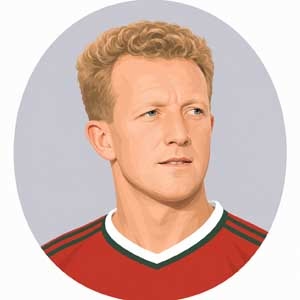
Wales - StrikerCharles, John
Rarely in the history of world football has a single athlete mastered two entirely opposing positions with equal world-class proficiency as John William Charles, the Welsh phenomenon universally revered across Italy as Il Gigante Buono (The Gentle Giant). Emerging through Leeds United under Major Frank Buckley, Charles was a physical colossus standing six-foot-two, blessed with extraordinary upper-body strength, rapid acceleration over long distances, and the most devastating aerial leap of the 1950s. At center-back, he was an immovable barrier: timing his tackles cleanly, winning every high clearance, and dominating opposition target-men through pure athletic leverage. When deployed as a center-forward, he was unstoppable: holding up possession, blasting volleys with either boot, and scoring towering headers against the toughest man-markers. A record £65,000 transfer to Juventus in 1957 saw him form the legendary "Trio Magico" alongside Omar Sívori and Giampiero Boniperti, scoring 105 goals in 182 matches to win three Scudetti and two Coppa Italia titles, finishing third in the 1959 Ballon d'Or. For Wales, he scored 15 goals in 38 caps, carrying the nation to the quarter-finals of the 1958 World Cup in Sweden—a tournament where his injury-enforced absence against Pelé's Brazil arguably altered footballing history.
Emotionally and psychologically, Charles was a figure of pristine moral integrity, immense warmth, and absolute competitive innocence. Despite playing in an era defined by brutal, unchecked physical violence from defenders and forwards alike, he operated with an unshakeable ethical code: he never threw an elbow, never retaliated against cynical fouls, and famously holds the distinction of never receiving a single booking or sending-off in his entire professional career. On the pitch, his leadership was completely organic; his sheer presence inspired confidence, while his calm temperament acted as the essential emotional tranquilizer for the combustible, hot-tempered genius of Sívori at Juventus. Inside the dressing room, he was a humble, gentle, and universally adored teammate who adapted to Italian culture with genuine affection, singing Italian folk songs in Turin restaurants and remaining completely untouched by arrogance. When brutal Italian stoppers hacked at his ankles, Charles simply helped them up from the turf with a smile and won the next duel cleanly through superior power and timing. Toward match officials and opponents, he personified the purest spirit of athletic nobility, leaving an immortal legacy as one of the most complete, versatile, and beloved footballers Britain and Italy have ever known.



 All Time JuventusClub