We use Google Analytics to understand how visitors use this site. Analytics cookies are only activated with your consent. For details, read our Privacy Policy.
Profile lensThe same player, read from a different angle.
Athletic83
Acceleration
77
Pace
82
Agility
77
Strength
88
Balance
85
Jumping
89
Stamina
85
Fitness
82
Technical84
Dribbling
83
Short Passing
79
Long Passing
82
Finishing
86
Shot Accuracy
84
Shot Power
91
Shooting Technique
87
Heading
93
Tackling
60
Crossing
79
Free Kick
73
Penalties
76
First Touch
80
Mental80
Composure
82
Aggression
85
Consistency
76
Creativity
73
Leadership
82
Work Rate
83
Tactical85
Vision
81
Off the Ball
86
Defensive Positioning
57
Teamwork
88
Anticipation
89
Marking
42
Player Traits
Attacking86
Crossing
79
Finishing
86
Heading Accuracy
93
Shot Accuracy
84
Off the Ball
86
Technique81
Dribbling
83
Free Kick
73
Short Passing
79
Long Passing
82
First Touch
80
Shot Technique
87
Movement80
Acceleration
77
Pace
82
Agility
77
Balance
85
Physicality87
Shot Power
91
Jumping
89
Stamina
85
Strength
88
Fitness
82
Defending53
Marking
42
Tackling
60
Def. Positioning
57
Mentality & Game Reading82
Aggression
85
Composure
82
Penalties
76
Vision
81
Leadership
82
Work Rate
83
Teamwork
88
Anticipation
89
Consistency
76
Creativity
73
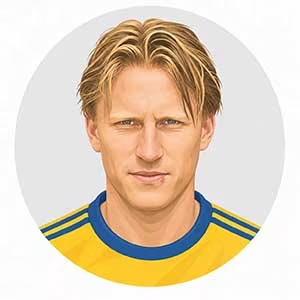
Sweden - StrikerEdström, Ralf
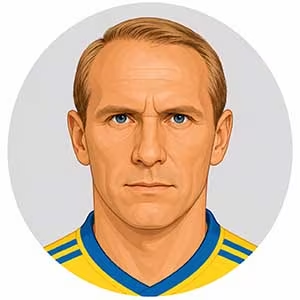
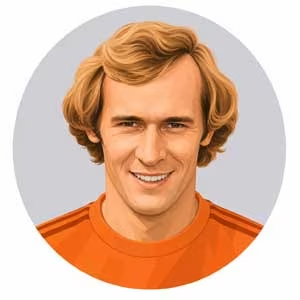
Long before the modern era popularized the concept of the athletic, vertically dominant center-forward, Ralf Sigvard Edström was dazzling European crowds throughout the 1970s with an aerial prowess and technical sophistication that earned him legendary status with Åtvidabergs FF, PSV Eindhoven, IFK Göteborg, Standard Liège, and Monaco. Blessed with remarkable leaping reach, broad shoulders, and an innate understanding of trajectory, Edström did not merely head the ball—he generated ferocious velocity and trajectory variations with his forehead, turning every high cross into a bona fide goal threat. Yet his brilliance extended far beyond airborne duels: he possessed graceful close control on the deck, exceptional link-up instincts, and a thunderous right-foot volley that caught goalkeepers off-guard from outside the eighteen-yard box. At PSV, he formed a devastating partnership with Willy van der Kuijlen, securing two Eredivisie titles and the 1974 KNVB Cup, while claiming league titles in Sweden, France, and Belgium. His international legacy was immortalized at the 1974 World Cup in West Germany, where he scored four goals—including his breathtaking, technically immaculate right-foot volley against the hosts in Düsseldorf, widely regarded as one of the greatest goals in World Cup history. Psychologically, Edström played with an aristocratic self-assurance and an incandescent competitive joy that made him an electric figure on the international stage. He did not view the penalty box as a zone of anxiety, but as an expansive theater where he could express his athletic freedom and outwit opposing defenders through pure spatial intuition. On the pitch, his leadership was vibrant, expressive, and demanding; he played with his heart on his sleeve, constantly driving his teammates forward and demanding high-tempo, ambitious service into the final third. Inside the locker room, he was a magnetic, articulate, and highly respected personality whose worldly perspective and self-confidence helped elevate the collective ambition of Swedish football from insular modesty to international swagger. When confronted with the sudden heartbreak of a severe knee injury that curtailed his peak years in the late 1970s, his resilience was profound; he reinvented his movement, adapted to a less explosive physical baseline, and continued to win championships across the continent. Toward match officials and opposing stoppers, Edström was an honorable, full-blooded competitor: he embraced high-impact aerial collisions without fear or malice, rejected gamesmanship and simulation, and carried himself with enduring Nordic grace, cementing his place as one of the most complete and captivating strikers Scandinavia ever produced.



 All Time SwedenNT