We use Google Analytics to understand how visitors use this site. Analytics cookies are only activated with your consent. For details, read our Privacy Policy.
Profile lensThe same player, read from a different angle.
Athletic81
Acceleration
74
Pace
78
Agility
72
Strength
91
Balance
83
Jumping
88
Stamina
82
Fitness
78
Technical83
Dribbling
79
Short Passing
76
Long Passing
73
Finishing
87
Shot Accuracy
82
Shot Power
87
Shooting Technique
82
Heading
93
Tackling
44
Crossing
71
Free Kick
77
Penalties
75
First Touch
82
Mental77
Composure
78
Aggression
72
Consistency
74
Creativity
71
Leadership
79
Work Rate
82
Tactical82
Vision
77
Off the Ball
87
Defensive Positioning
44
Teamwork
84
Anticipation
82
Marking
35
Player Traits
Attacking84
Crossing
71
Finishing
87
Heading Accuracy
93
Shot Accuracy
82
Off the Ball
87
Technique78
Dribbling
79
Free Kick
77
Short Passing
76
Long Passing
73
First Touch
82
Shot Technique
82
Movement77
Acceleration
74
Pace
78
Agility
72
Balance
83
Physicality85
Shot Power
87
Jumping
88
Stamina
82
Strength
91
Fitness
78
Defending41
Marking
35
Tackling
44
Def. Positioning
44
Mentality & Game Reading77
Aggression
72
Composure
78
Penalties
75
Vision
77
Leadership
79
Work Rate
82
Teamwork
84
Anticipation
82
Consistency
74
Creativity
71
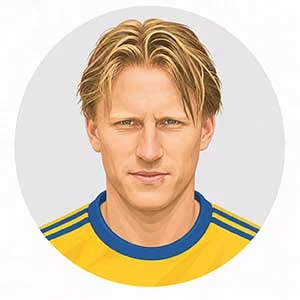
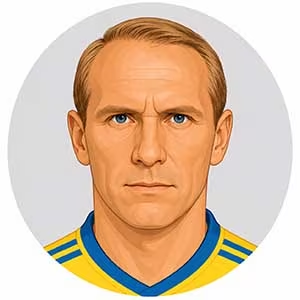
Sweden - StrikerAndersson, Kennet
Towering at six feet four inches with an extraordinarily soft, cushioning touch that defied his imposing physical silhouette, Kennet Andersson was one of the most effective and aesthetically unique target forwards in modern international football. Emerging from IFK Eskilstuna and IFK Göteborg before proving his pedigree across Europe with Mechelen, Lille, Caen, Bari, Bologna, Lazio, and Fenerbahçe, Andersson transformed aerial dominance into an exact science. Rather than operating merely as a static battering ram, his game was distinguished by pristine spatial anticipation, delicate chest control, and the ability to steer headers down into the path of surging runners with the pinpoint accuracy of a midfield playmaker. His signature international masterpiece arrived at the 1994 World Cup in the United States: forming an almost telepathic attacking partnership alongside Martin Dahlin and Tomas Brolin, Andersson claimed the Bronze Boot with five goals—most memorably his acrobatic, leaping volley against Brazil and his dramatic 115th-minute headed equalizer against Romania in the quarter-finals—propelling Sweden to an immortal third-place finish. In Serie A, particularly under Carlo Mazzone and Renzo Ulivieri at Bologna, he became a tactical cheat-code, anchoring the attack with immaculate hold-up play and guiding the Rossoblù to the 1998 Intertoto Cup and deep into the UEFA Cup. Mentally and emotionally, Andersson was the ultimate embodiment of serene, unselfish professionalism, possessing an inner tranquility that insulated him entirely from the frantic vanity of modern football stardom. He approached his craft with profound tactical humility, willingly enduring bruising, ninety-minute physical beatings from elite Italian stoppers like Pietro Vierchowod and Paolo Maldini simply to create five yards of attacking oxygen for his teammates. On the pitch, his leadership was gentle, organic, and non-confrontational; he led through sheer functional reliability, constantly communicating through subtle eye contact, unselfish decoy runs, and an unshakeable willingness to shoulder the dirty aerial work in both penalty boxes. Inside the dressing room, he was a universally beloved, easy-going presence whose dry Nordic humor and low-maintenance personality made him a natural cultural bridge across various leagues and national team generations. Under the furnace of high-leverage World Cup knockout ties, his nervous system was remarkably calm; he never panicked in chaotic goalmouth scrambles, executing complex aerial strikes with zen-like clarity. Toward match officials and aggressive markers who routinely climbed on his back or pulled his shirt, Andersson carried himself with spotless sportsmanship, never diving or feigning injury, absorbing the physical punishment with a knowing smile and letting his sublime aerial artistry deliver the ultimate answer.