We use Google Analytics to understand how visitors use this site. Analytics cookies are only activated with your consent. For details, read our Privacy Policy.
Profile lensThe same player, read from a different angle.
Athletic87
Acceleration
97
Pace
94
Agility
92
Strength
83
Balance
89
Jumping
78
Stamina
83
Fitness
79
Technical90
Dribbling
97
Short Passing
82
Long Passing
77
Finishing
92
Shot Accuracy
91
Shot Power
86
Shooting Technique
91
Heading
77
Tackling
40
Crossing
69
Free Kick
82
Penalties
86
First Touch
96
Mental81
Composure
85
Aggression
83
Consistency
84
Creativity
94
Leadership
74
Work Rate
77
Tactical85
Vision
82
Off the Ball
90
Defensive Positioning
40
Teamwork
80
Anticipation
90
Marking
38
Player Traits
Attacking 84
Crossing
69
Finishing
92
Heading Accuracy
77
Shot Accuracy
91
Off the Ball
90
Technique 88
Dribbling
97
Free Kick
82
Short Passing
82
Long Passing
77
First Touch
96
Shot Technique
91
Movement 93
Acceleration
97
Pace
94
Agility
92
Balance
89
Physicality 82
Shot Power
86
Jumping
78
Stamina
83
Strength
83
Fitness
79
Defending 39
Marking
38
Tackling
40
Def. Positioning
40
Mentality & Game Reading 84
Aggression
83
Composure
85
Penalties
86
Vision
82
Leadership
74
Work Rate
77
Teamwork
80
Anticipation
90
Consistency
84
Creativity
94
Curated interpretation
Signature Moves
Role-defining patterns—not attributes, traits or Inner Game measures. Three ways Ronaldo Nazário changes the meaning of the role around him.
01
Supersonic Frailty
His body unites acceleration and directional change almost incompatible with its power—and a terrible vulnerability created by the same extreme machine.
02
From the Future
The 1990s version appears to belong to a game not yet invented: winger speed, centre-forward power and number-ten technique in one modern prototype.
03
One More Dribble
Where other forwards see the moment to shoot, he often sees one more opponent to beat—even the goalkeeper can become merely the final dribble.
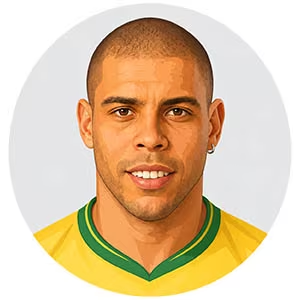
Brazil - StrikerRonaldo, Luís Nazário
In Yokohama on 30 June 2002, Ronaldo received Rivaldo’s pass inside the German penalty area, opened his body and guided the ball beyond Oliver Kahn. Twelve minutes earlier he had scored after following Rivaldo’s shot and reacting first to Kahn’s rebound. Brazil won the World Cup final 2–0 and Ronaldo finished the tournament with eight goals. The setting mattered because twenty-six months earlier, at the Stadio Olimpico, he had entered the Coppa Italia final for Internazionale after almost five months recovering from knee surgery. Within minutes he attempted a familiar attacking movement, planted his right leg and collapsed before making contact with an opponent. The patellar tendon had ruptured again. Ronaldo later described the pain and fear surrounding that period without pretending that rehabilitation had been psychologically simple. His return therefore was not merely recovery of fitness. The movements through which he had originally dominated defenders—acceleration, sudden loading of the knee, changes of direction—had become associated with catastrophic physical failure. By 2002 he was performing them again, selectively and differently, on the largest competitive stage.
Before those injuries, Ronaldo’s football was built around an almost unprecedented combination of technical control and acceleration. He could receive far from goal, turn towards defenders and create the entire scoring situation himself. His stepovers were functional mechanisms for freezing an opponent’s weight before accelerating in the opposite direction; once separation existed, powerful strides and exceptional balance allowed him to maintain control at speeds normally destructive to close dribbling. He could round goalkeepers, finish with either foot and improvise when the original route disappeared. At Barcelona in 1996–97 he scored 47 goals in 49 competitive matches, often beginning attacks well outside the penalty area. Internazionale received a forward capable of performing similar actions against deeper and more physically restrictive Italian defences. After the knee injuries, however, his football changed. Real Madrid received a heavier, less continuously explosive striker who increasingly concentrated movement around the final phase of attacks. The first acceleration remained dangerous, finishing became more central to his value, and his spatial anticipation allowed him to score without repeatedly constructing the chance from midfield. His 2002 World Cup demonstrated that this reduced athletic version could still be the decisive striker of an elite team.
The difference between those versions must not be romanticised away. Post-injury Ronaldo was not simply a more efficient improvement on the original player. He had lost repeated acceleration, some lateral explosiveness and much of the capacity to carry the ball through successive defenders over long distances. His defensive work rate was limited, particularly later in his career, and he was not a forward whose off-ball pressing could anchor an aggressive defensive system. Increasing body mass further reduced mobility as he aged. Even at his physical peak, the violence of his direction changes and acceleration placed enormous mechanical demands on his body; whether those movements directly caused the injuries cannot be established simplistically, but his style clearly depended upon physical capacities that repeated knee damage subsequently compromised. His later effectiveness therefore required tactical compensation: fewer long carries, more selective movements, greater penalty-area occupation and increased reliance on teammates to progress the ball. When deprived of service, the later Ronaldo could disappear from phases of play in a way the Barcelona version rarely did because the younger player could travel to the ball and manufacture the attack himself.
Psychologically, Ronaldo is best defined by **re-exposure after embodied failure**. The distinction goes beyond persistence in rehabilitation. After the second knee rupture, he had direct sensory evidence that an ordinary attacking movement could produce another catastrophic breakdown. Ronaldo later spoke openly about fear during rehabilitation and about the uncertainty surrounding whether he would play again. Yet returning to competition necessarily required more than accepting contact: he had to load the same leg, accelerate, decelerate and change direction while defenders acted unpredictably around him. The eventual adaptation was therefore neither denial nor complete restoration of the old self. Ronaldo re-entered the category of movement that had become threatening while simultaneously reducing how often his game depended upon its most extreme form. The 1998 World Cup final provides a different and important boundary. Ronaldo suffered a serious medical episode hours before the match, underwent examinations and nevertheless started after telling the staff that he wanted to play. The observable behaviour shows an extremely high threshold for relinquishing competitive participation; it does not establish that playing was psychologically or medically optimal, and his ineffective performance should not be converted into proof of pressure fragility. Four years later, the final produced the opposite outcome under enormous pressure. Evidence for systematic referee confrontation, retaliatory aggression, teammate blame or authority conflict is comparatively weak and should remain unknown. Ronaldo’s strongest psychological evidence lies elsewhere: **after his body had made maximal attacking commitment dangerous in a way no defender ever had, he returned to those actions without pretending that the danger had disappeared—and altered his football enough to survive the return**.


 All Time Internazionale Club
  All Time Brazil NT
  All-Time 1990s 1990s
  All-Time South America South America