We use Google Analytics to understand how visitors use this site. Analytics cookies are only activated with your consent. For details, read our Privacy Policy.
Profile lensThe same player, read from a different angle.
Athletic85
Acceleration
82
Pace
87
Agility
73
Strength
92
Balance
86
Jumping
79
Stamina
91
Fitness
92
Technical82
Dribbling
81
Short Passing
82
Long Passing
81
Finishing
77
Shot Accuracy
77
Shot Power
85
Shooting Technique
76
Heading
86
Tackling
87
Crossing
82
Free Kick
72
Penalties
70
First Touch
82
Mental88
Composure
86
Aggression
83
Consistency
88
Creativity
73
Leadership
91
Work Rate
90
Tactical82
Vision
76
Off the Ball
81
Defensive Positioning
79
Teamwork
87
Anticipation
82
Marking
86
Player Traits
Attacking81
Crossing
82
Finishing
77
Heading Accuracy
86
Shot Accuracy
77
Off the Ball
81
Technique79
Dribbling
81
Free Kick
72
Short Passing
82
Long Passing
81
First Touch
82
Shot Technique
76
Movement82
Acceleration
82
Pace
87
Agility
73
Balance
86
Physicality88
Shot Power
85
Jumping
79
Stamina
91
Strength
92
Fitness
92
Defending84
Marking
86
Tackling
87
Def. Positioning
79
Mentality & Game Reading83
Aggression
83
Composure
86
Penalties
70
Vision
76
Leadership
91
Work Rate
90
Teamwork
87
Anticipation
82
Consistency
88
Creativity
73
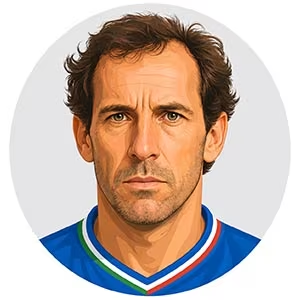
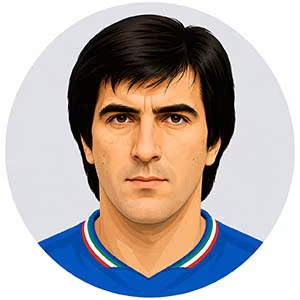
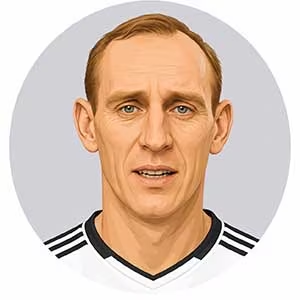
Italy - Left BackFacchetti, Giacinto
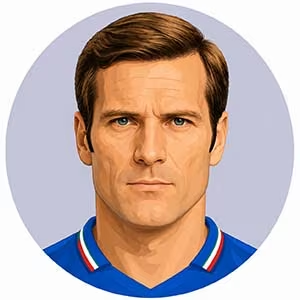
Long, powerful strides slicing through the left channel like an unstoppable locomotive dismantled the conservative dogma of Italian catenaccio, turning a forward-converted defender from Treviglio into the visionary prototype of the modern attacking full-back. Giacinto Facchetti was the dynamic powerhouse and spiritual captain of Helenio Herrera’s legendary Grande Inter, proving that a defender could fulfill rigorous man-marking duties while simultaneously serving as a devastating, double-digit scoring weapon.
Standing nearly six-foot-three with a sculpted, athletic frame, immense cardiovascular endurance, and an exceptional aerial leap, Facchetti governed the entire left flank. Herrera recognized his natural offensive instincts and built a system where Armando Picchi swept behind him, unleashing Facchetti on blistering overlapping runs to unleash venomous strikes with his right foot or arrive at the far post to bury headers. A proud one-club icon, he made 634 appearances and scored an astonishing 75 goals for Inter between 1960 and 1978—a historic tally for a defender of that era—sweeping four Scudetti (1963, 1965, 1966, 1971), two European Cups (1964, 1965), and two Intercontinental Cups, before finishing runner-up for the 1965 Ballon d'Or behind Eusébio. For Italy, across 94 caps (70 as captain) and three goals, his international pinnacle arrived as the proud captain of the 1968 European Championship triumph and the runner-up at the 1970 World Cup in Mexico.
That revolutionary, forward-leaning style, however, carried natural tactical dependencies. Facchetti was an athletic, linear powerhouse rather than an intricate, tight-space dribbler who could turn on a dime; his game relied on expansive green grass ahead of him to build momentum. When isolated against nimble, low-center-of-gravity right-wingers who cut sharply inside before he could close the gap, his larger turning radius could be tested if he was caught out of position upfield. Later in his career, as his blistering top-end sprint speed waned, he transitioned gracefully into a classic, cerebral sweeper (libero) to preserve his tactical influence.
Dignified, articulate, and carrying an aura of spotless moral rectitude, Facchetti was widely regarded as the ultimate gentleman of world football. Over an eighteen-year career defined by bruising physical battles against the greatest forwards on earth, he was sent off exactly once—for ironically applauding a refereeing decision. On the pitch, his body language was upright, commanding, and impeccably fair: challenging opponents with clean physical power, organizing his backline with measured authority, and leading by unshakeable example. Inside the Appiano Gentile and Azzurri dressing rooms, he was an untouchable patriarch and moral compass, later serving as Inter's beloved president, leaving behind an immortal legacy as the definitive pioneer, archetype, and noble giant of Italian football history.