We use Google Analytics to understand how visitors use this site. Analytics cookies are only activated with your consent. For details, read our Privacy Policy.
Profile lensThe same player, read from a different angle.
Athletic83
Acceleration
83
Pace
81
Agility
73
Strength
85
Balance
87
Jumping
86
Stamina
86
Fitness
80
Technical75
Dribbling
72
Short Passing
72
Long Passing
77
Finishing
61
Shot Accuracy
60
Shot Power
81
Shooting Technique
66
Heading
83
Tackling
82
Crossing
75
Free Kick
69
Penalties
66
First Touch
74
Mental78
Composure
82
Aggression
86
Consistency
76
Creativity
65
Leadership
70
Work Rate
86
Tactical78
Vision
73
Off the Ball
70
Defensive Positioning
79
Teamwork
82
Anticipation
85
Marking
79
Player Traits
Attacking70
Crossing
75
Finishing
61
Heading Accuracy
83
Shot Accuracy
60
Off the Ball
70
Technique72
Dribbling
72
Free Kick
69
Short Passing
72
Long Passing
77
First Touch
74
Shot Technique
66
Movement81
Acceleration
83
Pace
81
Agility
73
Balance
87
Physicality84
Shot Power
81
Jumping
86
Stamina
86
Strength
85
Fitness
80
Defending80
Marking
79
Tackling
82
Def. Positioning
79
Mentality & Game Reading77
Aggression
86
Composure
82
Penalties
66
Vision
73
Leadership
70
Work Rate
86
Teamwork
82
Anticipation
85
Consistency
76
Creativity
65
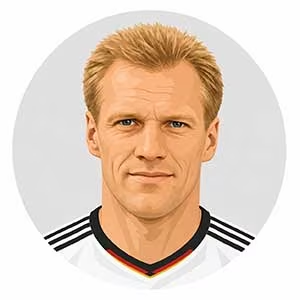
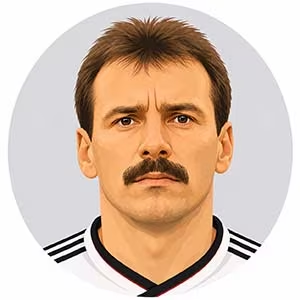
Germany - Left BackPflügler, Hans
Born in Freising, Bavaria, in 1960, the son of a master butcher, Pflügler came through Bayern Munich's youth system as a boy who watched the first team train alongside barely twenty other spectators, most of them pensioners, idolizing Franz Beckenbauer, Gerd Müller and Sepp Maier from close enough to see them work. He made his professional debut in 1981 and spent his entire career at the only club he ever knew, playing left-back or central defender with equal comfort, physically committed and positionally reliable rather than technically expansive. A complicated ankle fracture in training in September 1984 nearly ended his career before it had properly started, sidelining him for six months; his comeback the following March was praised as phenomenal by coach Udo Lattek. He won five Bundesliga titles and three DFB-Pokal cups with Bayern across more than a decade, made close to 400 official appearances, retired in 1992 when injuries had reduced him to fourteen league games — and was talked out of retirement in 1995 by Giovanni Trapattoni during an injury crisis, playing one final Bundesliga match at thirty-five and picking up a yellow card in it, evidently still capable of the same occasional clumsiness Heynckes had described. He later turned out for Bayern's reserve side in the regional league at forty-two. For West Germany he won 11 caps between 1987 and 1990, was named by Franz Beckenbauer to the World Cup-winning squad in Italy, and played the single tournament match — a group-stage draw with Colombia — that turned out to be his last international appearance.
His limitations were the ones his own coach identified in public. Pflügler's defending depended on being sharp and fresh, and when fatigue or a lack of full physical readiness set in, his positioning and timing suffered in ways that produced fouls rather than clean interventions — a specific, named vulnerability rather than a general lack of discipline. Recurring injuries, starting with the severe ankle break early in his career, interrupted his development and later curtailed his final professional seasons well before age alone would have. His performances at the top international level were also thin relative to his decorated club career, limited to a single World Cup appearance despite being part of the winning squad.
Temperamentally he was unusually grounded for a footballer of his stature, and unusually intellectual: he completed a university degree in structural steel engineering in 1986 while still playing professionally, becoming the first Bundesliga professional on record to hold an engineering diploma. He remained instinctively loyal to Bayern's internal culture, recalling with evident affection the dressing-room politics of his era — Uli Hoeneß fighting fiercely in public to defend coach Jupp Heynckes during a tense title run-in against Cologne in 1989 — as among his fondest memories, more than any individual highlight. He carried the club's traditional rivalry with 1860 Munich as a point of identity well into retirement, still describing himself as a "Red" through and through and taking his sixtieth birthday with the same dry, self-deprecating humor he was known for as a player, joking that he'd prefer to stay "59 plus 1." He remained visibly connected to the club for decades afterward, helping build and playing for Bayern's Legends team into his sixties. Physically committed, occasionally rough around the edges when tired, but never once disqualified for it, and privately more cerebral than his on-pitch reputation ever suggested, Pflügler spent an entire career and much of his life afterward as one club's own.