We use Google Analytics to understand how visitors use this site. Analytics cookies are only activated with your consent. For details, read our Privacy Policy.
Profile lensThe same player, read from a different angle.
Athletic80
Acceleration
85
Pace
86
Agility
82
Strength
70
Balance
74
Jumping
77
Stamina
85
Fitness
78
Technical78
Dribbling
80
Short Passing
77
Long Passing
81
Finishing
50
Shot Accuracy
60
Shot Power
77
Shooting Technique
73
Heading
71
Tackling
79
Crossing
78
Free Kick
65
Penalties
66
First Touch
80
Mental78
Composure
80
Aggression
78
Consistency
78
Creativity
70
Leadership
75
Work Rate
80
Tactical78
Vision
72
Off the Ball
71
Defensive Positioning
78
Teamwork
82
Anticipation
82
Marking
83
Attacking66
Crossing
78
Finishing
50
Heading Accuracy
71
Shot Accuracy
60
Off the Ball
71
Technique76
Dribbling
80
Free Kick
65
Short Passing
77
Long Passing
81
First Touch
80
Shot Technique
73
Movement82
Acceleration
85
Pace
86
Agility
82
Balance
74
Physicality77
Shot Power
77
Jumping
77
Stamina
85
Strength
70
Fitness
78
Defending80
Marking
83
Tackling
79
Def. Positioning
78
Mentality & Game Reading76
Aggression
78
Composure
80
Penalties
66
Vision
72
Leadership
75
Work Rate
80
Teamwork
82
Anticipation
82
Consistency
78
Creativity
70
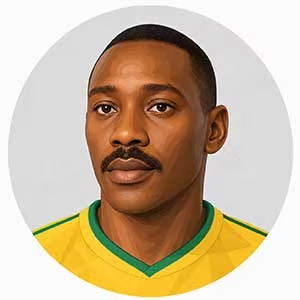
Brazil - Left BackEveraldo
The sweltering afternoon of June 21, 1970, inside Mexico City's Estadio Azteca saw a quiet native of Porto Alegre lift the Jules Rimet trophy as the unsung tactical foundation of football's greatest ever collective masterpiece. Everaldo Marques da Silva was the disciplined, defense-first left-back who provided the structural balance that allowed Pelé, Jairzinho, Tostão, Gérson, and Rivelino the absolute freedom to orchestrate attacking poetry. Stationed on the left flank for Grêmio across nearly 400 appearances, Everaldo was an exceptional positional defender: utilizing rapid short-burst acceleration, clean tackling mechanics, and sharp spatial anticipation to neutralize opposition wingers without committing reckless fouls, earning the prestigious Bola de Prata in 1970 as the best left-back in the Brazilian championship. For Brazil, across 24 caps between 1967 and 1972, his international record bordered on the supernatural: losing only one single match in the Seleção shirt and starting every knockout game in Mexico 1970 after winning back his place from Marco Antônio.
Yet Everaldo’s specialized profile was deliberately stripped of attacking flamboyance. He was not a dynamic, modern overlapping wing-back who bombed into the penalty box to deliver high crosses or score long-range screamers; his game was strictly containment and low-risk distribution to the midfield creators ahead of him. When his side was forced to chase games against deep, ultra-compact low blocks that demanded attacking width from full-backs, his creative output was modest. Cruelly, his life and career were cut short in October 1974 at just 30 years of age in a tragic car accident, prompting Grêmio to permanently dedicate a golden star on their official club flag in his honor.
Stoic, modest, and governed by an unyielding team-first ethos, Everaldo embraced the unglamorous dirty work with quiet pride. He never chased media headlines or demanded individual acclaim, understanding perfectly that his defensive vigilance was the bedrock that allowed his superstar teammates to shine. On the pitch, his body language was calm, focused, and immaculate: timing his challenges to perfection and resetting the defensive line with minimal fuss. Inside the 1970 Brazil dressing room, he was a universally respected, calming presence whose humility and tactical discipline earned the total trust of Mário Zagallo and Pelé, leaving behind an immortal legacy as the definitive, selfless guardian of the Tri.