We use Google Analytics to understand how visitors use this site. Analytics cookies are only activated with your consent. For details, read our Privacy Policy.
Profile lensThe same player, read from a different angle.
Athletic80
Acceleration
73
Pace
75
Agility
74
Strength
83
Balance
82
Jumping
81
Stamina
82
Fitness
88
Technical83
Dribbling
77
Short Passing
83
Long Passing
85
Finishing
65
Shot Accuracy
65
Shot Power
81
Shooting Technique
71
Heading
80
Tackling
95
Crossing
80
Free Kick
67
Penalties
66
First Touch
80
Mental87
Composure
93
Aggression
74
Consistency
88
Creativity
64
Leadership
85
Work Rate
85
Tactical88
Vision
78
Off the Ball
65
Defensive Positioning
95
Teamwork
95
Anticipation
92
Marking
88
Player Traits
Attacking71
Crossing
80
Finishing
65
Heading Accuracy
80
Shot Accuracy
65
Off the Ball
65
Technique77
Dribbling
77
Free Kick
67
Short Passing
83
Long Passing
85
First Touch
80
Shot Technique
71
Movement76
Acceleration
73
Pace
75
Agility
74
Balance
82
Physicality83
Shot Power
81
Jumping
81
Stamina
82
Strength
83
Fitness
88
Defending93
Marking
88
Tackling
95
Def. Positioning
95
Mentality & Game Reading82
Aggression
74
Composure
93
Penalties
66
Vision
78
Leadership
85
Work Rate
85
Teamwork
95
Anticipation
92
Consistency
88
Creativity
64
Curated interpretation
Signature Moves
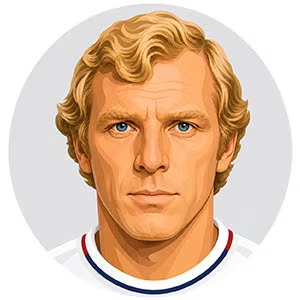
Role-defining patterns—not attributes, traits or Inner Game measures. Three ways Bobby Moore changes the meaning of the role around him.
01
Still Water
Calm that does not stay in him—it spreads to everyone around him.
02
Steady Hand
Authority that comes from reliability alone, never from noise.
03
The Long Look
He waits, lets the danger commit first, then closes the gap at the one moment it cannot be avoided.
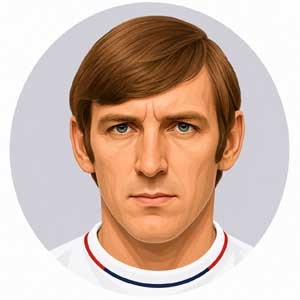
England - Centre-backMoore, Bobby
At Guadalajara on 7 June 1970, England were defending a 1–0 lead against Brazil when Jairzinho accelerated down the right and crossed towards Pelé. Bobby Moore had already spent much of the match managing a forward line capable of turning a small positional error into an immediate chance. Pelé received near the penalty area and attempted to move past him. Moore stayed upright, delayed the intervention until Pelé exposed the ball and then removed it cleanly before carrying possession away. The tackle became one of the most replayed defensive actions in World Cup history because almost nothing about it looked desperate. Four years earlier Moore had captained England to the World Cup; in Mexico he was facing perhaps the tournament’s strongest attacking team after experiencing severe disruption before the competition had even begun. Yet the mechanism of his defending remained the same: reduce the number of variables, stay balanced, wait for the attacker to reveal the ball and intervene only when the probability had moved in his favour.
Moore was a central defender whose comparative advantage lay in anticipation rather than recovery athleticism. He was neither exceptionally fast nor physically overwhelming, so positioning had to solve problems before they became races. His tackling reflected that economy: rather than entering every confrontation aggressively, he delayed, tracked the attacker’s touch and stepped in when possession became vulnerable. Once the ball was won, Moore could immediately change function. His first touch was unusually secure for a defender of his period and his passing allowed him to initiate attacks rather than simply clear danger. The fourth goal in the 1966 World Cup final illustrates that transition: after winning possession, Moore ignored instructions from the touchline to waste time and instead delivered the long pass from which Geoff Hurst completed his hat-trick. Across 108 England appearances, 90 as captain, and more than 600 competitive matches for West Ham, Moore became both defensive organiser and first constructor. His game therefore depended on decision quality at both ends of the defensive action: knowing when to intervene and knowing when the regained ball could become something more useful than relief.
The same construction contained limitations. Moore’s lack of elite pace meant that incorrect anticipation could leave him with less capacity to repair the mistake than faster defenders possessed. Direct exposure to long recovery runs or attackers already moving at speed reduced the advantage created by his reading. He was strong enough to compete physically but was not a dominant aerial enforcer, and a defence asking him to solve repeated power contests would waste much of what distinguished him. His preference for controlled intervention could also look vulnerable when opponents generated chaos faster than the defensive structure could be restored. Age made those margins narrower. By the early 1970s his England position became less secure, and Alf Ramsey eventually omitted him after 1973 as the national side itself entered decline. This should not be converted into sudden psychological deterioration. The athletic margin that allowed anticipation to remain sufficient was decreasing. Moore’s defending was exceptionally efficient precisely because he avoided unnecessary emergency; once circumstances forced emergency repeatedly, his relative advantage diminished.
Psychologically, Moore is best defined by **order-restoring response rather than emotional invulnerability**. The clearest evidence came immediately before the 1970 World Cup, when he was detained in Colombia after being accused of taking jewellery from a hotel shop. Moore denied the accusation, was released and rejoined England before the tournament. Teammates later recalled that he returned to training and preparation without making the episode the emotional centre of the group, and days later produced the performance against Brazil. This demonstrates compartmentalisation under severe external disruption; it does not prove that the experience caused him no fear or distress. His behaviour during matches followed a similar pattern. As captain he generally communicated without theatrical escalation, and the famous moment before receiving the Jules Rimet Trophy—realising his hands were muddy and wiping them before shaking Queen Elizabeth II’s hand—shows rapid awareness of situational demands even during overwhelming celebration. More revealing competitively was his decision immediately before Hurst’s fourth goal. With England seconds from becoming world champions, Moore did not automatically obey the safest available instruction to retain possession; he looked up, recognised Hurst’s movement and selected the constructive pass. Calm therefore did not mean risk avoidance. Evidence also prevents turning restraint into universal passivity: Moore could disagree with decisions and experienced difficult relationships later in his career, but surviving material does not support persistent referee confrontation, retaliatory aggression or teammate-directed blame as defining traits. The stronger pattern is narrower: **when disorder increased, Moore tended to restore a controllable structure around the next decision rather than allow the disorder itself to dictate that decision**.