We use Google Analytics to understand how visitors use this site. Analytics cookies are only activated with your consent. For details, read our Privacy Policy.
Profile lensThe same player, read from a different angle.
Athletic82
Acceleration
77
Pace
79
Agility
74
Strength
85
Balance
82
Jumping
85
Stamina
83
Fitness
89
Technical83
Dribbling
75
Short Passing
75
Long Passing
73
Finishing
93
Shot Accuracy
89
Shot Power
86
Shooting Technique
70
Heading
93
Tackling
44
Crossing
67
Free Kick
64
Penalties
77
First Touch
76
Mental82
Composure
88
Aggression
85
Consistency
80
Creativity
72
Leadership
76
Work Rate
82
Tactical85
Vision
74
Off the Ball
95
Defensive Positioning
40
Teamwork
78
Anticipation
89
Marking
36
Player Traits
Attacking87
Crossing
67
Finishing
93
Heading Accuracy
93
Shot Accuracy
89
Off the Ball
95
Technique72
Dribbling
75
Free Kick
64
Short Passing
75
Long Passing
73
First Touch
76
Shot Technique
70
Movement78
Acceleration
77
Pace
79
Agility
74
Balance
82
Physicality86
Shot Power
86
Jumping
85
Stamina
83
Strength
85
Fitness
89
Defending40
Marking
36
Tackling
44
Def. Positioning
40
Mentality & Game Reading80
Aggression
85
Composure
88
Penalties
77
Vision
74
Leadership
76
Work Rate
82
Teamwork
78
Anticipation
89
Consistency
80
Creativity
72
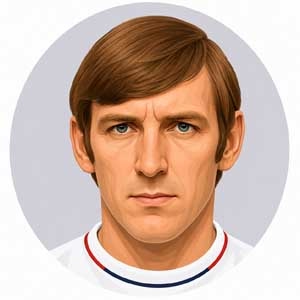
England - StrikerHurst, Geoff
The summer afternoon of July 30, 1966, inside Wembley Stadium culminated in the most famous piece of commentary in sports history, as a powerhouse forward from Ashton-under-Lyne drove into the left channel in the 120th minute and smashed a left-footed rocket into the roof of the net to seal a historic World Cup final hat-trick. Sir Geoffrey Charles Hurst was the quintessential English focal point of the 1960s, combining a muscular, broad-shouldered frame with exceptional back-to-goal hold-up play, sharp aerial timing, and a hammer of a shot off either foot. Forged under Ron Greenwood at West Ham United alongside Bobby Moore and Martin Peters, Hurst scored 249 goals in 502 appearances for the Hammers, capturing the 1964 FA Cup and the 1964–65 European Cup Winners' Cup, before enjoying a prolific spell at Stoke City. Across 49 caps and 24 goals for England, his international pinnacle was unmatched: starting the 1966 tournament as a reserve behind Jimmy Greaves before seizing the knockout stages with a decisive quarter-final header against Argentina and his legendary treble against West Germany in the final.
Yet Hurst’s direct, physical style operated within classic target-man boundaries. He was not a delicate, tight-space dribbler who could weave through multi-man low blocks without service; his efficiency relied entirely on aggressive deliveries into the penalty box, diagonal crosses to contest in the air, and physical service into his chest. When isolated against deep, cynical continental sweepers who refused to engage in aerial battles and systematically cut off crossing lanes from the flanks, his match involvement could be pushed into long spells of attritional wrestling.
Disciplined, modest, and possessing the quiet resolve of an old-school professional, Hurst approached high-stakes football with ruthless efficiency. He never sought flashy headlines or courted controversy, taking immense pride in the honest, physical labor of pinning center-halves and creating scoring runways for his attacking partners. On the pitch, his presence was imposing and direct: challenging stoppers with full commitment, holding off challenges with strong arms, and striking loose balls without hesitation. Inside the West Ham and England dressing rooms, he was an understated, dependable lieutenant whose mental toughness and clinical execution under intense stadium pressure earned the total trust of Alf Ramsey, cementing an immortal legacy as the defining, clutch hat-trick hero of English football history.