We use Google Analytics to understand how visitors use this site. Analytics cookies are only activated with your consent. For details, read our Privacy Policy.
Profile lensThe same player, read from a different angle.
Athletic81
Acceleration
77
Pace
83
Agility
75
Strength
81
Balance
87
Jumping
85
Stamina
79
Fitness
78
Technical85
Dribbling
79
Short Passing
72
Long Passing
70
Finishing
93
Shot Accuracy
92
Shot Power
83
Shooting Technique
80
Heading
93
Tackling
32
Crossing
63
Free Kick
66
Penalties
78
First Touch
85
Mental80
Composure
85
Aggression
87
Consistency
80
Creativity
73
Leadership
78
Work Rate
74
Tactical85
Vision
72
Off the Ball
95
Defensive Positioning
30
Teamwork
74
Anticipation
94
Marking
38
Player Traits
Attacking87
Crossing
63
Finishing
93
Heading Accuracy
93
Shot Accuracy
92
Off the Ball
95
Technique75
Dribbling
79
Free Kick
66
Short Passing
72
Long Passing
70
First Touch
85
Shot Technique
80
Movement81
Acceleration
77
Pace
83
Agility
75
Balance
87
Physicality81
Shot Power
83
Jumping
85
Stamina
79
Strength
81
Fitness
78
Defending33
Marking
38
Tackling
32
Def. Positioning
30
Mentality & Game Reading80
Aggression
87
Composure
85
Penalties
78
Vision
72
Leadership
78
Work Rate
74
Teamwork
74
Anticipation
94
Consistency
80
Creativity
73
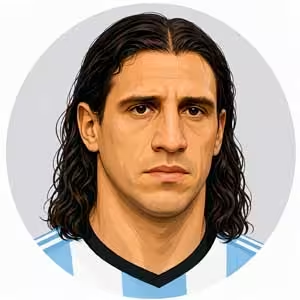
Argentina - StrikerCrespo, Hernán
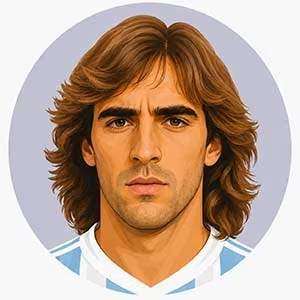
A trademark leaping header whipped across the near post or a delicate chip over an onrushing goalkeeper defined the clinical artistry of a center-forward from Florida, Buenos Aires, who turned penalty-box movement into an exact science. Hernán Jorge Crespo—immortalized across global football as Valdanito—was one of the most complete, instinctive, and devastating number nines of modern football, combining textbook spatial timing with cold-blooded finishing off either foot.
Forged at River Plate—where his brace in the 1996 final delivered the Copa Libertadores—Crespo conquered Serie A during its golden apex. With Alberto Malesani’s legendary Parma, he scored 94 goals in 201 matches, capturing the 1998–99 UEFA Cup, the Coppa Italia, and the Supercoppa Italiana, before completing a world-record £35 million transfer to SS Lazio in 2000. In Rome, he was crowned Serie A top scorer (Capocannoniere) with 26 goals in his debut season, later claiming titles across Europe with Chelsea (2005–06 Premier League), AC Milan (scoring twice in the 2005 Champions League final), and Inter Milan (three consecutive Scudetti between 2007 and 2009). For Argentina, across 64 caps and 35 goals, he remains the fourth-highest scorer in national history, featuring across three World Cups (1998, 2002, 2006) and winning the Silver Shoe at Germany 2006.
His game, however, was fundamentally anchored around the final eighteen yards. Crespo was not an intricate deep-lying playmaker who dropped thirty yards into midfield to orchestrate build-up through individual dribbles; he relied on dynamic service from wide channels and penetrating through-balls from number tens. When isolated in teams that struggled to generate box entries or against ultra-compact low blocks that crowded the penalty area, his overall involvement in open-field possession could be marginalized.
Polished, deeply professional, and carrying the natural dignity of a classic Argentine marksman, Crespo let his immaculate movement and finishing do the talking. He avoided petty theatrics, diving, and dressing-room politics, taking immense pride in the technical craft of peeling off defenders' shoulders. On the pitch, his body language was balanced and predatory: scanning defensive blind spots constantly before attacking the near post with explosive timing. Inside the locker rooms of River, Parma, Lazio, Chelsea, and Milan, he was a universally respected, model professional whose lethal efficiency under pressure cemented an enduring legacy as one of the finest pure strikers in European and South American history.