We use Google Analytics to understand how visitors use this site. Analytics cookies are only activated with your consent. For details, read our Privacy Policy.
Profile lensThe same player, read from a different angle.
Athletic81
Acceleration
85
Pace
78
Agility
95
Strength
66
Balance
82
Jumping
84
Stamina
76
Fitness
78
Technical86
Dribbling
94
Short Passing
85
Long Passing
84
Finishing
90
Shot Accuracy
84
Shot Power
78
Shooting Technique
91
Heading
63
Tackling
33
Crossing
80
Free Kick
82
Penalties
87
First Touch
95
Mental79
Composure
85
Aggression
85
Consistency
82
Creativity
94
Leadership
73
Work Rate
68
Tactical79
Vision
87
Off the Ball
85
Defensive Positioning
33
Teamwork
70
Anticipation
77
Marking
31
Player Traits
Attacking80
Crossing
80
Finishing
90
Heading Accuracy
63
Shot Accuracy
84
Off the Ball
85
Technique89
Dribbling
94
Free Kick
82
Short Passing
85
Long Passing
84
First Touch
95
Shot Technique
91
Movement85
Acceleration
85
Pace
78
Agility
95
Balance
82
Physicality76
Shot Power
78
Jumping
84
Stamina
76
Strength
66
Fitness
78
Defending32
Marking
31
Tackling
33
Def. Positioning
33
Mentality & Game Reading81
Aggression
85
Composure
85
Penalties
87
Vision
87
Leadership
73
Work Rate
68
Teamwork
70
Anticipation
77
Consistency
82
Creativity
94
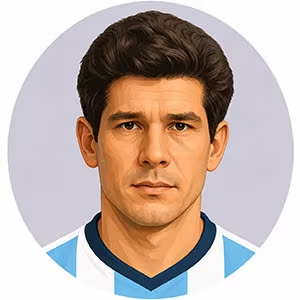
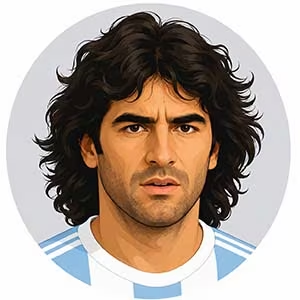
Argentina - ForwardSívori, Omar
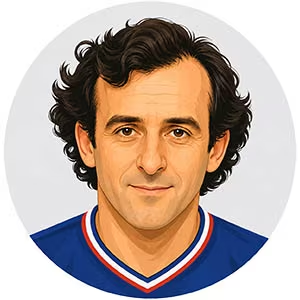
With socks rolled defiantly down around his ankles and a mop of wild dark hair framing a predator’s grin, Enrique Omar Sívori introduced an anarchic, street-forged virtuosity to European football that was as devastating as it was deeply insulting to opposing defenders. Emerging from River Plate’s legendary La Máquina lineage as one of the fabled Caras Sucias (Dirty Faces) alongside Antonio Valentín Angelillo and Humberto Maschio, the Argentine inside-left arrived at Juventus in 1957 for a world-record fee, instantly transforming the Bianconeri alongside John Charles and Giampiero Boniperti into the immortal Trio Magico. Possessing an impossibly low center of gravity, lightning short-burst acceleration over three yards, and a left foot capable of the most delicate cruelty, Sívori turned the tunnel nutmeg into an act of psychological humiliation. His technical game was pure improvisational genius: sudden hip-feints that sent lunging stoppers skidding across muddy turf, delicate chipped finishes over rushing goalkeepers, and sharp give-and-goes executed at breakneck speed. Crowned the Ballon d’Or winner in 1961—the year he equaled the Serie A record by scoring six goals in a single 9–1 dismantling of Inter Milan—he captured three Scudetti and two Coppa Italia titles in Turin before closing his glittering Italian journey by igniting the passions of Napoli.
Psychologically, Sívori was driven by a burning, confrontational pride and a theatrical appetite for chaos; he played not merely to defeat his markers, but to strip them of their dignity. On the pitch, his leadership was incandescent and rebellious, elevating the tempo of the entire forward line through sheer individual audacity while actively welcoming physical aggression as proof of his dominance. Inside the dressing room, he was a magnetic, fiercely loyal, yet notoriously mercurial presence who required patient, balancing counterweights like the gentle giant John Charles to channel his wild temperament toward collective victory. Under maximum matchday pressure, his emotional posture was venomous and fearless; he thrived in hostile away cauldrons and heated derbies, using terrace abuse and opposition intimidation as direct fuel for his showmanship. Toward match officials and opposition defenders, Sívori operated on the permanent razor’s edge of outright warfare: he was a master of psychological provocation, mocking markers after slipping the ball through their legs, engaging in constant verbal sparring, and delivering retaliatory kicks that resulted in numerous red cards and lengthy suspensions, leaving an immortal legacy as the ultimate anti-authoritarian pibe of world football.