We use Google Analytics to understand how visitors use this site. Analytics cookies are only activated with your consent. For details, read our Privacy Policy.
Profile lensThe same player, read from a different angle.
Athletic84
Acceleration
91
Pace
86
Agility
77
Strength
84
Balance
79
Jumping
86
Stamina
84
Fitness
85
Technical87
Dribbling
86
Short Passing
80
Long Passing
77
Finishing
92
Shot Accuracy
94
Shot Power
84
Shooting Technique
90
Heading
87
Tackling
47
Crossing
69
Free Kick
86
Penalties
88
First Touch
85
Mental83
Composure
86
Aggression
85
Consistency
85
Creativity
77
Leadership
78
Work Rate
85
Tactical85
Vision
81
Off the Ball
93
Defensive Positioning
42
Teamwork
83
Anticipation
86
Marking
38
Player Traits
Attacking87
Crossing
69
Finishing
92
Heading Accuracy
87
Shot Accuracy
94
Off the Ball
93
Technique84
Dribbling
86
Free Kick
86
Short Passing
80
Long Passing
77
First Touch
85
Shot Technique
90
Movement83
Acceleration
91
Pace
86
Agility
77
Balance
79
Physicality85
Shot Power
84
Jumping
86
Stamina
84
Strength
84
Fitness
85
Defending42
Marking
38
Tackling
47
Def. Positioning
42
Mentality & Game Reading83
Aggression
85
Composure
86
Penalties
88
Vision
81
Leadership
78
Work Rate
85
Teamwork
83
Anticipation
86
Consistency
85
Creativity
77
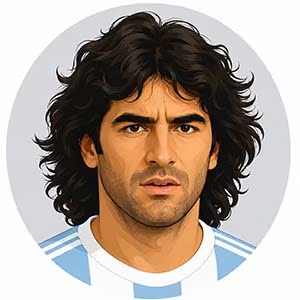
Argentina - StrikerKempes, Mario
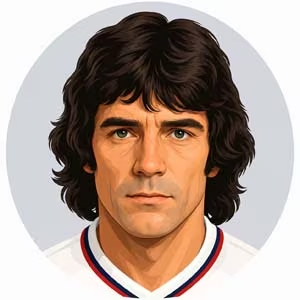
Open-field momentum, a flowing mane of dark hair, and thunderous diagonal transitions turned Mario Alberto Kempes Chiodi into the unstoppable attacking locomotive of Argentine football in the late 1970s. Emerging from Instituto and Rosario Central before making a seismic impact in Spain with Valencia, El Matador shattered the orthodox boundaries between a classic center-forward, an outside-left winger, and an attacking midfielder. Standing six feet tall with a broad, galloping gait, Kempes was virtually uncontainable when gathering possession thirty yards out: building up terrifying linear speed, using his upper-body mass to bounce off challenges, and unleashing ballistic, low-trajectory drives with his sledgehammer left foot. At Valencia, he claimed back-to-back Pichichi crowns (1976–77, 1977–78), the 1979 Copa del Rey, and the 1979–80 European Cup Winners' Cup. His global coronation arrived at the 1978 World Cup on home soil: deployed by César Luis Menotti in a free-roaming volante role, he finished as the tournament's top scorer and Golden Ball winner with six goals, including his legendary brace and iconic extra-time charge through the Dutch defense in the final. However, his game had noticeable mechanical limitations: he was heavily one-footed, struggled in static, congested six-yard boxes against deep low blocks where raw momentum could not be generated, and suffered a severe, premature physical decline in his late twenties due to cartilage degeneration, leaving him a shadow of his explosive self during a brief, muted spell at River Plate and later years in the Austrian Bundesliga.
Carrying the crushing sporting and geopolitical weight of a nation under military dictatorship, Kempes met the suffocating pressure of 1978 with flatline psychological composure. He was entirely indifferent to individual vanity or political posturing; when asked about the infamous handball save on the goal line against Poland that saved Argentina's tournament, he treated it as a simple, instinctive act of survival for the team. On the pitch, his competitive motor was selfless and relentless; he tracked back deep into his own half to win tackles before launching his trademark 60-yard surges, completely devoid of the prima-donna posturing often exhibited by star strikers. Inside the locker room, he was a grounded, low-maintenance teammate who commanded unconditional respect through his sheer physical sacrifice rather than vocal rhetoric, acting as the quiet, undisputed focal point of Menotti’s tactical system. When elite man-markers like Claudio Gentile or Ernie Brandts attempted to halt his runs with shirt-pulls and tactical trips, Kempes leaned hard into the contact, using his heavy frame to brush off defenders without pausing his sprint. Match officials found him straightforward and honest, leaving an enduring legacy as one of the most explosive, dynamic, and clutch tournament match-winners South American football has ever witnessed.