We use Google Analytics to understand how visitors use this site. Analytics cookies are only activated with your consent. For details, read our Privacy Policy.
Profile lensThe same player, read from a different angle.
Athletic86
Acceleration
90
Pace
83
Agility
91
Strength
78
Balance
86
Jumping
92
Stamina
88
Fitness
76
Technical85
Dribbling
88
Short Passing
83
Long Passing
81
Finishing
88
Shot Accuracy
88
Shot Power
84
Shooting Technique
78
Heading
88
Tackling
52
Crossing
78
Free Kick
78
Penalties
73
First Touch
85
Mental83
Composure
86
Aggression
83
Consistency
78
Creativity
83
Leadership
84
Work Rate
86
Tactical84
Vision
85
Off the Ball
91
Defensive Positioning
35
Teamwork
86
Anticipation
80
Marking
42
Player Traits
Attacking87
Crossing
78
Finishing
88
Heading Accuracy
88
Shot Accuracy
88
Off the Ball
91
Technique82
Dribbling
88
Free Kick
78
Short Passing
83
Long Passing
81
First Touch
85
Shot Technique
78
Movement88
Acceleration
90
Pace
83
Agility
91
Balance
86
Physicality84
Shot Power
84
Jumping
92
Stamina
88
Strength
78
Fitness
76
Defending43
Marking
42
Tackling
52
Def. Positioning
35
Mentality & Game Reading82
Aggression
83
Composure
86
Penalties
73
Vision
85
Leadership
84
Work Rate
86
Teamwork
86
Anticipation
80
Consistency
78
Creativity
83
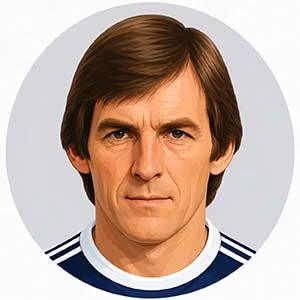
England - ForwardKeegan, Kevin
Kevin Keegan never looked physically designed to dominate a football match. At around 1.73 metres, with neither the stride of an elite sprinter nor the dimensions of a conventional English centre-forward, he compensated by making himself repeatedly available to the game. He would drop towards midfield, release the ball, accelerate beyond it, chase a defender receiving backwards and then arrive inside the penalty area before the same move had finished. The running was not supplementary to his technique; it altered the number of situations in which that technique could matter. Bill Shankly initially paired him with John Toshack at Liverpool, creating a partnership in which Keegan’s constant movement around a larger reference point made defensive assignments difficult to preserve. By the time he left England in 1977, the supposedly undersized forward had become the central attacking personality of a European champion.
Keegan operated between second striker, centre-forward and attacking connector. His low centre of gravity allowed him to turn quickly, protect possession and change direction in congested areas, while sharp finishing made movements away from goal dangerous because defenders could not simply allow him to return unchecked. He was exceptionally good in the air relative to height, attacking crosses through timing and commitment rather than physical reach. His passing was direct and functional rather than orchestral, but he could combine rapidly enough to link midfield and attack before continuing his own run. At Liverpool he won three league championships, the UEFA Cup twice, the FA Cup and the 1977 European Cup. Moving immediately afterwards to Hamburger SV removed the familiar structure around him. His first German season was difficult, but the response was substantial: under Branko Zebec, Hamburg won the Bundesliga in 1978–79 and Keegan won a second consecutive Ballon d’Or. The trajectory is important because his greatest individual recognition arrived after voluntarily leaving the environment in which his status was safest.
His limitations were genuine. Keegan did not possess the passing range of a specialist playmaker and could not control slow possession simply by remaining on the ball. Nor was he a pure winger capable of repeatedly creating separation through top-end speed. His attacking influence therefore depended partly on maintaining the movement volume that allowed him to create additional interactions. When physical intensity declined, fewer of those situations appeared. His competitiveness could also become inefficient. Continuous chasing and confrontation sometimes spent energy on low-value actions, while personal provocation could shift aggression from tactical pressure towards emotional retaliation. The clearest example came in the 1974 Charity Shield against Leeds, when a running conflict with Billy Bremner culminated in both players exchanging punches and being sent off. Whatever had preceded the incident, Keegan’s reaction directly removed him from the match. That is real degradation through emotional escalation and should not be softened into “passion”.
Psychologically, Keegan is best defined by **challenge-amplified self-investment with a finite provocation threshold**. His career repeatedly shows doubt or difficulty producing additional effort rather than avoidance. Liverpool had signed him inexpensively from Scunthorpe without the status of an established star; he converted opportunity into responsibility through extraordinary training and match involvement. More revealingly, leaving Liverpool for Hamburg exposed him to a new language, tactical environment and initial criticism when performances did not immediately justify his reputation. He stayed, adapted and became the central player of a championship team. Hostility itself did not reliably degrade him. Returning to Anfield with Hamburg in the 1977 European Super Cup, Keegan was booed by sections of his former crowd; the emotional significance was obvious, but there is insufficient evidence to generalise from that match into hostile-crowd fragility. Individual confrontation was different. The Bremner incident demonstrates that targeted physical and interpersonal escalation could provoke retaliation strong enough to override competitive usefulness. Keegan therefore should be neither romanticised as endlessly inspirational nor reduced to volatility. Evidence for chronic referee conflict or teammate-directed blame is weak. His sharper contradiction is that **difficulty usually made him invest more of himself in solving the football problem, but when the challenge became sufficiently personal, that same readiness to engage could cross from productive effort into direct confrontation**.