We use Google Analytics to understand how visitors use this site. Analytics cookies are only activated with your consent. For details, read our Privacy Policy.
Profile lensThe same player, read from a different angle.
Athletic85
Acceleration
90
Pace
93
Agility
81
Strength
75
Balance
84
Jumping
79
Stamina
91
Fitness
85
Technical86
Dribbling
90
Short Passing
85
Long Passing
84
Finishing
87
Shot Accuracy
85
Shot Power
82
Shooting Technique
83
Heading
81
Tackling
51
Crossing
81
Free Kick
77
Penalties
76
First Touch
87
Mental81
Composure
85
Aggression
86
Consistency
76
Creativity
83
Leadership
83
Work Rate
82
Tactical85
Vision
86
Off the Ball
88
Defensive Positioning
55
Teamwork
90
Anticipation
83
Marking
51
Player Traits
Attacking84
Crossing
81
Finishing
87
Heading Accuracy
81
Shot Accuracy
85
Off the Ball
88
Technique84
Dribbling
90
Free Kick
77
Short Passing
85
Long Passing
84
First Touch
87
Shot Technique
83
Movement87
Acceleration
90
Pace
93
Agility
81
Balance
84
Physicality82
Shot Power
82
Jumping
79
Stamina
91
Strength
75
Fitness
85
Defending52
Marking
51
Tackling
51
Def. Positioning
55
Mentality & Game Reading83
Aggression
86
Composure
85
Penalties
76
Vision
86
Leadership
83
Work Rate
82
Teamwork
90
Anticipation
83
Consistency
76
Creativity
83
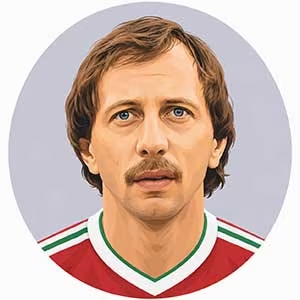
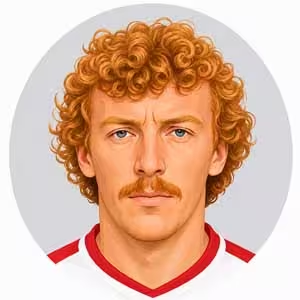
Poland - ForwardBoniek, Zbigniew
Blistering acceleration over thirty yards, dynamic diagonal runs behind defensive lines, and a legendary appetite for floodlit European fixtures earned Zbigniew Kazimierz Boniek the poetic moniker Bello di Notte (Beauty of the Night) from Juventus president Gianni Agnelli. Emerging as the driving talisman of Widzew Łódź—capturing consecutive Polish Ekstraklasa titles in 1981 and 1982—the Bydgoszcz-born attacker established his global pedigree at the 1982 World Cup in Spain. Across 80 caps and 24 goals for Poland, his devastating hat-trick against Belgium propelled the national team to a historic bronze medal, securing him third place in the 1982 Ballon d'Or. Moving to Giovanni Trapattoni’s Juventus alongside Michel Platini, Boniek functioned as the ultimate transitional weapon: an athletic hybrid between an attacking midfielder, an inside-forward, and an inverted winger. He specialized in vertical counter-attacks, latching onto Platini’s pinpoint passes, taking on sweepers with aggressive forward momentum, and earning pivotal penalties through sudden changes of pace. In Turin, he won the 1983–84 Scudetto, the 1983–84 European Cup Winners' Cup (scoring the winning goal against Porto), the 1984 European Super Cup (netting a match-winning brace against Liverpool), and the 1985 European Cup. He concluded his top-flight career with AS Roma, claiming the 1986 Coppa Italia.
Tactically, however, Boniek’s game was heavily reliant on open running channels. In congested, low-block domestic encounters where defensive lines sat deep inside their own penalty box, his explosive bursts were largely neutralized, resulting in noticeable scoring droughts across thirty-game league marathons. His first touch on the turn could occasionally be heavy under tight back-to-goal pressure, and his defensive tracking was intermittent when deployed on the wide flank.
Charismatic, fiercely outspoken, and powered by supreme self-assurance, Boniek was a big-game specialist who demanded the grandest stages to unlock his absolute maximum output. He was indifferent to routine domestic fixtures, saving his sharpest physical and tactical focus for high-stakes continental knockout matches. On the pitch, his body language radiated raw defiance: he played with an aggressive, upright swagger, leaning his chest into challenges and directly confronting man-markers who attempted to foul him out of rhythm. Inside the locker rooms of Widzew, Juventus, and Roma, he was an authoritative, sharp-witted figure whose leadership was respected by heavyweights like Dino Zoff and Platini, never hesitating to challenge tactical decisions or demand higher standards from his peers. Opposing defenders found his sudden, explosive changes of direction exhausting, while match officials encountered a determined, vocal competitor who consistently contested the whistle, cementing his legacy as the most dynamic, clutch, and internationally revered forward in Polish football history.


 All Time JuventusClub