We use Google Analytics to understand how visitors use this site. Analytics cookies are only activated with your consent. For details, read our Privacy Policy.
Profile lensThe same player, read from a different angle.
Athletic83
Acceleration
92
Pace
89
Agility
90
Strength
74
Balance
77
Jumping
81
Stamina
86
Fitness
74
Technical83
Dribbling
87
Short Passing
78
Long Passing
77
Finishing
87
Shot Accuracy
82
Shot Power
82
Shooting Technique
85
Heading
82
Tackling
54
Crossing
78
Free Kick
73
Penalties
78
First Touch
85
Mental81
Composure
82
Aggression
86
Consistency
78
Creativity
76
Leadership
82
Work Rate
82
Tactical82
Vision
79
Off the Ball
87
Defensive Positioning
54
Teamwork
78
Anticipation
85
Marking
41
Player Traits
Attacking83
Crossing
78
Finishing
87
Heading Accuracy
82
Shot Accuracy
82
Off the Ball
87
Technique81
Dribbling
87
Free Kick
73
Short Passing
78
Long Passing
77
First Touch
85
Shot Technique
85
Movement87
Acceleration
92
Pace
89
Agility
90
Balance
77
Physicality79
Shot Power
82
Jumping
81
Stamina
86
Strength
74
Fitness
74
Defending50
Marking
41
Tackling
54
Def. Positioning
54
Mentality & Game Reading81
Aggression
86
Composure
82
Penalties
78
Vision
79
Leadership
82
Work Rate
82
Teamwork
78
Anticipation
85
Consistency
78
Creativity
76
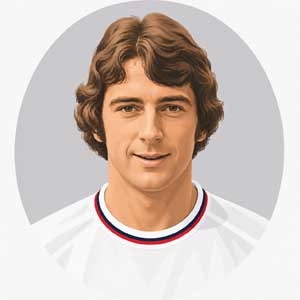
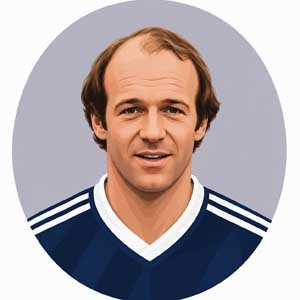
England - ForwardFrancis, Trevor
When Brian Clough walked into a crowded press conference in February 1979 carrying a squash racquet and casually declared that his new signing cost £999,999 to spare the young man the psychological weight of a seven-figure tag, English football entered an irreversible modern era. Trevor John Francis was the historic pioneer of the million-pound barrier: an electrifying, graceful forward and outside-right whose blistering change of pace, low-gravity body swerves, and sharp aerial timing made him one of the most dynamic attacking weapons of his generation.
Francis was an elusive forward built on rapid acceleration and razor-sharp diagonal runs from wide areas into the half-spaces. He possessed clean two-footed ball control, a sharp turning radius that left defenders lunging at shadows, and an exceptional vertical leap that made him a lethal aerial threat despite an unassuming, slender frame. Rising as a teenage prodigy at Birmingham City—scoring four goals in a single match at sixteen and amassing 133 goals in 329 matches—his world-class apex unfolded at Nottingham Forest under Brian Clough. There, he etched his name into continental immortality on May 30, 1979, at the Olympiastadion in Munich, diving at the far post to head home John Robertson’s cross on the stroke of half-time to secure Forest’s historic first European Cup triumph over Malmö FF. He followed it by lifting the 1979 European Super Cup, before later starring at Manchester City, pioneering a successful Serie A spell with Sampdoria (winning the 1984–85 Coppa Italia alongside Graeme Souness and Roberto Mancini) and Atalanta, and concluding his playing days winning silverware with Rangers and Sheffield Wednesday. For England, across 52 caps and 12 goals, he was a key figure under Ron Greenwood and Bobby Robson, scoring twice in the group stages of the 1982 World Cup in Spain.
That extraordinary, dynamic athletic burst, however, was repeatedly derailed by chronic physical fragility. Francis possessed delicate hamstring muscles and vulnerable Achilles tendons; a devastating ruptured Achilles tendon in the spring of 1980 cruelly forced him to miss Forest's second consecutive European Cup final triumph in Madrid, and a relentless cycle of muscular breakdowns gradually eroded that explosive first-yard separation that had previously made him uncontainable in open-field transitions. Furthermore, when deployed as an isolated, static target man against rugged, six-foot-three center-halves who denied him running lanes and forced him to play strictly with his back to goal on heavy winter pitches, his goalscoring output could be contained.
Psychologically, Francis carried the immense, suffocating scrutiny of being the game's first million-pound footballer with quiet dignity, immense professional courage, and deep personal modesty. He never embraced the rock-star arrogance of the late 1970s, approaching training with monastic seriousness and refusing to let public pressure alter his elegant, respectful demeanor. On the pitch, his body language was a masterclass in poised, kinetic grace: gliding across the turf with his head up, scanning channels for Robertson's crossing triggers, and converting historic moments with crisp, effortless execution rather than wild theatrics. Inside the Nottingham Forest, Sampdoria, and England dressing rooms, he was an admired, cultured professional whose historic goal in Munich and trailblazing European pedigree cemented an immortal legacy as one of the most explosive, elegant forwards in British football history.