We use Google Analytics to understand how visitors use this site. Analytics cookies are only activated with your consent. For details, read our Privacy Policy.
Profile lensThe same player, read from a different angle.
Athletic82
Acceleration
92
Pace
88
Agility
91
Strength
78
Balance
76
Jumping
78
Stamina
76
Fitness
75
Technical85
Dribbling
93
Short Passing
78
Long Passing
80
Finishing
85
Shot Accuracy
87
Shot Power
82
Shooting Technique
85
Heading
80
Tackling
40
Crossing
83
Free Kick
78
Penalties
76
First Touch
88
Mental78
Composure
81
Aggression
75
Consistency
78
Creativity
87
Leadership
75
Work Rate
72
Tactical79
Vision
79
Off the Ball
87
Defensive Positioning
33
Teamwork
74
Anticipation
82
Marking
33
Player Traits
Attacking84
Crossing
83
Finishing
85
Heading Accuracy
80
Shot Accuracy
87
Off the Ball
87
Technique84
Dribbling
93
Free Kick
78
Short Passing
78
Long Passing
80
First Touch
88
Shot Technique
85
Movement87
Acceleration
92
Pace
88
Agility
91
Balance
76
Physicality78
Shot Power
82
Jumping
78
Stamina
76
Strength
78
Fitness
75
Defending35
Marking
33
Tackling
40
Def. Positioning
33
Mentality & Game Reading78
Aggression
75
Composure
81
Penalties
76
Vision
79
Leadership
75
Work Rate
72
Teamwork
74
Anticipation
82
Consistency
78
Creativity
87
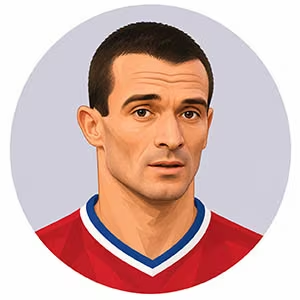
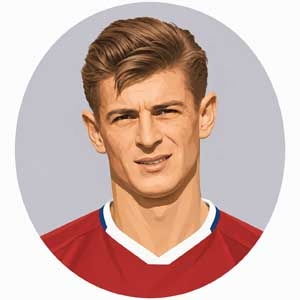
Serbia - ForwardMilutinović, Miloš
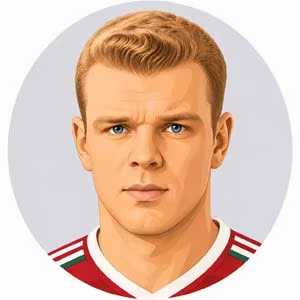
European night skies in the mid-1950s seemed to freeze whenever the slender, ethereal figure from Bajina Bašta drifted across the frozen mud of Belgrade, leaving French and Portuguese defenders chasing a ghost in the fog. Miloš Milutinović—celebrated across the continent as Plava čigra (The Blue Whirlwind) or The Blond Angel—was arguably the most aesthetically gifted pure forward in post-war Balkan football: an incandescent inside-right and center-forward whose game fused effortless, gliding dribbling, extraordinary spatial intuition, and a ruthless, historic scoring output in continental competition.
Milutinović was a master of deceptive rhythm and low-gravity elegance. Rather than relying on brute physical force, he dismantled defenses through sudden body feints, rapid-fire first-touch combinations, and an extraordinary ability to strike lethal, bending finishes off either foot while running at full speed. Operating as the crown jewel of FK Partizan between 1952 and 1958, he scored 231 goals in 213 matches across all competitions, lifting two Yugoslav Cups (1954, 1957). His continental peak arrived in the inaugural 1955–56 European Cup campaign, where he finished as the tournament's historic first top scorer with eight goals in just four matches—including two strikes in a breathtaking 3–0 second-leg victory over Alfredo Di Stéfano’s Real Madrid in the Belgrade snow. He later crossed the city divide to OFK Beograd before playing abroad with Bayern Munich, Racing Club de Paris, and Stade Français. For Yugoslavia, across 33 caps and 16 goals, he starred across two World Cups (1954 in Switzerland, where he scored the winner against France, and 1958 in Sweden), after being named Player of the Tournament and top scorer at the 1951 UEFA European Under-18 Championship.
The tragic, heartbreaking ceiling of Milutinović’s genius, however, was a devastating encounter with pulmonary tuberculosis in the late 1950s that systematically destroyed his lung capacity during what should have been his physical prime. The illness stripped away the explosive stamina and high-intensity mobility that had previously made him unstoppable across ninety minutes, forcing him to adapt into a more static, cerebral penalty-box poacher in France and Germany. Furthermore, his game belonged to the classical school of pure offensive expression: he offered virtually zero defensive tracking without the ball, and against hyper-physical, cynical stoppers who targeted his frail frame with unpunished hacking on waterlogged pitches, his fragile physical resilience could be worn down.
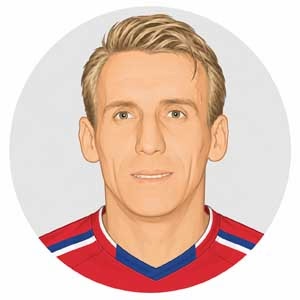
Introspective, poetic, and possessing an almost melancholic sensitivity, Milutinović played the game with the delicate grace of an artist who knew his time at the summit was borrowed. He was devoid of arrogance or hostility, rejecting performative aggression in favor of pure technical chivalry and understated dignity. The brutal tragedy of his health struggles never embittered him; he carried the heavy weight of unfulfilled physical potential with quiet, noble resignation, letting the pure memories of his European Cup masterclasses speak for his immortality. On the pitch, his posture was upright, aristocratic, and seemingly weightless: floating between defensive lines with his blond hair gleaming under floodlights, receiving passes with a feather-light touch, and dispatching finishes with effortless, cold-blooded serenity. Inside the Partizan, Bayern, and Yugoslav dressing rooms, he was an adored, almost mythical prodigy whose breathtaking artistry, tragic vulnerability, and incandescent talent cemented an eternal legacy as the most romantic and naturally gifted forward in Serbian football history.


 All Time SerbiaNT