We use Google Analytics to understand how visitors use this site. Analytics cookies are only activated with your consent. For details, read our Privacy Policy.
Profile lensThe same player, read from a different angle.
Athletic76
Acceleration
72
Pace
73
Agility
76
Strength
77
Balance
84
Jumping
73
Stamina
75
Fitness
75
Technical90
Dribbling
95
Short Passing
90
Long Passing
85
Finishing
91
Shot Accuracy
92
Shot Power
85
Shooting Technique
87
Heading
80
Tackling
38
Crossing
81
Free Kick
83
Penalties
88
First Touch
93
Mental83
Composure
87
Aggression
86
Consistency
83
Creativity
90
Leadership
75
Work Rate
84
Tactical87
Vision
86
Off the Ball
93
Defensive Positioning
37
Teamwork
81
Anticipation
91
Marking
33
Player Traits
Attacking87
Crossing
81
Finishing
91
Heading Accuracy
80
Shot Accuracy
92
Off the Ball
93
Technique89
Dribbling
95
Free Kick
83
Short Passing
90
Long Passing
85
First Touch
93
Shot Technique
87
Movement76
Acceleration
72
Pace
73
Agility
76
Balance
84
Physicality77
Shot Power
85
Jumping
73
Stamina
75
Strength
77
Fitness
75
Defending36
Marking
33
Tackling
38
Def. Positioning
37
Mentality & Game Reading85
Aggression
86
Composure
87
Penalties
88
Vision
86
Leadership
75
Work Rate
84
Teamwork
81
Anticipation
91
Consistency
83
Creativity
90
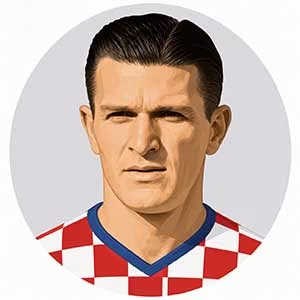
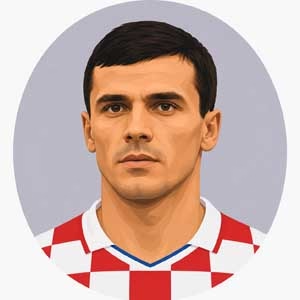
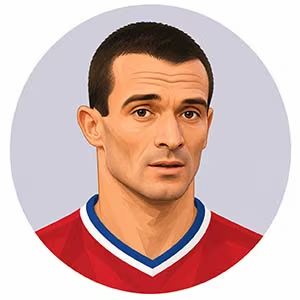
Croatia - ForwardBobek, Stjepan
A delicate backheel rolled through the legs of a charging center-half into the path of an overlapping forward became the definitive tactical calling card of a Zagreb-born maestro who invented modern center-forward play in post-war Eastern Europe. Stjepan Bobek—immortalized across Belgrade folklore as Štef—was a visionary pioneer of the deep-lying forward role, combining the lethal finishing instincts of a classical poacher with the exquisite vision, spatial intelligence, and passing range of a world-class playmaker.
Nominally deployed as a central striker, Bobek was decades ahead of his time: dropping twenty yards off the front line into midfield to drag opposing stoppers out of position, creating passing triangles, and releasing rapid wingers with reverse passes before surging into the penalty box to finish moves himself with either foot. As the spiritual leader and tactical anchor of FK Partizan between 1945 and 1959, he scored an astonishing 403 goals in 468 matches, capturing two Yugoslav First League championships (1946–47, 1948–49) and four Yugoslav Cups, holding the club's all-time scoring record to this day. For Yugoslavia, across 63 caps, he remains the all-time top scorer in national history with 38 goals, captaining the famous Olympic Team to consecutive Silver Medals at London 1948 and Helsinki 1952, alongside starring appearances across two World Cups (1950 in Brazil and 1954 in Switzerland).
Bobek’s revolutionary, cerebral game, however, required collective technical harmony around him to thrive. He lacked raw, straight-line linear sprint speed and explosive physical power, relying entirely on anticipation, body balance, and quick give-and-goes rather than bulldozing through backlines. When isolated against ultra-cynical, man-marking defensive setups on heavy, muddy surfaces where referees permitted aggressive physical hacking and his teammates failed to read his subtle disguise passes, his match involvement could be restricted.
Aristocratic, deeply dignified, and carrying a spotless sporting reputation, Bobek was the ultimate gentleman-footballer of the post-war era. He viewed football as an intellectual and aesthetic pursuit, abhorring dirty play, simulation, or unsporting gamesmanship. On the pitch, his presence was serene, composed, and effortlessly authoritative: orchestrating attacking movements with subtle head movements and directing teammates through pristine positional examples. Inside the Partizan and Yugoslav locker rooms, his moral authority was absolute—a revered patriarch whose tactical innovations directly influenced the legendary Hungarian Magical Magyars and laid the foundation for the entire golden tradition of Balkan football.