We use Google Analytics to understand how visitors use this site. Analytics cookies are only activated with your consent. For details, read our Privacy Policy.
Profile lensThe same player, read from a different angle.
Athletic86
Acceleration
88
Pace
91
Agility
85
Strength
84
Balance
79
Jumping
87
Stamina
87
Fitness
86
Technical83
Dribbling
84
Short Passing
79
Long Passing
90
Finishing
84
Shot Accuracy
83
Shot Power
85
Shooting Technique
72
Heading
86
Tackling
69
Crossing
85
Free Kick
74
Penalties
77
First Touch
79
Mental86
Composure
84
Aggression
85
Consistency
86
Creativity
74
Leadership
87
Work Rate
89
Tactical84
Vision
87
Off the Ball
84
Defensive Positioning
68
Teamwork
85
Anticipation
86
Marking
68
Player Traits
Attacking84
Crossing
85
Finishing
84
Heading Accuracy
86
Shot Accuracy
83
Off the Ball
84
Technique80
Dribbling
84
Free Kick
74
Short Passing
79
Long Passing
90
First Touch
79
Shot Technique
72
Movement86
Acceleration
88
Pace
91
Agility
85
Balance
79
Physicality86
Shot Power
85
Jumping
87
Stamina
87
Strength
84
Fitness
86
Defending68
Marking
68
Tackling
69
Def. Positioning
68
Mentality & Game Reading84
Aggression
85
Composure
84
Penalties
77
Vision
87
Leadership
87
Work Rate
89
Teamwork
85
Anticipation
86
Consistency
86
Creativity
74
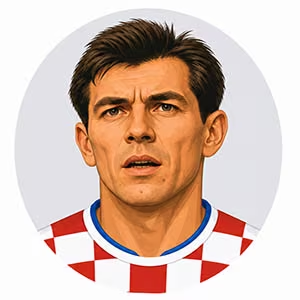
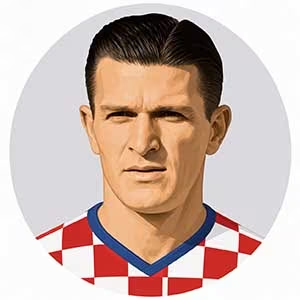
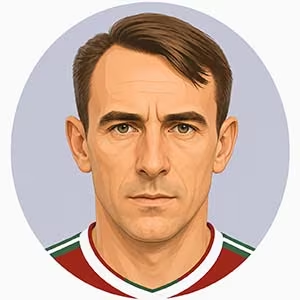
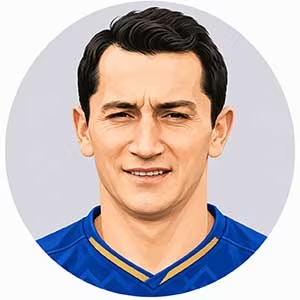
Croatia - Left WingerZebec, Branko
A stopwatch in hand and a mind that calculated passing angles with the icy detachment of an engineer turned a versatile polymath from Zagreb into one of the most intellectually dominant and tactically complete figures in European football history. Branko Zebec was the ultimate total footballer long before the phrase had currency, capable of operating with world-class distinction as an electric, goalscoring left-winger, an athletic box-to-box midfielder, or an impenetrable, ball-playing defensive sweeper.
Blessed with a sprinter’s linear speed—capable of clocking under eleven seconds in the 100-meter dash—Zebec tore flanks apart in his early career through devastating straight-line acceleration, pinpoint crossing, and a venomous left-footed strike. As his career matured, his extraordinary spatial IQ allowed him to retreat into central midfield and the libero role, where he dictated tempo, cut off passing lanes with clinical anticipation, and launched transitions with raking forty-yard distributions. Across a dominant domestic career spanning FK Partizan (where he won three Yugoslav Cups and finished as top scorer in the inaugural 1955–56 European Cup campaign) and Red Star Belgrade (capturing the 1959–60 Yugoslav First League title), he was universally regarded as the tactical brain of every team he represented, before concluding his playing days with Alemannia Aachen. For Yugoslavia, across 65 caps and 17 goals, he captained the immortal Olympic Team to the Silver Medal at Helsinki 1952 (finishing as tournament top scorer with seven goals), starred across two World Cups (1954 in Switzerland and 1958 in Sweden), and reached the final of the inaugural 1960 European Nations' Cup in Paris.
Zebec’s intellectual superiority, however, carried an uncompromising rigidity. He had little patience for players who operated on raw emotion rather than strict spatial discipline; if a teammate broke structure or failed to track a runner, Zebec’s reactions could be scathingly dismissive. Furthermore, while lightning-fast in a forward sprint, his turning radius in deep defensive areas became more deliberate in the latter half of his career, requiring disciplined positional anticipation over raw lateral agility.
Psychologically, Zebec was an uncompromising, severe perfectionist whose brilliance was shadowed by a tragic, melancholic intensity. He possessed a tyrannical work ethic and expected the same monastic self-discipline from everyone around him, viewing football not as popular entertainment, but as an exact science of space, mathematics, and physical endurance. On the pitch, his body language was aloof, upright, and aristocratic: surveying the field with cold, analytical detachment, barking precise tactical commands, and refusing to celebrate routine goals with cheap theatricality. Inside the dressing rooms of Belgrade, Zagreb, and the national side—and later as the mastermind manager of Bayern Munich and Hamburger SV—he was an intimidating, isolated genius whose relentless tactical clarity and tragic battle with alcoholism in later years left behind an immortal legacy as one of the sharpest, most complex minds European football ever produced.