We use Google Analytics to understand how visitors use this site. Analytics cookies are only activated with your consent. For details, read our Privacy Policy.
Profile lensThe same player, read from a different angle.
Athletic83
Acceleration
91
Pace
89
Agility
85
Strength
81
Balance
74
Jumping
78
Stamina
85
Fitness
84
Technical80
Dribbling
80
Short Passing
76
Long Passing
79
Finishing
84
Shot Accuracy
86
Shot Power
82
Shooting Technique
81
Heading
75
Tackling
44
Crossing
83
Free Kick
75
Penalties
73
First Touch
79
Mental80
Composure
82
Aggression
78
Consistency
78
Creativity
74
Leadership
78
Work Rate
82
Tactical79
Vision
82
Off the Ball
85
Defensive Positioning
45
Teamwork
76
Anticipation
82
Marking
42
Player Traits
Attacking83
Crossing
83
Finishing
84
Heading Accuracy
75
Shot Accuracy
86
Off the Ball
85
Technique78
Dribbling
80
Free Kick
75
Short Passing
76
Long Passing
79
First Touch
79
Shot Technique
81
Movement85
Acceleration
91
Pace
89
Agility
85
Balance
74
Physicality82
Shot Power
82
Jumping
78
Stamina
85
Strength
81
Fitness
84
Defending44
Marking
42
Tackling
44
Def. Positioning
45
Mentality & Game Reading79
Aggression
78
Composure
82
Penalties
73
Vision
82
Leadership
78
Work Rate
82
Teamwork
76
Anticipation
82
Consistency
78
Creativity
74
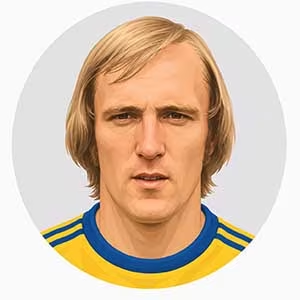
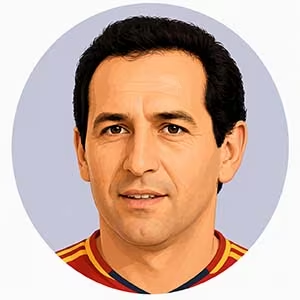
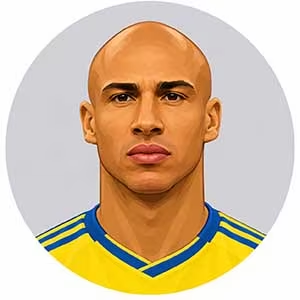
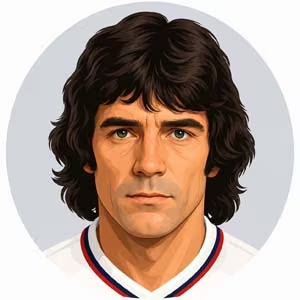
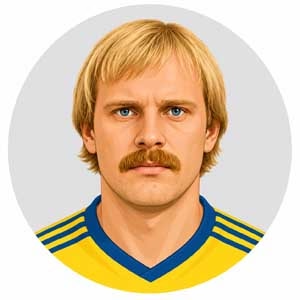
Sweden - Left WingerSandberg, Roland
A hyper-direct, predatory spearhead whose game was forged in relentless diagonal running, explosive physical power, and cold-blooded penalty-box efficiency, Roland Sandberg stood as the ultimate counter-attacking battering ram for Åtvidabergs FF, 1. FC Kaiserslautern, and the Swedish national team during the 1970s. Blessed with a powerful sprinting stride over 30 meters, broad shoulders, and an innate instinct for finding the blind spot between opposing center-backs, Sandberg was a nightmare to mark in transition. Technically, his signature was the sudden vertical dart onto through-balls, using his upper body to shield off defenders before unleashing venomous, low-trajectory drives with either foot or attacking crosses with a courageous, diving header. Forming a legendary, telepathic "big-man/speedster" partnership with Ralf Edström at Åtvidaberg—sweeping back-to-back Allsvenskan titles in 1972 and 1973—he made an explosive transition to the German Bundesliga with Kaiserslautern, netting 60 league goals in just 118 appearances. His international crowning moment arrived at the 1974 World Cup in West Germany, where his searing pace and clinical finishing yielded two crucial goals, including a stunning, precise strike against the hosts in Düsseldorf that temporarily rattled the eventual world champions. Psychologically, Sandberg was a ruthless pragmatist fueled by an intense, no-nonsense competitive drive and a total lack of aesthetic pretension. He did not care about elaborate skill moves or individual showmanship; he viewed football through the clinical lens of territorial penetration and mathematical output. Inside the dressing room, he was a quiet, highly professional presence—serious in his preparation, deeply committed to tactical instructions, and possessing a grounded Nordic humility that allowed him to adapt instantly to the ferocious physical demands and demanding media culture of the German Bundesliga. Under maximum tournament pressure, his mental clarity was extraordinary; he thrived in high-tempo, chaotic matches where space was compressed, requiring only a split-second mistake from an opposing marker to strike with lethal precision. When devastating knee injuries cruelly cut his prime short in the late 1970s, he met the physical setback with stoic grace, having poured every ounce of energy into his craft without regret. Toward match officials and bruising Bundesliga stoppers who routinely hacked him down on full-speed breakaways, Sandberg operated with pure sporting honesty: he absorbed heavy tackles, bounced immediately back to his feet, and responded not with theatrics or verbal disputes, but by ruthlessly exploiting the very next pocket of space behind the defensive line.