We use Google Analytics to understand how visitors use this site. Analytics cookies are only activated with your consent. For details, read our Privacy Policy.
Profile lensThe same player, read from a different angle.
Athletic82
Acceleration
95
Pace
87
Agility
92
Strength
70
Balance
76
Jumping
77
Stamina
79
Fitness
79
Technical84
Dribbling
90
Short Passing
78
Long Passing
78
Finishing
91
Shot Accuracy
91
Shot Power
76
Shooting Technique
81
Heading
76
Tackling
48
Crossing
81
Free Kick
68
Penalties
80
First Touch
87
Mental80
Composure
85
Aggression
83
Consistency
78
Creativity
80
Leadership
79
Work Rate
77
Tactical80
Vision
76
Off the Ball
92
Defensive Positioning
37
Teamwork
74
Anticipation
89
Marking
37
Player Traits
Attacking86
Crossing
81
Finishing
91
Heading Accuracy
76
Shot Accuracy
91
Off the Ball
92
Technique80
Dribbling
90
Free Kick
68
Short Passing
78
Long Passing
78
First Touch
87
Shot Technique
81
Movement88
Acceleration
95
Pace
87
Agility
92
Balance
76
Physicality76
Shot Power
76
Jumping
77
Stamina
79
Strength
70
Fitness
79
Defending41
Marking
37
Tackling
48
Def. Positioning
37
Mentality & Game Reading80
Aggression
83
Composure
85
Penalties
80
Vision
76
Leadership
79
Work Rate
77
Teamwork
74
Anticipation
89
Consistency
78
Creativity
80
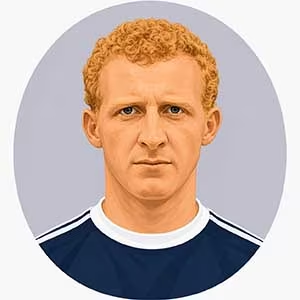
Sweden - Right WingerHamrin, Kurt
A low center of gravity, rapid-fire stutter steps on the chalk of the right wing, and an uncanny ability to squeeze the ball into the net from angles that seemed mathematically closed made a soft-spoken native of Stockholm one of the most prolific foreign marksmen in Italian football history. Kurt Roland Hamrin—immortalized across Tuscany simply as Uccellino (Little Bird) for his light-footed, fluttering agility—was a lethal hybrid of outside-right and auxiliary center-forward who turned balance and acceleration into 190 Serie A goals, an all-time record that places him ninth on the league's all-time scoring list.
Hamrin’s game was built on sudden deceleration followed by an explosive burst past lunging defenders. He was virtually impossible to knock off balance in tight channels: utilizing a deceptive body feint to drop his shoulder, cutting inside along the goal line, and clipping precise, stabbed finishes past advancing goalkeepers. Emerging from AIK, he arrived in Italy via Juventus and Padova under Nereo Rocco, but found his spiritual home at ACF Fiorentina between 1958 and 1967. In Florence, he scored 208 goals across 362 matches, captaining the Viola to two Coppa Italia titles (1960–61, 1965–66), the 1960–61 European Cup Winners' Cup, and the 1966 Mitropa Cup. His late-career move to Nereo Rocco’s AC Milan yielded ultimate continental glory: scoring both goals in the 1968 Cup Winners' Cup final against Hamburger SV and lifting the 1967–68 Scudetto alongside the 1968–69 European Cup. For Sweden, across 32 caps and 17 goals, his crowning moment remains the 1958 World Cup semi-final against West Germany, where he slalomed through the entire German backline from the touchline to seal a 3–1 victory and carry his nation into the final.
That extraordinary short-burst agility, however, was housed in a slight, five-foot-seven frame that avoided direct physical friction. Hamrin was not a traditional winger who could contest aerial crosses in crowded six-yard boxes, nor was he a powerhouse runner capable of winning attritional wrestling matches against rugged, man-marking defenders on waterlogged winter pitches. When isolated against physical full-backs who were permitted to foul him before he could face forward and turn his hips, his influence could be restricted if his midfield failed to release him quickly into space.
Gentlemanly, modest, and completely integrated into the daily life of Florence—where he chose to live for the rest of his life—Hamrin played with a lighthearted, clean sportsmanship that disarmed opponents and endeared him to rival crowds. He never feigned injury, dived, or protested refereeing calls, taking pride in beating his markers through pure technical precision and balance. On the pitch, his body language was all kinetic alertness: scanning the defensive line while hovering on the shoulder of the last man, exploding into life the split-second a channel opened. Inside the Fiorentina and Milan dressing rooms, he was an indispensable, calming veteran whose spotless professionalism and clinical goalscoring earned the unconditional adoration of Nereo Rocco and generations of Italian supporters, leaving behind an immortal legacy as one of the most elegant and lethal wingers in European history.



 All Time SwedenNT