We use Google Analytics to understand how visitors use this site. Analytics cookies are only activated with your consent. For details, read our Privacy Policy.
Profile lensThe same player, read from a different angle.
Athletic76
Acceleration
74
Pace
76
Agility
81
Strength
75
Balance
80
Jumping
68
Stamina
78
Fitness
75
Technical90
Dribbling
91
Short Passing
97
Long Passing
91
Finishing
78
Shot Accuracy
74
Shot Power
84
Shooting Technique
88
Heading
66
Tackling
58
Crossing
89
Free Kick
81
Penalties
77
First Touch
94
Mental78
Composure
89
Aggression
68
Consistency
74
Creativity
91
Leadership
70
Work Rate
74
Tactical85
Vision
93
Off the Ball
84
Defensive Positioning
55
Teamwork
87
Anticipation
75
Marking
52
Player Traits
Attacking78
Crossing
89
Finishing
78
Heading Accuracy
66
Shot Accuracy
74
Off the Ball
84
Technique90
Dribbling
91
Free Kick
81
Short Passing
97
Long Passing
91
First Touch
94
Shot Technique
88
Movement78
Acceleration
74
Pace
76
Agility
81
Balance
80
Physicality76
Shot Power
84
Jumping
68
Stamina
78
Strength
75
Fitness
75
Defending55
Marking
52
Tackling
58
Def. Positioning
55
Mentality & Game Reading80
Aggression
68
Composure
89
Penalties
77
Vision
93
Leadership
70
Work Rate
74
Teamwork
87
Anticipation
75
Consistency
74
Creativity
91
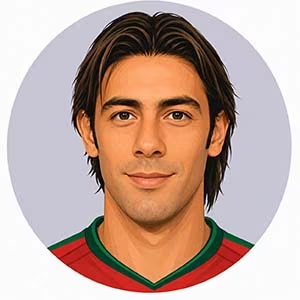
Portugal - Attacking MidfielderRui Costa
Socks rolled down to the ankles, head tilted upward, and an unerring instinct for the geometry of the final third marked Rui Manuel César Sampaio da Costa as one of the last pure classic trequartisti of European football. Cultivated within Benfica’s academy under the direct eye of Eusébio, Rui Costa reached his creative peak across twelve uninterrupted seasons in Serie A. Operating behind the strikers with an upright, languid gait, he did not rely on physical bursts or quick stepovers to beat his man; instead, he used subtle body feints, the outside of his right boot, and a supreme panoramic vision to unlock compact defensive lines. His signature weapon was the filtrante—a heavily weighted, ground-level through-ball delivered with backspin that arrived precisely into the stride of charging forwards. At Fiorentina, his telepathic partnership with Gabriel Batistuta anchored the Tuscan club to two Coppa Italia titles and the 1996 Supercoppa Italiana. His record-breaking 2001 move to Carlo Ancelotti’s AC Milan yielded the 2002–03 UEFA Champions League, the 2003–04 Scudetto, and a Coppa Italia, functioning as the primary playmaker before tactically sharing duties with Andrea Pirlo and Kaká. For Portugal’s Geração de Ouro, he collected 94 caps and 26 goals, orchestrating the midfield across three European Championships (1996, 2000, 2004) and the 2002 World Cup, punctuated by a thunderous long-range strike against England in the Euro 2004 quarter-final.
Carrying himself with an innate, melancholic elegance and deep romantic attachment to his clubs, Rui Costa lived every tactical sequence with immense emotional investment. He was a deeply sensitive creator whose performance level was tied to emotional trust and creative autonomy; when relegated to a secondary role by Kaká’s emergence at Milan, he displayed remarkable humility, mentoring the young Brazilian rather than causing locker-room tension. On the pitch, his body language was expressive, often sighing or looking to the sky when a teammate misread his visionary passing lanes, yet he never berated his colleagues openly. Inside the dressing rooms of Florence and Milan, he was universally revered—an authentic gentleman who avoided cynical gamesmanship, respected tactical instructions, and prioritized aesthetic collective football over personal goal tallies. When marked tightly by aggressive defensive pivots in the tactical cauldron of Serie A, he absorbed heavy physical challenges with quiet stoicism, refusing to retaliate or simulate contact. Referees and opponents regarded him as a paragon of sporting fairness, leaving a lasting legacy as one of the most aesthetically refined, generous, and gifted playmakers in modern continental history.


 All Time PortugalNT