We use Google Analytics to understand how visitors use this site. Analytics cookies are only activated with your consent. For details, read our Privacy Policy.
Profile lensThe same player, read from a different angle.
Athletic79
Acceleration
82
Pace
77
Agility
80
Strength
77
Balance
83
Jumping
75
Stamina
82
Fitness
76
Technical93
Dribbling
91
Short Passing
96
Long Passing
94
Finishing
87
Shot Accuracy
87
Shot Power
83
Shooting Technique
90
Heading
77
Tackling
63
Crossing
90
Free Kick
87
Penalties
84
First Touch
96
Mental83
Composure
92
Aggression
70
Consistency
76
Creativity
93
Leadership
83
Work Rate
77
Tactical90
Vision
95
Off the Ball
86
Defensive Positioning
65
Teamwork
95
Anticipation
82
Marking
54
Player Traits
Attacking85
Crossing
90
Finishing
87
Heading Accuracy
77
Shot Accuracy
87
Off the Ball
86
Technique92
Dribbling
91
Free Kick
87
Short Passing
96
Long Passing
94
First Touch
96
Shot Technique
90
Movement81
Acceleration
82
Pace
77
Agility
80
Balance
83
Physicality79
Shot Power
83
Jumping
75
Stamina
82
Strength
77
Fitness
76
Defending61
Marking
54
Tackling
63
Def. Positioning
65
Mentality & Game Reading85
Aggression
70
Composure
92
Penalties
84
Vision
95
Leadership
83
Work Rate
77
Teamwork
95
Anticipation
82
Consistency
76
Creativity
93
Curated interpretation
Signature Moves
Role-defining patterns—not attributes, traits or Inner Game measures. Three ways Juan Schiaffino changes the meaning of the role around him.
01
Twin Currents
South American intensity and European precision meet in the same player instead of one softening the other.
02
The Balcony
He plays as if watching the match from above his own position: head up, distances measured before the ball arrives.
03
Before the Word
He is already playing the deep-lying playmaker before football has a name for it.
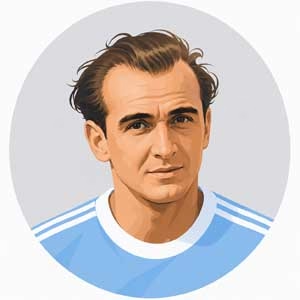
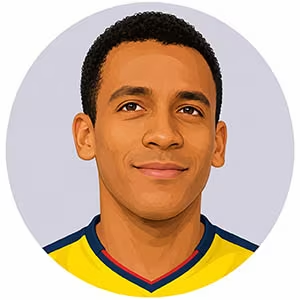
Uruguay - Attacking MidfielderSchiaffino, Juan
At the Maracanã on 16 July 1950, Uruguay were trailing Brazil 1–0 in a match the hosts needed only to draw to become world champions. Juan Alberto Schiaffino had spent much of the tournament operating as an inside-left, connecting midfield to attack rather than waiting permanently near goal. Midway through the second half Alcides Ghiggia escaped down the right and drove a low ball backwards. Schiaffino arrived centrally and struck first time past Moacir Barbosa. Uruguay later scored again through Ghiggia and won the World Cup. The equaliser matters because Schiaffino’s influence was not limited to orchestration from safety. When the structure required him to become the finisher, he entered the decisive space himself. Four years later he scored again in a World Cup semi-final, against Hungary, before Uruguay were eliminated in extra time. His tournament record therefore shows neither avoidance of major-event responsibility nor dependence on one fixed creative position: Schiaffino could alter his relationship with the attack according to what the match required.
At Peñarol, Schiaffino developed primarily as an inside-left whose technical range allowed him to construct and finish attacks. Lean, agile and effectively two-footed, he could receive between lines, turn quickly and play passes whose value came from early recognition rather than elaborate preparation. His vision was accompanied by accurate shooting and enough short-distance acceleration to exploit the spaces he had identified. Milan paid a then-extraordinary fee to sign him after the 1954 World Cup, when he was already twenty-nine, yet Italian football expanded rather than diminished his tactical range. He increasingly dropped towards midfield, touched the ball more frequently and became a reference for directing possession while retaining the capacity to arrive near goal. Milan won three league championships during his six seasons, and contemporary Italian assessments repeatedly emphasised the intelligence with which he interpreted spaces rather than merely his technique. Later, at Roma, he could operate even deeper, including as a libero. The progression from inside-forward to playmaker and finally defensive organiser was possible because his principal advantage was not tied to one athletic action: Schiaffino understood where the next phase of play needed to begin.
There were nevertheless clear boundaries. Schiaffino was not physically imposing and could not dominate matches through sustained contact, aerial power or defensive athleticism. His ball-winning contribution was intelligent and occasionally aggressive, including sliding interventions unusual for a player of his creative profile, but he was never a specialist destroyer. Nor should tactical intelligence be converted into omnipotence. His greatest influence required access to the ball and teammates capable of responding to the solutions he identified; denying him central reception or forcing the game into repeated physical transitions reduced his comparative advantage. Age progressively removed some of the acceleration that had made the younger inside-forward more directly penetrative, and the move deeper was therefore adaptation as well as tactical enrichment. His temperament could create another cost. A player convinced that he had understood the correct solution before others could become impatient when teammates failed to execute it. Contemporary recollections of Schiaffino repeatedly describe demands and corrections directed towards those around him. That behaviour could raise collective standards, but it could also make his authority abrasive. Tactical intelligence did not guarantee interpersonal flexibility.
Psychologically, Schiaffino is best defined by **corrective authority**. Accounts from teammates and observers consistently present a player who did not merely perceive the match but communicated how he believed it should be played, correcting positioning and demanding particular actions from those around him. At Milan that authority was reinforced by his extraordinary technical credibility: younger teammates could be instructed by a foreign player because his solutions repeatedly worked. Yet the mechanism was not gentle consensus. Schiaffino could reprimand teammates sharply when they failed to read a situation as he expected, and his competitive behaviour included argument with officials rather than universal emotional detachment. This matters because the common image of the cerebral playmaker can falsely imply passivity. His intelligence generated intervention: once he believed he had identified the correct structure, he expected the group to conform to it. At the same time, his own career demonstrates considerable capacity for self-correction. Moving from Uruguay to Italy at twenty-nine did not lead him to protect the identity of the attacking inside-forward; he accepted increasingly deep responsibilities and eventually operated as the last defensive organiser. Authority therefore did not mean positional possessiveness. Evidence for systematic retaliatory aggression, deterioration after individual provocation or inability to recover from his own mistakes is insufficient and should remain unknown. What is documented more securely is a player whose reading of the game produced an urge to **correct the environment around him**—through the pass when possible, through instruction when necessary and occasionally through confrontation when others resisted the solution he believed the match demanded.