We use Google Analytics to understand how visitors use this site. Analytics cookies are only activated with your consent. For details, read our Privacy Policy.
Profile lensThe same player, read from a different angle.
Athletic79
Acceleration
74
Pace
72
Agility
81
Strength
83
Balance
82
Jumping
87
Stamina
64
Fitness
87
Technical44
Dribbling
50
Short Passing
59
Long Passing
63
Shot Accuracy
44
Shot Power
80
Shooting Technique
44
Heading
50
Free Kick
44
Penalties
44
First Touch
55
Mental89
Composure
91
Consistency
87
Leadership
87
Goalkeeping92
Reflexes
94
Positioning
96
Handling
92
Kicking
87
Goalkeeping92
Reflexes
94
Positioning
96
Handling
92
Kicking
87
Attacking47
Heading Accuracy
50
Shot Accuracy
44
Technique53
Dribbling
50
Free Kick
44
Short Passing
59
Long Passing
63
First Touch
55
Shot Technique
44
Physicality80
Shot Power
80
Jumping
87
Stamina
64
Strength
83
Fitness
87
Movement77
Acceleration
74
Pace
72
Agility
81
Balance
82
Mentality & Game Reading77
Composure
91
Penalties
44
Leadership
87
Consistency
87
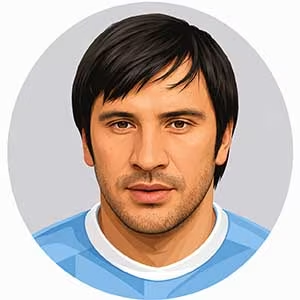
Uruguay - GoalkeeperMazurkiewicz, Ladislao
The 1970 World Cup semi-final in Guadalajara produced an indelible slice of football mythology when Pelé executed his famous no-touch dummy around an onrushing goalkeeper, yet the man stranded by that split-second sorcery had already spent years establishing himself as the premier shot-stopper in the Americas. Ladislao Mazurkiewicz Iglesias, born in Piriápolis to Polish and Spanish lineage, was the impenetrable wall behind Peñarol's golden era and Uruguay's modern international apex. Blessed with explosive lateral spring, glue-like handling on greasy leather balls, and razor-sharp positional intuition, El Chiquito made difficult stops look routine by narrowing angles with aggressive, calculated footwork. With Peñarol, he lifted three Uruguayan league titles, the 1966 Copa Libertadores, and shut out Real Madrid across both legs of the 1966 Intercontinental Cup, later collecting the 1971 Campeonato Brasileiro with Atlético Mineiro. Across 36 caps for La Celeste, he competed in three consecutive World Cups (1966, 1970, 1974), winning Best Goalkeeper honors in Mexico 1970 after conceding just one goal on the way to the semi-finals.
His classical methods, however, operated within distinct physical boundaries. Mazurkiewicz was an agile six-footer rather than a towering aerial giant; when pinned on his goal line by direct, physical European forwards during crowded set pieces, he occasionally struggled to punch clear through traffic. Furthermore, his distribution remained strictly functional for his era, relying on deep, direct punts rather than controlled build-up play under back-pass pressure.
Dignified, ice-cold under pressure, and possessing an unyielding South American competitive spine, Mazurkiewicz approached his goalmouth like sovereign territory. He never indulged in erratic hysterics or theatrical dives for the press, controlling his penalty box through quiet, commanding stares and perfectly timed interventions. On the pitch, his body language radiated total composure, instantly subduing team panic during high-intensity away legs in the Copa Libertadores. Inside the dressing rooms of Peñarol and the national side, he was a revered leader whose technical precision and big-game bravery set the standard for generations of South American shot-stoppers, leaving behind an immortal legacy as the greatest goalkeeper Uruguay ever produced.


 All Time UruguayNT