We use Google Analytics to understand how visitors use this site. Analytics cookies are only activated with your consent. For details, read our Privacy Policy.
Profile lensThe same player, read from a different angle.
Athletic75
Acceleration
68
Pace
67
Agility
73
Strength
85
Balance
78
Jumping
78
Stamina
60
Fitness
89
Technical46
Dribbling
45
Short Passing
53
Long Passing
55
Shot Accuracy
44
Shot Power
82
Shooting Technique
43
Heading
45
Free Kick
45
Penalties
41
First Touch
50
Mental87
Composure
87
Consistency
88
Leadership
87
Goalkeeping94
Reflexes
97
Positioning
98
Handling
94
Kicking
85
Goalkeeping94
Reflexes
97
Positioning
98
Handling
94
Kicking
85
Attacking45
Heading Accuracy
45
Shot Accuracy
44
Technique49
Dribbling
45
Free Kick
45
Short Passing
53
Long Passing
55
First Touch
50
Shot Technique
43
Physicality79
Shot Power
82
Jumping
78
Stamina
60
Strength
85
Fitness
89
Movement72
Acceleration
68
Pace
67
Agility
73
Balance
78
Mentality & Game Reading76
Composure
87
Penalties
41
Leadership
87
Consistency
88
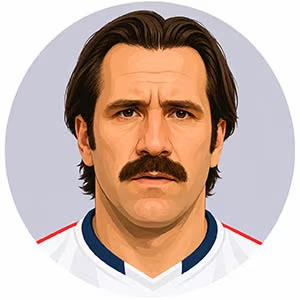
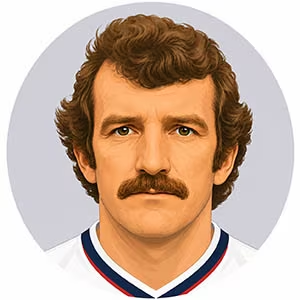
England - GoalkeeperBanks, Gordon
In Guadalajara on 7 June 1970, Jairzinho crossed from the right and Pelé headed the ball sharply downwards towards Gordon Banks’s right-hand corner. Banks was positioned closer to the near post and initially believed the header would beat him. He moved laterally, launched himself across goal and reached the ball immediately after it bounced, using his right hand to redirect it over the crossbar. Pelé had already begun celebrating. Banks later resisted the mythology around the save, explaining its mechanics through positioning, footwork and the unusually hard Mexican surface that helped the ball rebound upwards. The response is revealing. Presented with the action most commonly used to describe him as superhuman, Banks reconstructed it as a solvable goalkeeping problem. He did not deny its difficulty; he removed the mystery. That preference for reducing dramatic situations to manageable technical components ran through his football and, more importantly, through the way he dealt with mistakes.
Banks was a goalkeeper built around positioning, footwork and secure handling rather than constant aggressive occupation outside his area. He adjusted before the shot, reducing how much distance the final save required, and possessed the reactions to compensate when anticipation alone was insufficient. His handling was particularly reliable in an era of heavier balls, difficult surfaces and frequent contact around goalkeepers; catching rather than parrying removed the second action before it existed. At Leicester City he reached two FA Cup finals and won the League Cup before moving to Stoke City, where he later won another League Cup in 1972. With England he became first choice before the 1966 World Cup and conceded only three goals throughout the tournament, keeping clean sheets through the group stage and quarter-final. His distribution was controlled and functional, but describing it as deliberately possession-oriented in the modern sense would be anachronistic. Banks’s primary contribution remained reduction of defensive uncertainty: positioning before the shot, secure handling during it and a restart after danger had been conclusively ended.
There were nevertheless limits. Banks was not a proactive sweeper-keeper in the more expansive sense and did not derive comparable value from defending large spaces far beyond his penalty area. His distribution could initiate play effectively but was not a central creative mechanism of the team. Nor did excellent positioning eliminate the possibility of technical error. Banks himself recalled conceding goals he considered his fault and described how dangerous the psychological aftermath could become if the goalkeeper continued replaying the mistake. The 1970 World Cup also provides an important boundary to heroic narratives. Acute illness prevented him from playing the quarter-final against West Germany, and England surrendered a two-goal lead with Peter Bonetti in goal. Banks’s absence demonstrates how dependent his performance was, like any player’s, on physical availability; it should not become retrospective proof that England would certainly have won with him. Two years later a car accident cost him the sight in his right eye and effectively ended his elite English career. His subsequent return to professional football in North America was remarkable, but reduced visual capacity necessarily changed the conditions under which his goalkeeping operated.
Psychologically, Banks is best defined by **error containment through task narrowing**. He later described making a mistake for Leicester and discovering that he was still mentally replaying it while the match continued. His response was deliberate: he told himself that the incident had finished and that carrying it forward would only create another mistake. This was not emotional indifference. Banks acknowledged the error, experienced the intrusive continuation of it and then consciously restricted attention to the next goalkeeping problem. That mechanism differs from the effortless serenity often projected onto him. His account of the Pelé save works similarly: rather than use the action to enlarge his own mythology, he broke it into positioning, movement, contact and surface conditions. High-pressure reliability therefore emerged partly from cognitive simplification—turning extraordinary circumstances back into individual tasks that could be executed. His response to the career-threatening eye injury provides a different form of evidence. Banks attempted to return to goalkeeping despite permanent loss of vision in one eye and eventually played successfully in the NASL, but this should be scored as behavioural persistence rather than proof of emotional invulnerability. Evidence for systematic referee confrontation, retaliatory aggression, teammate blame or individual provocation is insufficient and should remain unknown. The stronger pattern is precise: **when an action threatened to occupy more psychological space than it deserved, Banks worked to close it, reduce the field of attention and make the next action independent of the previous one**.