We use Google Analytics to understand how visitors use this site. Analytics cookies are only activated with your consent. For details, read our Privacy Policy.
Profile lensThe same player, read from a different angle.
Athletic78
Acceleration
68
Pace
66
Agility
79
Strength
85
Balance
82
Jumping
85
Stamina
65
Fitness
91
Technical45
Dribbling
50
Short Passing
54
Long Passing
60
Shot Accuracy
57
Shot Power
84
Shooting Technique
55
Heading
47
Free Kick
44
Penalties
47
First Touch
55
Mental86
Composure
86
Consistency
87
Leadership
85
Goalkeeping87
Reflexes
87
Positioning
92
Handling
84
Kicking
86
Goalkeeping87
Reflexes
87
Positioning
92
Handling
84
Kicking
86
Attacking52
Heading Accuracy
47
Shot Accuracy
57
Technique53
Dribbling
50
Free Kick
44
Short Passing
54
Long Passing
60
First Touch
55
Shot Technique
55
Physicality82
Shot Power
84
Jumping
85
Stamina
65
Strength
85
Fitness
91
Movement74
Acceleration
68
Pace
66
Agility
79
Balance
82
Mentality & Game Reading76
Composure
86
Penalties
47
Leadership
85
Consistency
87
England - GoalkeeperStepney, Alex
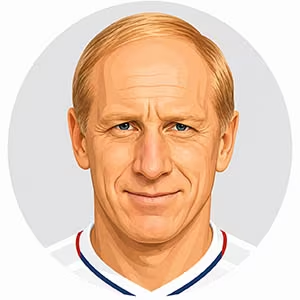
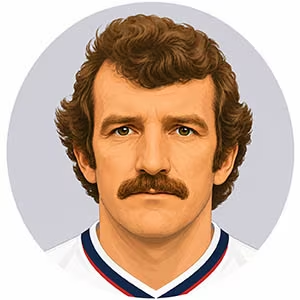
Wembley Stadium on May 29, 1968, held its breath in the 88th minute of the European Cup final when Eusébio broke clean through on goal, only for an unblinking Manchester United shot-stopper to stand tall and catch the Portuguese legend's thunderous drive cleanly against his chest—prompting Eusébio to stop and applaud his brilliance. Alexander Cyril Stepney was the unflappable, heroic guardian between the posts for Sir Matt Busby’s historic European conquerors. Standing six feet tall with exceptional positional discipline, safe hands, and swift ground-level recovery, Stepney was the rock that stabilized United through their golden peak and subsequent turbulent transition. Across 545 appearances for the Red Devils between 1966 and 1978, he won the 1966–67 First Division championship, the historic 1968 European Cup against Benfica, and the 1977 FA Cup (denying Liverpool a historic treble), famously scoring two penalties as the club's designated spot-kick taker in 1973–74. For England, across one cap, he was a member of the 1968 European Championship and 1970 World Cup squads, serving as an elite deputy in the golden era of Gordon Banks and Peter Bonetti.
His traditional shot-stopping game, however, had era-specific boundaries. Stepney was not an adventurous sweeper who roamed outside his eighteen-yard box to challenge forwards with his feet, preferring to anchor himself along his goal line and manage threats within his area. On heavy, waterlogged winter pitches, his explosive horizontal spring on low, skidding drives could be challenged by sudden bounces, and his distribution was limited to long, direct clearances downfield.
Calm, unshakeable, and completely devoid of theatrics, Stepney was the ultimate steady hand behind a team filled with mercurial superstars like George Best, Denis Law, and Bobby Charlton. He never engaged in hysterical finger-pointing or theatrical despair after conceding; his focus was entirely dedicated to resetting his defense and maintaining concentration. On the pitch, his body language was neat and reassuring, commanding his penalty box with quiet authority. Inside the Old Trafford dressing room, he was a revered senior figure whose longevity, unpretentious work ethic, and immense bravery under fire earned the deep respect of multiple managerial generations, leaving an immortal legacy as one of the most reliable and iconic goalkeepers in Manchester United history.


 All Time Manchester UnitedClub