We use Google Analytics to understand how visitors use this site. Analytics cookies are only activated with your consent. For details, read our Privacy Policy.
Profile lensThe same player, read from a different angle.
Athletic73
Acceleration
66
Pace
68
Agility
74
Strength
78
Balance
77
Jumping
83
Stamina
60
Fitness
80
Technical43
Dribbling
50
Short Passing
55
Long Passing
59
Shot Accuracy
44
Shot Power
80
Shooting Technique
42
Heading
45
Free Kick
46
Penalties
45
First Touch
53
Mental90
Composure
91
Consistency
88
Leadership
89
Goalkeeping91
Reflexes
93
Positioning
93
Handling
91
Kicking
85
Goalkeeping91
Reflexes
93
Positioning
93
Handling
91
Kicking
85
Attacking45
Heading Accuracy
45
Shot Accuracy
44
Technique51
Dribbling
50
Free Kick
46
Short Passing
55
Long Passing
59
First Touch
53
Shot Technique
42
Physicality76
Shot Power
80
Jumping
83
Stamina
60
Strength
78
Fitness
80
Movement71
Acceleration
66
Pace
68
Agility
74
Balance
77
Mentality & Game Reading78
Composure
91
Penalties
45
Leadership
89
Consistency
88
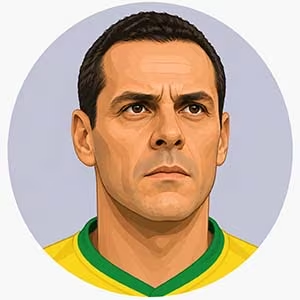
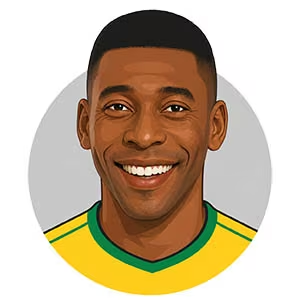
Brazil - GoalkeeperGilmar
Before Gilmar became the goalkeeper behind Santos’s greatest years, Corinthians had already decided that he might be part of the problem. He had joined the club in 1951 and won major titles, but the relationship deteriorated after a sequence of poor results late in the decade. Defeats were increasingly attributed to him, supporters questioned his performances and the club eventually allowed him to leave. In 1961 he crossed to Santos. The supposed declining goalkeeper then became the defensive reference of a team that won consecutive Copa Libertadores and Intercontinental Cups while he remained Brazil’s first choice. The sequence matters more than the later image of permanent serenity. Gilmar experienced a direct collapse in institutional confidence and emerged not by proving publicly that criticism could not affect him, but by rebuilding his sporting legitimacy in another environment.
Gilmar was a goalkeeper whose technique emphasised positioning, handling and economy of intervention. At approximately 1.81 metres he was not physically enormous, so early adjustment to the trajectory of the ball reduced the amount of goal he subsequently needed to cover. He caught cleanly when possible, controlled rebounds and possessed quick enough reactions to correct situations his positioning had not already solved. His movement was measured rather than spectacular, but describing him as permanently attached to the six-yard box goes too far. Contemporary Brazilian goalkeeping already required intervention on crosses and judgement about when to leave the line; Gilmar’s distinction was more plausibly the economy with which he made those decisions. Distribution similarly should not be retrofitted into modern build-up terminology. He could restart possession accurately and avoid unnecessary clearance, but surviving evidence does not justify treating him as a goalkeeper-playmaker. His value was primarily the reduction of defensive volatility. Across three World Cups he played every match of Brazil’s victories in 1958 and 1962 and remained first choice into the 1966 tournament, while at Santos he operated behind an extraordinarily attacking side without requiring their risk to transform his own goalkeeping into permanent emergency.
There were meaningful limits. Gilmar lacked the reach and physical dominance of larger goalkeepers, leaving less margin when positioning failed or when high deliveries became direct aerial contests. His preference for controlled intervention also offered less value in systems requiring the goalkeeper to defend enormous spaces aggressively beyond the penalty area. He was not a prototype modern sweeper-keeper, but neither should that become an anachronistic criticism: the tactical structures of his period did not ask the position to operate continuously as an additional defender in possession. Age eventually affected reactions and mobility, and Brazil’s 1966 World Cup demonstrated that experience could not stabilise a team whose collective structure had deteriorated dramatically. Gilmar conceded three against Hungary and three against Portugal as the defending champions were eliminated in the group stage. There is insufficient evidence to interpret those results as his psychological collapse; they are better evidence of the boundary of goalkeeper influence when the defensive environment itself loses control.
Psychologically, Gilmar is best defined by **non-defensive response to scapegoating combined with role stability**. The Corinthians rupture supplies unusually useful evidence because goalkeeper criticism is inherently personal: one position can be isolated visually from collective failure more easily than almost any other. Gilmar was increasingly blamed during the club’s decline and ultimately moved to Santos rather than winning back his status where he had established himself. Yet the subsequent response was competitive reconstruction rather than a documented campaign of public retaliation against former teammates, supporters or directors. That does not prove criticism left him emotionally untouched; the evidence does not permit such a claim. It demonstrates that loss of institutional trust did not permanently alter his willingness to occupy the same exposed role. At Santos and with Brazil, teammates repeatedly described the security produced by his presence, but that should be treated as an interpersonal effect rather than proof of internal serenity. His leadership was less theatrically confrontational than that of some goalkeepers, yet evidence is insufficient to score low vocal communication as a defining trait. Likewise, systematic referee conflict, retaliatory aggression and teammate-directed blame are poorly documented and should remain unknown. The stronger distinction is narrower: **when a football environment turned collective decline into a judgement on his personal reliability, Gilmar did not need to defeat that judgement rhetorically; he allowed continued performance in another environment to replace it**.