We use Google Analytics to understand how visitors use this site. Analytics cookies are only activated with your consent. For details, read our Privacy Policy.
Profile lensThe same player, read from a different angle.
Athletic81
Acceleration
81
Pace
78
Agility
81
Strength
83
Balance
75
Jumping
78
Stamina
88
Fitness
87
Technical81
Dribbling
82
Short Passing
85
Long Passing
79
Finishing
71
Shot Accuracy
70
Shot Power
84
Shooting Technique
78
Heading
76
Tackling
83
Crossing
72
Free Kick
64
Penalties
68
First Touch
83
Mental88
Composure
88
Aggression
85
Consistency
87
Creativity
81
Leadership
89
Work Rate
92
Tactical82
Vision
82
Off the Ball
68
Defensive Positioning
80
Teamwork
91
Anticipation
84
Marking
73
Attacking71
Crossing
72
Finishing
71
Heading Accuracy
76
Shot Accuracy
70
Off the Ball
68
Technique79
Dribbling
82
Free Kick
64
Short Passing
85
Long Passing
79
First Touch
83
Shot Technique
78
Movement79
Acceleration
81
Pace
78
Agility
81
Balance
75
Physicality84
Shot Power
84
Jumping
78
Stamina
88
Strength
83
Fitness
87
Defending79
Marking
73
Tackling
83
Def. Positioning
80
Mentality & Game Reading85
Aggression
85
Composure
88
Penalties
68
Vision
82
Leadership
89
Work Rate
92
Teamwork
91
Anticipation
84
Consistency
87
Creativity
81
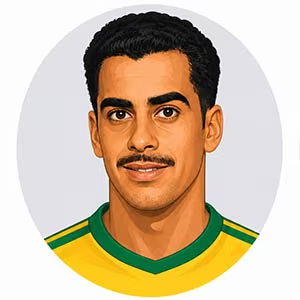
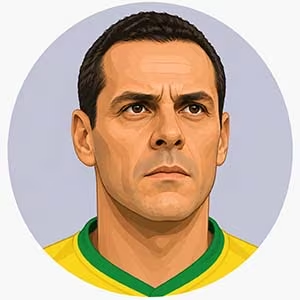
Brazil - Defensive MidfielderZito
Long before the world was dazzled by the incandescent teenage brilliance of Pelé or the magical dribbles of Pepe and Coutinho, an iron-willed midfield general named José Ely de Miranda laid down the tactical foundation upon which the greatest club side in history was built. Known universally and simply as O Gerente (The Manager), Zito served as the tactical engine room, protective shield, and undisputed moral authority for Santos and the Brazilian national team across the 1950s and 1960s. Operating as a tireless, deep-lying defensive midfielder, Zito was the master of balance: breaking up opposition counter-attacks with razor-sharp positional interceptions, winning physical battles on heavy pitches, and instantly recycling possession with crisp, unpretentious short passes to the creative artists ahead of him. His lung-busting stamina allowed him to cover vast swathes of grass while occasionally pushing forward into the box, most famously demonstrated when he scored a crucial header in the 1962 World Cup final against Czechoslovakia to secure back-to-back world titles for the Seleção, sitting alongside his two Copa Libertadores and two Intercontinental Cup triumphs with Santos.
Mentally and emotionally, Zito was an uncompromising, vocal patriarch whose leadership was both absolute and non-negotiable. While the world marveled at the flair of Santos's golden generation, it was Zito who held the whip hand—constantly barking orders, grabbing teammates by their shirts if their tracking back was deficient, and famously reprimanding even Pelé on the pitch whenever the young king attempted an unnecessary trick instead of an efficient pass. Inside the dressing room, he was the undisputed conscience of the squad, setting an iron baseline of discipline, humility, and collective responsibility that prevented superstar egos from fragmenting the team. Under maximum tournament pressure, such as the brutal away legs of the Intercontinental Cup against Benfica and AC Milan, his courage was total; he absorbed heavy physical targeting without flinching, using high-friction moments to elevate his own tactical aggression and rally his teammates. Toward referees and opposing hard-men, Zito presented a fierce, intimidating presence, fighting tooth and nail for every 50-50 ball with raw competitive venom, yet he commanded universal reverence across South America for his incorruptible sporting honesty and his lifelong eye for talent—having personally discovered and championed both Pelé and, decades later, a young Neymar for Santos.