We use Google Analytics to understand how visitors use this site. Analytics cookies are only activated with your consent. For details, read our Privacy Policy.
Profile lensThe same player, read from a different angle.
Athletic80
Acceleration
79
Pace
74
Agility
79
Strength
74
Balance
77
Jumping
82
Stamina
87
Fitness
88
Technical77
Dribbling
77
Short Passing
80
Long Passing
74
Finishing
66
Shot Accuracy
65
Shot Power
77
Shooting Technique
73
Heading
75
Tackling
79
Crossing
66
Free Kick
68
Penalties
66
First Touch
80
Mental83
Composure
78
Aggression
85
Consistency
85
Creativity
69
Leadership
85
Work Rate
87
Tactical79
Vision
75
Off the Ball
68
Defensive Positioning
79
Teamwork
88
Anticipation
82
Marking
78
Attacking68
Crossing
66
Finishing
66
Heading Accuracy
75
Shot Accuracy
65
Off the Ball
68
Technique75
Dribbling
77
Free Kick
68
Short Passing
80
Long Passing
74
First Touch
80
Shot Technique
73
Movement77
Acceleration
79
Pace
74
Agility
79
Balance
77
Physicality82
Shot Power
77
Jumping
82
Stamina
87
Strength
74
Fitness
88
Defending79
Marking
78
Tackling
79
Def. Positioning
79
Mentality & Game Reading80
Aggression
85
Composure
78
Penalties
66
Vision
75
Leadership
85
Work Rate
87
Teamwork
88
Anticipation
82
Consistency
85
Creativity
69
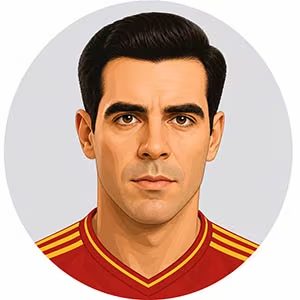
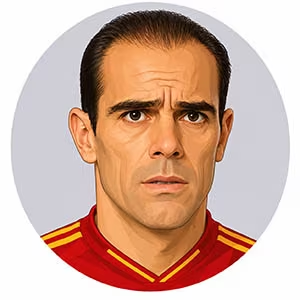
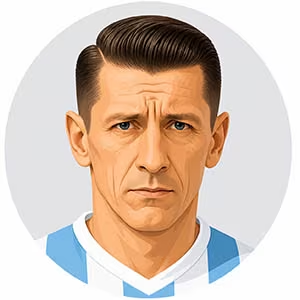
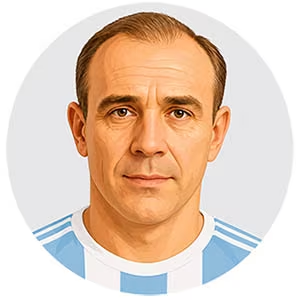
Spain - Defensive MidfielderZarraga, José Maria
Born in Bilbao in 1930, Zárraga was a defensive midfielder in the purest destructive sense, a wing-half whose entire function was to intercept, recover and redistribute simply, freeing the players ahead of him to operate without defensive obligation. He was not a technician in the mould of his more celebrated teammates, and he never needed to be; his value lay in positioning, work rate and a willingness to do the repetitive, unglamorous defensive work that a team built around Di Stéfano's total freedom of movement required structurally. He joined Real Madrid's youth system as a teenager and broke into the first team in the early 1950s, becoming a fixture of the side across its greatest period. He won five consecutive European Cups from 1956 to 1960, and multiple Spanish league titles, appearing in all five European Cup finals of that historic run — a distinction shared by very few players in the club's history. His Spain caps remained modest relative to his sustained club success, a consequence of Real Madrid's midfield being assessed at the time primarily through its attacking output rather than its defensive foundation.
His limitations followed directly from the definition of his role. Zárraga offered essentially nothing in an attacking sense, rarely advancing beyond his defensive function, and his individual technical output was modest by comparison to nearly every other player in that Real Madrid side. In a team increasingly built around individual brilliance further forward, his contribution was structurally undervalued by contemporary observers, who had limited vocabulary for describing what a purely functional midfielder contributed to a side dominated by attacking superstars. Against opponents who neutralized Real Madrid's attacking players directly, the team had comparatively little else to fall back on, since Zárraga's game was not designed to generate chances independently.
Temperamentally he appears, from the available record, to have been exactly what his role demanded: unassuming, disciplined and entirely without the need for individual recognition that his attacking teammates commanded as a matter of course. He is not associated with any documented conflict with coaches, teammates or officials across a decade at the pinnacle of European football, a career notable for its complete absence of controversy in an era when a functional destroyer playing behind two of the greatest attacking players in history received almost no public attention regardless of his consistency. He accepted, by every indication available, a role that guaranteed him a smaller share of the glory his team produced, appearing in the same finals as Di Stéfano and Puskás without ever approaching their fame. Away from the pitch, his profile after retirement remained low, consistent with a player whose identity was built entirely around service to a collective structure rather than individual visibility. Steady, unheralded and structurally essential, Zárraga occupied the same role for the greatest club side of his century that history would later assign, with more documentation, to players like Boghossian and Gilberto Silva for their own generations.