We use Google Analytics to understand how visitors use this site. Analytics cookies are only activated with your consent. For details, read our Privacy Policy.
Profile lensThe same player, read from a different angle.
Athletic80
Acceleration
77
Pace
77
Agility
84
Strength
65
Balance
86
Jumping
70
Stamina
90
Fitness
90
Technical87
Dribbling
88
Short Passing
97
Long Passing
90
Finishing
74
Shot Accuracy
77
Shot Power
73
Shooting Technique
88
Heading
64
Tackling
68
Crossing
88
Free Kick
85
Penalties
74
First Touch
93
Mental88
Composure
94
Aggression
65
Consistency
90
Creativity
88
Leadership
82
Work Rate
82
Tactical87
Vision
94
Off the Ball
83
Defensive Positioning
68
Teamwork
97
Anticipation
80
Marking
55
Player Traits
Attacking77
Crossing
88
Finishing
74
Heading Accuracy
64
Shot Accuracy
77
Off the Ball
83
Technique90
Dribbling
88
Free Kick
85
Short Passing
97
Long Passing
90
First Touch
93
Shot Technique
88
Movement81
Acceleration
77
Pace
77
Agility
84
Balance
86
Physicality78
Shot Power
73
Jumping
70
Stamina
90
Strength
65
Fitness
90
Defending64
Marking
55
Tackling
68
Def. Positioning
68
Mentality & Game Reading85
Aggression
65
Composure
94
Penalties
74
Vision
94
Leadership
82
Work Rate
82
Teamwork
97
Anticipation
80
Consistency
90
Creativity
88
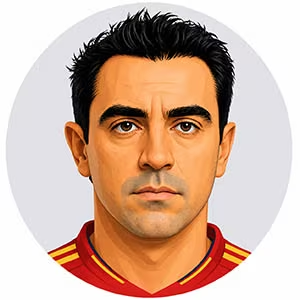
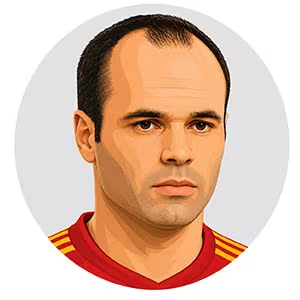
Spain - Centre MidfielderXavi
Johannesburg, 11 July 2010, the World Cup final. Spain had 57% of the ball, attempted more than six hundred passes, and won 1–0 in the 116th minute. Xavi Hernández played 136 of those passes himself, almost none of them longer than twenty metres, almost none of them memorable, and every single one of them moving the Dutch defensive block a few centimetres out of shape. He had been doing exactly this for a decade, in a sport that had spent a century believing midfielders should do something more visible.
Born in Terrassa in 1980, Xavi entered La Masia at eleven and became the most influential midfielder of the modern era. At 1.70m he was slight, slow in a straight line, and physically unremarkable, and he built everything on two things: continuous, obsessive scanning — turning his head before receiving, several times per possession — and a first touch that oriented the ball away from pressure before the presser arrived. His passing was short, incisive and weighted to the receiver's stride, and his signature turn to shield the ball in congested central areas allowed him to survive in spaces where no space existed. He made 767 appearances for Barcelona, a club record until Messi passed it, and won eight La Liga titles, four Champions Leagues and three Copas del Rey, including the 2009 sextuple under Pep Guardiola. For Spain he collected 133 caps and won the 2008 European Championship, where he was named player of the tournament, the 2010 World Cup and the 2012 European Championship — the only sequence of three consecutive major titles in international football history. He closed his career at Al Sadd in Qatar.
His limitations were physical and were exploited by anyone who understood them. Xavi offered almost nothing defensively in individual terms: he did not tackle, could not cope with strong runners in transition, and depended on Sergio Busquets behind him and on a collective press to compensate. He was ineffective in matches that became physical and vertical rather than positional, and sides that pressed him aggressively in his own half — Chelsea in 2012, Inter in 2010, José Mourinho's Real Madrid on their better nights — reduced his influence substantially, forcing sideways possession without penetration. He scored and assisted less than his standing suggests, since his contribution occurred two or three passes before the decisive one, and in teams less technically capable than Barcelona and Spain his method simply did not function.
Mentally he was an uncompromising purist who treated possession not as a strategy but as a moral position. He led through relentless verbal instruction and positioning, directing teammates with short commands and hand gestures to maintain passing triangles, and inside the dressing room he built an intense, ideological camaraderie with his midfield partners, acting as the bridge between the senior squad and the academy graduates arriving behind him. Chaotic matches did not unsettle him and aggressive pressing produced no visible panic; his tempo in a Champions League final was indistinguishable from his tempo in training. Towards everything outside that circle he was dogmatic and frequently ungenerous: he dismissed low-block and defensive tactics as illegitimate football, and attributed unfavourable results to pitches, referees or opponents' cynicism rather than to flaws in his own side's system. His relationship with officials was one of persistent tactical pressure — he led teammates in surrounding referees to protest physical fouls and to control the timing of restarts, a habit that sat uncomfortably beside the purity he preached. His professional discipline was extreme, his training rigour meticulous, and his disciplinary record exceptionally clean, since he defended by anticipation rather than contact. Away from the pitch he was serious, articulate and entirely without scandal, and he carried the same ideological rigidity into management, where it produced both a Spanish title and a visible inability to adapt when the method stopped working. Certain, controlled and impossible to argue with, Xavi won everything by refusing, for twenty years, to consider that there might be another way to play.