We use Google Analytics to understand how visitors use this site. Analytics cookies are only activated with your consent. For details, read our Privacy Policy.
Profile lensThe same player, read from a different angle.
Athletic78
Acceleration
73
Pace
74
Agility
78
Strength
75
Balance
88
Jumping
68
Stamina
87
Fitness
81
Technical90
Dribbling
92
Short Passing
94
Long Passing
99
Finishing
77
Shot Accuracy
77
Shot Power
86
Shooting Technique
91
Heading
67
Tackling
72
Crossing
91
Free Kick
94
Penalties
90
First Touch
95
Mental85
Composure
98
Aggression
65
Consistency
82
Creativity
90
Leadership
77
Work Rate
75
Tactical88
Vision
97
Off the Ball
83
Defensive Positioning
67
Teamwork
96
Anticipation
81
Marking
60
Player Traits
Attacking79
Crossing
91
Finishing
77
Heading Accuracy
67
Shot Accuracy
77
Off the Ball
83
Technique94
Dribbling
92
Free Kick
94
Short Passing
94
Long Passing
99
First Touch
95
Shot Technique
91
Movement78
Acceleration
73
Pace
74
Agility
78
Balance
88
Physicality79
Shot Power
86
Jumping
68
Stamina
87
Strength
75
Fitness
81
Defending66
Marking
60
Tackling
72
Def. Positioning
67
Mentality & Game Reading85
Aggression
65
Composure
98
Penalties
90
Vision
97
Leadership
77
Work Rate
75
Teamwork
96
Anticipation
81
Consistency
82
Creativity
90
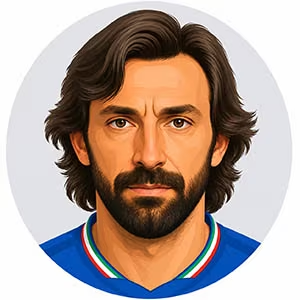
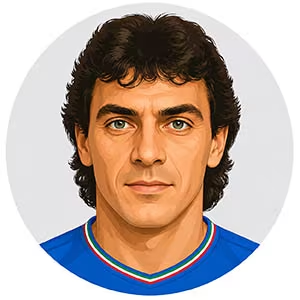
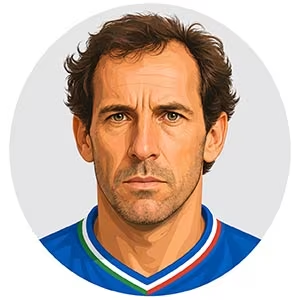
Italy - Centre MidfielderPirlo, Andrea
Andrea Pirlo often appeared to receive the ball as if the surrounding urgency belonged to somebody else. The impression came partly from movement: short steps, upright posture, little wasted acceleration, then a pass travelling forty metres while opponents were still closing the space around him. At Kyiv on 24 June 2012, Italy and England reached a penalty shoot-out after 120 minutes. Italy were behind in the sequence when Pirlo approached Joe Hart. The goalkeeper had been moving aggressively along his line, attempting to intimidate the takers. Pirlo chipped the penalty gently through the centre. He later explained that the decision was not a prearranged exhibition of nerve: he saw Hart’s behaviour, judged that the goalkeeper needed to be brought down from his confidence and selected the Panenka accordingly. Italy scored its remaining penalties while England missed twice. What looked like detachment was therefore active interpretation. Pirlo was not outside the psychological pressure of the situation; he was still collecting information from inside it.
Pirlo became a regista only after beginning senior football much higher up the pitch. At Brescia and early in his career he was considered a number ten, but Carlo Mazzone and subsequently Carlo Ancelotti recognised that his vision could become more influential from deeper positions where he faced the entire field. From there Pirlo could receive from defenders, manipulate the first presser with body orientation and alter the point of attack through long diagonal passes. His lofted balls behind defensive lines were especially dangerous because identical preparation could produce either circulation or penetration. Set pieces added another source of progression and goals: free kicks, corners and penalties all benefited from exceptional control of contact. At Milan he operated within midfields that supplied much of the running and defensive confrontation around him, winning two Champions Leagues and two Serie A titles. Juventus later reconstructed a similar platform around him after Milan allowed his contract to expire in 2011, and Pirlo immediately became central to four consecutive league championships. Italy used the same organising capacity throughout the 2006 World Cup and again during the run to the Euro 2012 final.
His limitations were real and structurally important. Pirlo lacked recovery speed and could be exposed badly when possession was lost with large spaces around him. He was positionally intelligent and capable of intercepting, but he was not a defensive midfielder designed to extinguish repeated transitions through athletic coverage or physical tackling. Teams maximised him by providing runners and ball-winners capable of protecting the zones his role could not cover alone. Intense man-oriented pressure could also reduce his influence if opponents prevented him from receiving with enough orientation to access the next pass; denying Pirlo the ball was often more productive than challenging him after he had already seen the field. Age amplified those vulnerabilities even while passing quality remained. Nor was his apparently relaxed style evidence that concentration never fluctuated. His low running intensity could visually resemble disengagement when his passing influence disappeared, but the defensible limitation is tactical rather than psychological: without access to possession, Pirlo possessed fewer alternative mechanisms for imposing himself than a midfielder capable of compensating through athletic ball-winning or repeated carrying.
Psychologically, Pirlo is best defined by **pressure treated as information rather than pressure denied**. His own accounts repeatedly contradict the idea that major matches left him emotionally untouched. Before the 2006 World Cup final he described sleeping and distracting himself rather than inhabiting some permanent state of competitive meditation; his autobiography frequently uses humour precisely when discussing situations carrying enormous tension. The 2012 Panenka supplies the cleaner behavioural evidence. Pirlo observed Hart’s escalating confidence, altered his penalty accordingly and later said that the successful kick helped shift pressure back towards England. The action was therefore both execution and intervention in the emotional structure of the shoot-out. His response to the 2005 Champions League final provides the necessary counterweight. Milan’s collapse from 3–0 against Liverpool affected him deeply enough that he later described questioning whether he wanted to continue playing. That is incompatible with “unshakeable calmness”; catastrophic defeat could penetrate far beyond the final whistle. Yet he returned the following season and two years later helped Milan win the same competition. Evidence for retaliatory aggression, chronic referee confrontation or teammate-directed blame is weak. Pirlo’s behavioural signature is narrower and more useful: **pressure could affect him strongly, but while the contest remained active he retained enough observational bandwidth to treat the pressure itself—his own situation, the opponent’s behaviour, the changing emotional balance—as another variable from which a football decision could be constructed**.