We use Google Analytics to understand how visitors use this site. Analytics cookies are only activated with your consent. For details, read our Privacy Policy.
Profile lensThe same player, read from a different angle.
Athletic81
Acceleration
77
Pace
82
Agility
82
Strength
83
Balance
87
Jumping
74
Stamina
81
Fitness
78
Technical93
Dribbling
91
Short Passing
97
Long Passing
96
Finishing
87
Shot Accuracy
85
Shot Power
91
Shooting Technique
89
Heading
73
Tackling
41
Crossing
87
Free Kick
86
Penalties
89
First Touch
93
Mental81
Composure
88
Aggression
77
Consistency
77
Creativity
90
Leadership
80
Work Rate
76
Tactical89
Vision
96
Off the Ball
87
Defensive Positioning
45
Teamwork
91
Anticipation
82
Marking
38
Player Traits
Attacking84
Crossing
87
Finishing
87
Heading Accuracy
73
Shot Accuracy
85
Off the Ball
87
Technique92
Dribbling
91
Free Kick
86
Short Passing
97
Long Passing
96
First Touch
93
Shot Technique
89
Movement82
Acceleration
77
Pace
82
Agility
82
Balance
87
Physicality81
Shot Power
91
Jumping
74
Stamina
81
Strength
83
Fitness
78
Defending41
Marking
38
Tackling
41
Def. Positioning
45
Mentality & Game Reading85
Aggression
77
Composure
88
Penalties
89
Vision
96
Leadership
80
Work Rate
76
Teamwork
91
Anticipation
82
Consistency
77
Creativity
90
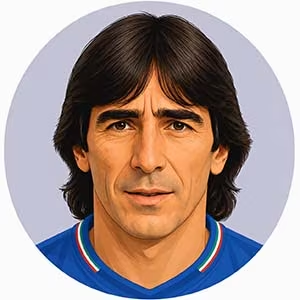
Italy - Attacking MidfielderTotti, Francesco
Francesco Totti rarely needed to run faster than the defender if he could make the defender move first. He received with his back to goal, absorbed contact through a powerful upper body and delayed the next touch until an opponent revealed which space he intended to protect. Then the ball could disappear somewhere else: a first-time pass around the corner, a disguised vertical delivery, a heel touch or the chipped finish that became so associated with him that in Italy the gesture itself acquired his name. His football was built around manipulating expectation. At Roma this eventually allowed several different versions of Totti to coexist across the same career: young attacking midfielder, roaming second striker, advanced playmaker and, under Luciano Spalletti, a nominal centre-forward who vacated the conventional striker’s space and attacked it again after defenders had followed him away.
Technically, Totti combined exceptional vision with strength in possession, shooting range and unusually fast execution once the passing solution appeared. He could receive between lines and turn, but was equally dangerous playing first-time because he often identified the next action before possession reached him. His passing included disguised short combinations, long diagonals and vertical balls delivered with minimal preparation. Around goal he could finish powerfully with either foot, place shots from distance or use the chip when the goalkeeper advanced. Spalletti’s 2005–06 conversion into a false nine concentrated these qualities by reducing the amount of long running required while giving Totti continuous access to central combinations and finishing zones. He responded with the European Golden Shoe in 2006–07 after scoring 26 Serie A goals. Across 786 competitive Roma appearances he scored 307 times, winning the 2001 Scudetto and becoming both the club’s record appearance-maker and scorer. Italy used him more selectively across 58 internationals, with his creative contribution remaining important during the 2006 World Cup despite arriving after a severe ankle injury.
His limitations changed with age but were real. Totti possessed good acceleration when young but was never primarily a long-distance speed forward, and declining mobility increasingly reduced his ability to contribute away from possession. His defensive work rate was variable rather than literally zero; nevertheless, systems demanding sustained pressing, repeated recovery runs or rigid wide defensive occupation sacrificed much of what made him exceptional. His greatest value required central access and enough freedom to interpret where the next attacking connection should occur. This could create structural cost because teammates had to compensate when he abandoned a nominal position or contributed less defensive running. Physical availability also became increasingly important later in his career. The 2006 ankle fracture required accelerated rehabilitation before the World Cup, while subsequent knee and muscular problems reduced continuity. His longevity therefore depended partly on moving the game towards his remaining advantages: first-touch creation, body protection, shooting and anticipation rather than repeated athletic movement.
Psychologically, Totti is best defined by **identity-fused responsibility combined with genuine provocation-reactive aggression**. Roma was not merely an institution he represented: remaining at the club despite opportunities to leave progressively fused his personal status with the team’s competitive identity. That increased his willingness to absorb responsibility—captaincy, penalties, creative centrality and public accountability—but also raised the emotional stakes of conflict around his role. His relationship with Spalletti demonstrates both sides. Totti accepted one of the most radical tactical reinterpretations of his career under the coach and produced exceptional football, showing that strong identity did not imply positional rigidity. Years later, when reduced playing time made him feel marginalised, the relationship deteriorated publicly and Totti explicitly challenged his treatment. Provocation on the pitch could produce a more immediate loss of regulation. At Euro 2004 he spat at Christian Poulsen after sustained antagonism and received a three-match suspension; in the 2010 Coppa Italia final he kicked Mario Balotelli from behind and was sent off, later acknowledging that the action was deliberate while describing accumulated provocation. These episodes cannot be softened into competitive intensity: emotional aggression directly produced disciplinary and availability costs. Yet neither episode demonstrates general pressure fragility. Totti continued taking decisive penalties, including the stoppage-time kick against Australia at the 2006 World Cup shortly after returning from major injury. His contradiction is therefore unusually sharp: **the deeper Totti felt personally invested in the meaning of a contest or relationship, the more responsibility he could absorb—but personalisation also increased the probability that provocation or perceived rejection would escape the boundaries of functional competition**.