We use Google Analytics to understand how visitors use this site. Analytics cookies are only activated with your consent. For details, read our Privacy Policy.
Profile lensThe same player, read from a different angle.
Athletic88
Acceleration
87
Pace
91
Agility
87
Strength
92
Balance
90
Jumping
94
Stamina
88
Fitness
77
Technical87
Dribbling
89
Short Passing
90
Long Passing
86
Finishing
86
Shot Accuracy
83
Shot Power
90
Shooting Technique
88
Heading
91
Tackling
73
Crossing
83
Free Kick
80
Penalties
82
First Touch
87
Mental83
Composure
82
Aggression
87
Consistency
84
Creativity
82
Leadership
84
Work Rate
80
Tactical89
Vision
87
Off the Ball
88
Defensive Positioning
68
Teamwork
93
Anticipation
87
Marking
67
Player Traits
Attacking86
Crossing
83
Finishing
86
Heading Accuracy
91
Shot Accuracy
83
Off the Ball
88
Technique87
Dribbling
89
Free Kick
80
Short Passing
90
Long Passing
86
First Touch
87
Shot Technique
88
Movement89
Acceleration
87
Pace
91
Agility
87
Balance
90
Physicality88
Shot Power
90
Jumping
94
Stamina
88
Strength
92
Fitness
77
Defending69
Marking
67
Tackling
73
Def. Positioning
68
Mentality & Game Reading85
Aggression
87
Composure
82
Penalties
82
Vision
87
Leadership
84
Work Rate
80
Teamwork
93
Anticipation
87
Consistency
84
Creativity
82
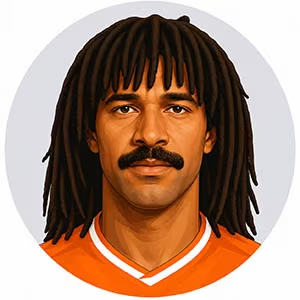
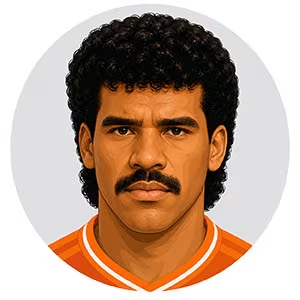
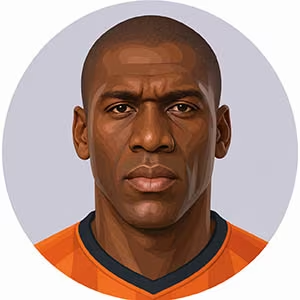
Netherlands - Attacking MidfielderGullit, Ruud
At Munich’s Olympiastadion on 25 June 1988, the Netherlands were leading the Soviet Union 1–0 in the European Championship final when Ruud Gullit received the trophy as captain. Earlier he had opened the scoring by attacking Marco van Basten’s cross and heading powerfully beyond Rinat Dasaev. The goal came after a tournament in which Gullit had not needed to dominate possession to dominate the structure around it: he could begin centrally, move towards the forwards, press, carry through contact and then appear inside the penalty area as the physically strongest attacker. One year later, after knee surgery had threatened his availability, he returned in time for Milan’s European Cup final against Steaua București and scored twice in a 4–0 victory. These moments helped create the image of effortless supremacy, but the underlying mechanism was less romantic. Gullit repeatedly accepted substantial changes in what the team required from him, provided those changes still left him meaningful agency inside the game.
Gullit’s physical range made unusual tactical combinations possible. At approximately 1.90 metres he possessed the strength and aerial ability of a centre-forward but could accelerate, carry and combine like a much smaller attacking midfielder. Earlier in his career he had played deeper roles, including sweeper and midfield positions, before Feyenoord and PSV increasingly moved him towards attack. At Milan, Arrigo Sacchi exploited that breadth rather than assigning him one static identity. Gullit could drop to connect midfield, attack channels, press defenders, carry vertically and then become the target inside the penalty area. His technique supported the athleticism: secure control while running, powerful shooting, heading, combination play and long passing made him dangerous before and after defensive lines were broken. Under the Netherlands’ 1988 structure he operated as captain and attacking reference without functioning as a conventional fixed striker. Later, at Sampdoria and Chelsea, he demonstrated further tactical adaptation as athletic dominance declined, eventually operating deeper and even returning to defensive responsibilities. His completeness was therefore developmental rather than simultaneous perfection at every position.
There were significant limits. Gullit’s enormous athletic range encouraged teams to ask him to solve many different problems, but versatility did not mean that every assignment extracted equal value. His influence was greatest when he could move dynamically between lines and attack space; highly static positioning reduced the advantage created by carrying, physical superiority and late arrival. Recurrent knee injuries became the defining physical constraint of his peak years. Surgery interrupted the 1988–89 season, further problems restricted him severely afterwards, and the explosive player who had arrived in Italy could not simply preserve the same running volume indefinitely. Milan’s increasingly crowded foreign-player hierarchy created another limitation unrelated to technical ability. Under Fabio Capello, selection among Gullit, Marco van Basten, Frank Rijkaard and later other foreign players meant that tactical contribution became entangled with institutional status. Gullit could adapt positionally, but adaptation became harder when he no longer understood whether the structure genuinely contained a role for him. That distinction is crucial: positional flexibility was exceptionally high; tolerance for indefinite functional ambiguity was not.
Psychologically, Gullit is best defined by **autonomy-preserving adaptability**. His career repeatedly shows willingness to change function without surrendering the expectation that his function remain meaningful. Sacchi could demand intense pressing, tactical discipline and movements far removed from free-form attacking football, yet Gullit later spoke with enormous respect for what Sacchi taught him. Strong structure itself was therefore not the problem. Under Capello the relationship became more difficult as Gullit’s selection and role became less secure. In 1993 he left for Sampdoria, where Sven-Göran Eriksson restored both responsibility and attacking freedom; Gullit responded with a major revival and scored against Milan in Sampdoria’s victory over his former club. He later returned to Milan but departed again when the arrangement failed to provide the role he expected. This is not generic ego or resistance to competition. Gullit had already survived tactical discipline, injury-driven adaptation and elite competition for places. The trigger was more specific: flexibility remained productive while he retained interpretative ownership inside the new function. His captaincy with the Netherlands also should not be converted automatically into emotional dominance. Gullit was publicly expressive and willing to speak on matters beyond football, but evidence for systematic referee conflict, retaliatory aggression or teammate-directed blame is insufficient. His strongest behavioural contradiction is cleaner: **he could change almost everything about where he played, but was far less willing to become merely an interchangeable piece whose purpose was defined without meaningful participation from him**.