We use Google Analytics to understand how visitors use this site. Analytics cookies are only activated with your consent. For details, read our Privacy Policy.
Profile lensThe same player, read from a different angle.
Athletic86
Acceleration
92
Pace
88
Agility
91
Strength
80
Balance
94
Jumping
85
Stamina
81
Fitness
77
Technical93
Dribbling
98
Short Passing
91
Long Passing
90
Finishing
88
Shot Accuracy
86
Shot Power
87
Shooting Technique
93
Heading
78
Tackling
54
Crossing
91
Free Kick
92
Penalties
89
First Touch
99
Mental86
Composure
85
Aggression
86
Consistency
83
Creativity
99
Leadership
98
Work Rate
74
Tactical88
Vision
92
Off the Ball
86
Defensive Positioning
50
Teamwork
85
Anticipation
87
Marking
33
Player Traits
Attacking86
Crossing
91
Finishing
88
Heading Accuracy
78
Shot Accuracy
86
Off the Ball
86
Technique94
Dribbling
98
Free Kick
92
Short Passing
91
Long Passing
90
First Touch
99
Shot Technique
93
Movement91
Acceleration
92
Pace
88
Agility
91
Balance
94
Physicality82
Shot Power
87
Jumping
85
Stamina
81
Strength
80
Fitness
77
Defending46
Marking
33
Tackling
54
Def. Positioning
50
Mentality & Game Reading88
Aggression
86
Composure
85
Penalties
89
Vision
92
Leadership
98
Work Rate
74
Teamwork
85
Anticipation
87
Consistency
83
Creativity
99
Curated interpretation
Signature Moves
Role-defining patterns—not attributes, traits or Inner Game measures. Three ways Diego Maradona changes the meaning of the role around him.
01
Emotional Gravity
The match begins to orbit his presence. Teammates, opponents and the crowd are drawn into the emotional field he creates.
02
Beautiful Disobedience
He turns irreverent, unorthodox or apparently wrong solutions into a football advantage.
03
Giant’s Reckoning
Against powers, favourites and symbolically larger opponents, he tends to raise the scale of his performance.
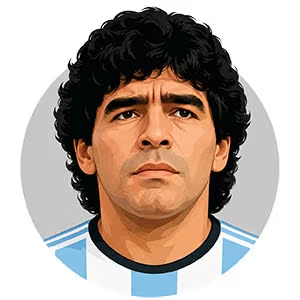
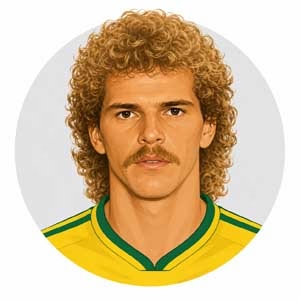
Argentina - Attacking MidfielderMaradona, Diego
Mexico City, 22 June 1986, four minutes that contain the entire man. First a punched goal, concealed from the referee and celebrated with theatrical innocence. Then sixty metres carrying the ball past five England players and the goalkeeper, at altitude, in thirty-degree heat, in a quarter-final against the country Argentina had gone to war with four years earlier. Cunning and sublimity, delivered consecutively, neither cancelling the other. Diego Armando Maradona spent his whole life being two things at once, and never once apologised for either of them.
Born in 1960 in Villa Fiorito, a shantytown on the southern edge of Buenos Aires, he was the greatest transformer of ordinary teams the sport has produced. At 1.65m, thick-legged and impossibly low to the ground, he combined a left foot of unmatched touch with balance that made him almost impossible to knock over and acceleration in the first three metres that no defender of his era could match. He was a hybrid between attacking midfielder and second striker rather than a classical enganche, equally inclined to create and to finish, and he struck free kicks and penalties with the same authority. He emerged at Argentinos Juniors, moved to Boca Juniors in 1981 and won the Metropolitano immediately, then joined Barcelona in 1982, where hepatitis, a horrific ankle fracture inflicted by Andoni Goikoetxea, and a permanent conflict with the club's hierarchy ruined two seasons. Napoli signed him in 1984, and there he found the only environment that ever fully suited him: a mid-table southern club in a hostile northern league, carrying a city that identified with him completely. He delivered two Serie A titles, in 1987 and 1990 — the only ones in the club's history until 2023 — plus the 1989 UEFA Cup and the Coppa Italia. For Argentina, across 91 caps and 34 goals, he won the 1986 World Cup as the most dominant individual force any tournament has seen, and dragged a considerably weaker 1990 side to a second final.
His football was not the collective, orchestrating kind. Maradona could disappear for long stretches of a match, contributing little between moments of decisive improvisation, and he offered almost nothing defensively or in structured build-up. He was fouled constantly and the accumulated damage — the Goikoetxea injury, years of Italian man-marking, chronic ankle problems — eroded his acceleration well before he was thirty. His training discipline was erratic throughout his career, he was vocally dismissive of tactical instruction, and he required a coach willing to build a functional team around him rather than integrate him into one; when that condition was absent, as at Barcelona, the arrangement collapsed within two seasons.
He led as an intensely emotional figure who governed dressing rooms through absolute technical authority, protective affection, and open solidarity with lesser teammates — shielding colleagues from blame while publicly confronting club executives, referees, and international football authorities on their behalf. His response to high-stakes tension was uniquely confrontational: he actively sought hostile stadium atmospheres and used crowd animosity as an accelerant, playing his best football in the environments most designed to break him. Within his inner circle he displayed unyielding generosity and fierce loyalty; with referees he practised constant gamesmanship, theatrical reactions to heavy fouling, and persistent vocal pressure. His relationship with institutional rules was fundamentally transgressional, and he accumulated bookings, suspensions and confrontations across his career for unsporting play, dissent, and on-pitch altercations, including the mass brawl he initiated at the end of the 1984 Copa del Rey final against Athletic Bilbao. Two long bans, in 1991 and again after the 1994 World Cup, ended chapters of his career abruptly and left institutional relationships he never repaired. Yet his matchday reliability in elimination fixtures remained exceptionally high regardless of his physical condition or the chaos surrounding him, anchored by a lifelong attachment to Villa Fiorito and an identification with anti-establishment, underdog narratives that dictated every major sporting choice he made. He was warm, impulsive and generous with strangers, incapable of moderation in any direction, and permanently at war with somebody. Beloved and detested in equal measure, Maradona remains the only footballer whose personality was as consequential as his talent.