We use Google Analytics to understand how visitors use this site. Analytics cookies are only activated with your consent. For details, read our Privacy Policy.
Profile lensThe same player, read from a different angle.
Athletic82
Acceleration
73
Pace
82
Agility
68
Strength
92
Balance
87
Jumping
89
Stamina
84
Fitness
78
Technical78
Dribbling
72
Short Passing
76
Long Passing
77
Finishing
62
Shot Accuracy
64
Shot Power
84
Shooting Technique
62
Heading
87
Tackling
88
Crossing
64
Free Kick
60
Penalties
60
First Touch
74
Mental79
Composure
80
Aggression
84
Consistency
77
Creativity
64
Leadership
83
Work Rate
78
Tactical82
Vision
76
Off the Ball
64
Defensive Positioning
85
Teamwork
75
Anticipation
88
Marking
87
Player Traits
Attacking68
Crossing
64
Finishing
62
Heading Accuracy
87
Shot Accuracy
64
Off the Ball
64
Technique70
Dribbling
72
Free Kick
60
Short Passing
76
Long Passing
77
First Touch
74
Shot Technique
62
Movement78
Acceleration
73
Pace
82
Agility
68
Balance
87
Physicality85
Shot Power
84
Jumping
89
Stamina
84
Strength
92
Fitness
78
Defending87
Marking
87
Tackling
88
Def. Positioning
85
Mentality & Game Reading77
Aggression
84
Composure
80
Penalties
60
Vision
76
Leadership
83
Work Rate
78
Teamwork
75
Anticipation
88
Consistency
77
Creativity
64
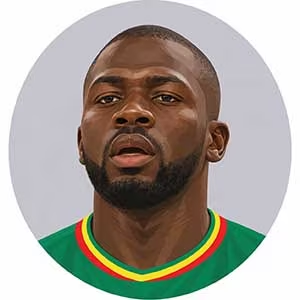
Senegal - Centre-backKoulibaly, Kalidou
Kalidou Koulibaly defended as though allowing the forward to establish possession was already a concession. Powerful enough to survive direct contact yet quick enough to step beyond the defensive line, he preferred to attack the developing action rather than wait for it to reach him. At Napoli this became one of the defining movements of his peak: follow the striker towards midfield, arrive through or around the first touch, recover the ball and immediately carry it forward with long strides before the opposition could rebuild. The method demanded enormous confidence in distance and timing. When correct, Koulibaly could remove an attack before it existed; when late, the same movement opened space behind him. His football was therefore aggressive without being merely physical. The central decision was always territorial: decide whether the defender should protect the space or leave it in order to eliminate the player threatening it.
Koulibaly combined exceptional strength with unusually good acceleration for a centre-back of his size. He could defend shoulder-to-shoulder, attack aerial balls and recover across significant distances, making him suitable both for deeper defending and for a higher line. His first seasons in Europe had already demonstrated positional flexibility: at Genk he was used not only centrally but occasionally at right-back and defensive midfield. At Napoli, however, centre-back became the position through which his technical range was fully expressed. He could receive under pressure, carry beyond the first line and play progressive passes rather than treating possession as something to remove from danger. Maurizio Sarri’s Napoli particularly exploited that capacity because defenders were required to maintain ambitious spacing while circulating quickly from the back. Koulibaly could therefore combine front-foot defending with progressive construction, while later coaches asked him to operate in structures with different levels of territorial aggression. For Senegal his responsibilities expanded further into captaincy, culminating in the country’s first Africa Cup of Nations title in 2022.
The same proactive style contained real limitations. Koulibaly could become vulnerable when several aggressive decisions had to be made consecutively without adequate protection around him: stepping forward successfully once did not guarantee that the space behind would remain covered on the second movement. His large frame and long stride also made rapid changes of direction less comfortable than straight-line recovery, particularly against smaller attackers capable of manipulating him after he had committed his weight. In possession he was progressive but not a specialist controller capable of dictating the entire first phase through passing alone. Later career environments exposed some of these margins more sharply. His single Chelsea season produced 32 appearances but never the continuity or defensive authority of his Napoli peak before he left for Al-Hilal. That should not be reduced to inability to adapt to England: age, collective instability, tactical changes and reduced athletic recovery margin all overlapped. His defending was most effective when aggression and surrounding structure reinforced one another; when teammates could not protect the space created by his interventions, the same instincts carried greater cost.
Psychologically, Koulibaly is best defined by **dignity-boundary confrontation rather than generalized emotional aggression**. The Inter–Napoli match of December 2018 provides unusually clear evidence. After being subjected to racist chanting during the game, with Napoli repeatedly asking for the match to be stopped, Koulibaly was booked for a foul and immediately received a second yellow after sarcastically applauding the referee. Carlo Ancelotti explicitly linked his unusual irritability to the abuse, while Koulibaly’s own response afterwards combined regret at leaving his teammates with a public affirmation of his identity. Three years later at Fiorentina, confronted with another racist insult after the match, he directly challenged the spectator to repeat it face-to-face. These episodes should not be converted into “poor emotional control”: the trigger is unusually specific and qualitatively different from ordinary provocation. His captaincy with Senegal shows the opposite side of the same mechanism. Before the 2022 AFCON final, after having missed the 2019 final through suspension, Koulibaly framed the opportunity in collective terms—being present to help deliver Senegal its first title—and later lifted the trophy as captain. He has also publicly disagreed with institutional statements about African internationals while separating the individual responsible from the wider club and city, demonstrating confrontation without indiscriminate generalisation. Evidence for chronic referee conflict, teammate blame or retaliation after normal football provocation is insufficient. The stronger pattern is that **Koulibaly can tolerate enormous competitive contact and responsibility without converting them into personal conflict, but when the contest crosses into an attack on dignity rather than football, his threshold for remaining silent changes sharply**.


 All-Time AfricaAfrica