We use Google Analytics to understand how visitors use this site. Analytics cookies are only activated with your consent. For details, read our Privacy Policy.
Profile lensThe same player, read from a different angle.
Athletic85
Acceleration
77
Pace
87
Agility
75
Strength
91
Balance
89
Jumping
87
Stamina
84
Fitness
93
Technical79
Dribbling
73
Short Passing
77
Long Passing
75
Finishing
66
Shot Accuracy
70
Shot Power
88
Shooting Technique
64
Heading
86
Tackling
94
Crossing
69
Free Kick
66
Penalties
60
First Touch
73
Mental88
Composure
88
Aggression
92
Consistency
94
Creativity
60
Leadership
82
Work Rate
91
Tactical85
Vision
68
Off the Ball
69
Defensive Positioning
91
Teamwork
85
Anticipation
86
Marking
95
Player Traits
Attacking72
Crossing
69
Finishing
66
Heading Accuracy
86
Shot Accuracy
70
Off the Ball
69
Technique71
Dribbling
73
Free Kick
66
Short Passing
77
Long Passing
75
First Touch
73
Shot Technique
64
Movement82
Acceleration
77
Pace
87
Agility
75
Balance
89
Physicality89
Shot Power
88
Jumping
87
Stamina
84
Strength
91
Fitness
93
Defending93
Marking
95
Tackling
94
Def. Positioning
91
Mentality & Game Reading81
Aggression
92
Composure
88
Penalties
60
Vision
68
Leadership
82
Work Rate
91
Teamwork
85
Anticipation
86
Consistency
94
Creativity
60
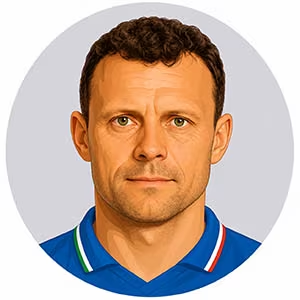
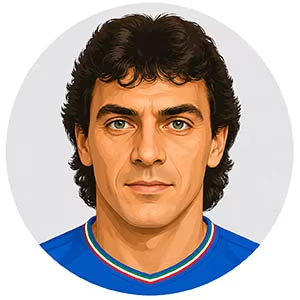
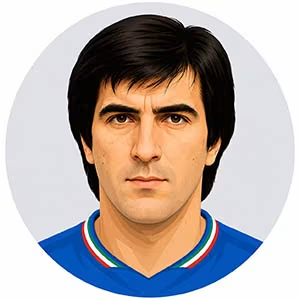
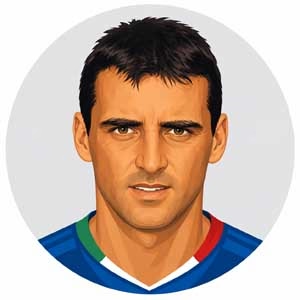
Italy - Centre-backVierchowod, Pietro
Sprint athletes in the 1980s rarely encountered a football defender who could match their pure linear velocity, but the man known universally as Lo Zar (The Tsar) turned recovery speed, raw muscular density, and suffocating man-marking into an insurmountable barrier for Como, Fiorentina, Roma, Sampdoria, Juventus, and the Italian national team. The son of a Ukrainian Red Army soldier who settled in Lombardy, Pietro Vierchowod possessed an extraordinary physical framework: granite-like pectoral and core strength, an explosive 30-meter sprint that allowed him to grant opposing strikers a five-meter head start before casually running them down, and an unyielding cardiovascular engine that never dipped across ninety minutes. His defensive craft was a masterclass in relentless physical shadowing; he did not simply track forwards, he attached himself to their hip like a shadow, suffocating their first touch with aggressive, legal upper-body contact and executing razor-sharp recovery slide tackles that swept ball and turf cleanly away. A tactical chameleon who won the historic 1982–83 Scudetto on loan at Nils Liedholm’s Roma, he became the emotional and defensive bedrock of Vujadin Boškov’s romantic Sampdoria side—claiming the 1990–91 Serie A title, the 1990 European Cup Winners' Cup, and reaching the 1992 European Cup final—before adding a UEFA Champions League crown with Juventus in 1996 at thirty-seven years of age and being part of Italy’s 1982 World Cup-winning squad. Even Diego Maradona and Marco van Basten famously named him the most difficult, relentlessly exhausting defender they ever faced in their careers.
Mentally and emotionally, Vierchowod was a Spartan warrior of monastic discipline, relentless physical pride, and total professional seriousness. He held zero interest in the modern spectacle of football celebrity, treating every Sunday afternoon like a grueling, manual shift in an iron foundry. On the pitch, his leadership was completely non-verbal; he did not scream or posture, but led through an intimidating physical presence and a standard of maximum concentration that terrified opposing strikers before the whistle even blew. Inside the dressing room, he was a quiet, deeply respected patriarch whose fanatical dedication to physical conditioning and recovery enabled him to play at the highest level past the age of forty, serving as an unshakeable point of stability in vibrant, eccentric locker rooms like Boškov's Sampdoria. Under the maximum tension of domestic title run-ins and European finals, his emotional state was cold, combative, and impervious to panic; he welcomed one-on-one open-field duels against the greatest dribblers on earth with serene confidence. Toward match officials and opposition forwards, Vierchowod operated with fierce, old-school integrity: his challenges were bone-shattering, heavy, and physically punishing right on the boundary of legality, yet he never engaged in dirty off-the-ball spitting, cynical pinching, theatrical diving, or protracted referee disputes, accepting his role as an uncompromising, honorable gladiator of Italian defending.