We use Google Analytics to understand how visitors use this site. Analytics cookies are only activated with your consent. For details, read our Privacy Policy.
Profile lensThe same player, read from a different angle.
Athletic84
Acceleration
87
Pace
86
Agility
85
Strength
84
Balance
79
Jumping
85
Stamina
84
Fitness
85
Technical85
Dribbling
82
Short Passing
76
Long Passing
78
Finishing
91
Shot Accuracy
87
Shot Power
85
Shooting Technique
94
Heading
86
Tackling
48
Crossing
73
Free Kick
77
Penalties
86
First Touch
85
Mental82
Composure
85
Aggression
85
Consistency
80
Creativity
77
Leadership
80
Work Rate
86
Tactical84
Vision
76
Off the Ball
90
Defensive Positioning
45
Teamwork
82
Anticipation
88
Marking
44
Player Traits
Attacking85
Crossing
73
Finishing
91
Heading Accuracy
86
Shot Accuracy
87
Off the Ball
90
Technique82
Dribbling
82
Free Kick
77
Short Passing
76
Long Passing
78
First Touch
85
Shot Technique
94
Movement84
Acceleration
87
Pace
86
Agility
85
Balance
79
Physicality85
Shot Power
85
Jumping
85
Stamina
84
Strength
84
Fitness
85
Defending46
Marking
44
Tackling
48
Def. Positioning
45
Mentality & Game Reading83
Aggression
85
Composure
85
Penalties
86
Vision
76
Leadership
80
Work Rate
86
Teamwork
82
Anticipation
88
Consistency
80
Creativity
77
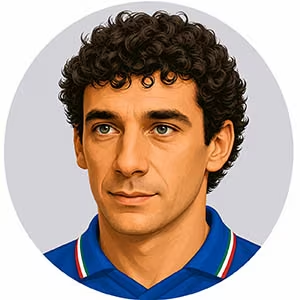
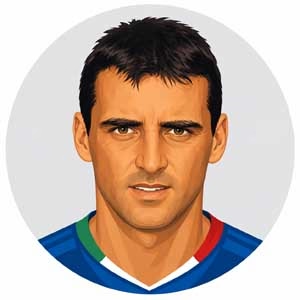
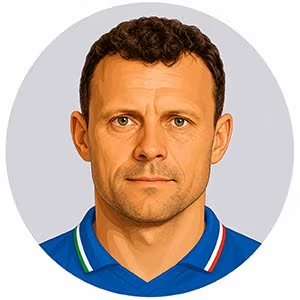
Italy - StrikerVialli, Gianluca
The Stadio Luigi Ferraris in Genoa in May 1991 belonged to an irrepressible, acrobatic forward who led Sampdoria to their historic, mythic Scudetto, forming the legendary Gemelli del Gol (Goal Twins) tandem alongside his lifelong brother Roberto Mancini. Gianluca Vialli was the definitive, complete modern Italian center-forward of his era, transitioning from Sampdoria to Juventus and Chelsea. Blending a powerhouse physical frame with breathtaking acrobatic agility, Vialli scored extraordinary goals: executing gravity-defying overhead kicks, diving headers through clusters of boots, and ferocious volleys off either foot on the full turn. Across a glittering career, he won two Scudetti, four Copas Italia, the 1989–90 European Cup Winners' Cup with Sampdoria, captained Juventus to the 1995–96 UEFA Champions League crown in Rome, and won the 1998 Cup Winners' Cup and FA Cup with Chelsea. For Italy, across 59 caps and 16 goals, he starred at the 1986 and 1990 World Cups and Euro '88, earning a place in the Team of the Tournament.
Yet Vialli’s maximalist, physical approach was heavily dependent on peak athletic condition. A series of muscular injuries and knee setbacks in his early Juventus years temporarily slowed his explosive turning burst, requiring an intense physical transformation under Marcello Lippi to restore his dominant pressing presence. Furthermore, his international legacy for Italy suffered from a high-profile tactical and personal falling-out with Arrigo Sacchi in 1992, which abruptly closed his international career during his absolute prime.
Charismatic, generous, and possessing a rare, magnetic leadership soul, Vialli was the ultimate captain and cultural unifier. He led not by demanding privileges, but through ferocious work rate: pressing defenders tirelessly, tracking back fifty yards to win tackles, and celebrating teammates' goals with even greater joy than his own. On the pitch, his presence was explosive and infectious, driving entire squads forward through pure willpower and emotional bravery. Inside the dressing rooms of Genoa, Turin, and London, he was universally adored—an intelligent, witty, and deeply empathetic leader who later served as the beloved delegation chief for Italy's Euro 2020 triumph. Opposing stoppers universally dreaded the bruising, 90-minute war of marking him, leaving behind an immortal legacy as one of the most complete, charismatic, and legendary leaders in European football history.