We use Google Analytics to understand how visitors use this site. Analytics cookies are only activated with your consent. For details, read our Privacy Policy.
Profile lensThe same player, read from a different angle.
Athletic78
Acceleration
86
Pace
78
Agility
86
Strength
72
Balance
84
Jumping
70
Stamina
78
Fitness
73
Technical90
Dribbling
97
Short Passing
92
Long Passing
89
Finishing
90
Shot Accuracy
93
Shot Power
77
Shooting Technique
92
Heading
74
Tackling
37
Crossing
86
Free Kick
92
Penalties
92
First Touch
98
Mental82
Composure
90
Aggression
70
Consistency
80
Creativity
95
Leadership
73
Work Rate
77
Tactical86
Vision
91
Off the Ball
88
Defensive Positioning
41
Teamwork
84
Anticipation
86
Marking
40
Player Traits
Attacking86
Crossing
86
Finishing
90
Heading Accuracy
74
Shot Accuracy
93
Off the Ball
88
Technique93
Dribbling
97
Free Kick
92
Short Passing
92
Long Passing
89
First Touch
98
Shot Technique
92
Movement84
Acceleration
86
Pace
78
Agility
86
Balance
84
Physicality74
Shot Power
77
Jumping
70
Stamina
78
Strength
72
Fitness
73
Defending39
Marking
40
Tackling
37
Def. Positioning
41
Mentality & Game Reading84
Aggression
70
Composure
90
Penalties
92
Vision
91
Leadership
73
Work Rate
77
Teamwork
84
Anticipation
86
Consistency
80
Creativity
95
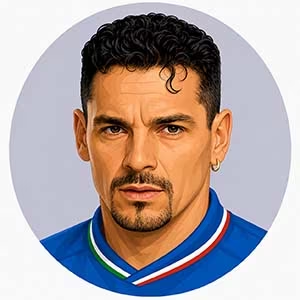
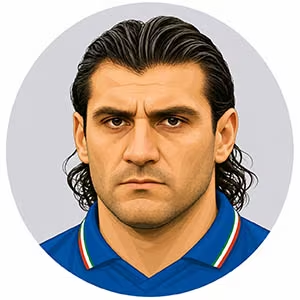
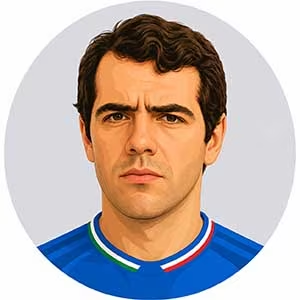
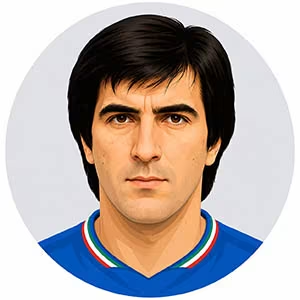
Italy - ForwardBaggio, Roberto
At Pasadena on 17 July 1994, Roberto Baggio walked towards the penalty spot with Brazil one successful kick away from winning the World Cup. Italy’s tournament had repeatedly depended on him: two late goals against Nigeria had prevented elimination, he had scored the winner against Spain and both goals against Bulgaria in the semi-final. His penalty travelled over the crossbar. Brazil were champions. Baggio later rejected attempts to make the miss disappear from his story; he remembered it, discussed it and acknowledged that he had dreamed of that World Cup since childhood. Yet the same career contains a useful counterweight. Penalties did not disappear from his football afterwards. He continued taking them for clubs and country and converted Italy’s first kick in the shoot-out against France at the 1998 World Cup. The relevant sequence is therefore not failure followed by emotional erasure. It is catastrophic public failure followed by continued voluntary exposure to the same action.
Baggio was a second striker and attacking midfielder whose football depended on receiving between defensive reference points rather than remaining fixed within one positional line. His first touch could orient him away from pressure, while exceptional balance and close control allowed him to change direction in extremely small spaces. He could carry towards defenders, combine around the penalty area, create through disguised passes and finish with either placement or power. Free kicks and penalties added substantial set-piece value. Severe knee damage suffered while still a teenager permanently altered the physical conditions of his career, and repeated problems meant he could not build his game around continuous high-intensity running. Instead he became exceptionally economical: movement was selected according to where possession could become dangerous rather than performed continuously for structural effect. That economy produced 205 Serie A goals and 27 in 56 appearances for Italy. His later years at Bologna and Brescia showed that reduced athletic capacity did not remove his ability to organise and finish attacks when the team gave him access to the spaces he understood best.
The same economy produced tactical friction. Baggio was not naturally suited to systems demanding continuous pressing, rigid defensive occupation or high-volume running without the ball. Coaches who considered collective structure dependent on those behaviours could therefore view his freedom as a cost rather than simply a privilege earned by talent. His career repeatedly exposed that conflict: Arrigo Sacchi, Marcello Lippi and later Fabio Capello all made decisions that limited or complicated his role in different contexts. This should not be reduced to managers failing to understand genius. Baggio’s physical history genuinely restricted the defensive workload he could sustain, while systems built around synchronised movement had legitimate reasons to demand behaviours that were not his comparative strength. His degradation conditions were therefore both physical and structural: repeated knee problems, loss of acceleration and environments where the opportunity cost of granting him positional freedom became greater than the attacking benefit. When given a system capable of absorbing those costs, however, his technical influence could remain exceptional well into his thirties.
Psychologically, Baggio is best defined by **self-authored persistence under authority rejection**. Marginalisation occurred too repeatedly to be treated as a single grievance. Sacchi omitted him from important selections; Lippi’s relationship with him deteriorated at Inter; Capello did not build Milan around him; and Giovanni Trapattoni ultimately left him out of the 2002 World Cup despite a rapid recovery from another serious knee injury. Baggio did not respond to every episode identically, and preserving those differences matters. He could criticise decisions and retain grievances, but his dominant behavioural response was repeatedly to seek another route back into footballing relevance rather than reshape himself entirely around the authority rejecting him. At Brescia, Carlo Mazzone gave him tactical responsibility and trust, and Baggio responded with four productive late-career seasons rather than treating provincial football as a loss of status. The 1994 penalty adds another dimension. Baggio did not become detached from the failure, yet continued taking penalties afterwards and scored from the spot against France in the 1998 World Cup shoot-out. This was not fearlessness; the remembered failure remained part of his identity. Evidence for persistent referee conflict, retaliatory aggression or teammate-directed blame is weak. His conflict was more often vertical than horizontal: **when authority defined him as tactically inconvenient, physically finished or no longer central, Baggio repeatedly preserved his own judgement that his football remained worth expressing and searched for a context willing to test that judgement on the field**.