We use Google Analytics to understand how visitors use this site. Analytics cookies are only activated with your consent. For details, read our Privacy Policy.
Profile lensThe same player, read from a different angle.
Athletic84
Acceleration
94
Pace
84
Agility
91
Strength
68
Balance
87
Jumping
85
Stamina
80
Fitness
84
Technical90
Dribbling
92
Short Passing
83
Long Passing
80
Finishing
97
Shot Accuracy
96
Shot Power
80
Shooting Technique
98
Heading
85
Tackling
33
Crossing
76
Free Kick
82
Penalties
93
First Touch
95
Mental90
Composure
94
Aggression
85
Consistency
93
Creativity
92
Leadership
85
Work Rate
82
Tactical88
Vision
83
Off the Ball
95
Defensive Positioning
30
Teamwork
77
Anticipation
97
Marking
30
Player Traits
Attacking90
Crossing
76
Finishing
97
Heading Accuracy
85
Shot Accuracy
96
Off the Ball
95
Technique88
Dribbling
92
Free Kick
82
Short Passing
83
Long Passing
80
First Touch
95
Shot Technique
98
Movement89
Acceleration
94
Pace
84
Agility
91
Balance
87
Physicality79
Shot Power
80
Jumping
85
Stamina
80
Strength
68
Fitness
84
Defending31
Marking
30
Tackling
33
Def. Positioning
30
Mentality & Game Reading88
Aggression
85
Composure
94
Penalties
93
Vision
83
Leadership
85
Work Rate
82
Teamwork
77
Anticipation
97
Consistency
93
Creativity
92
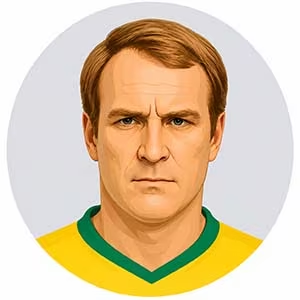
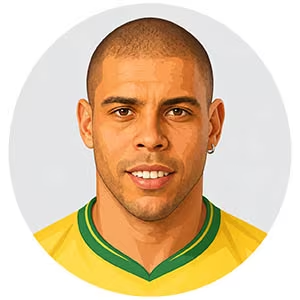
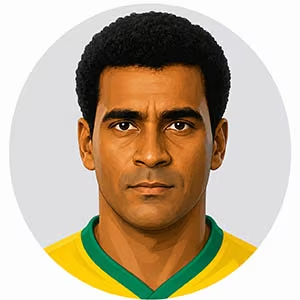
Brazil - StrikerRomário
Few forwards in the history of the sport have matched the supernatural brevity of movement, icy clinical precision, and supreme self-belief displayed by Romário de Souza Faria. Starring for PSV Eindhoven, Barcelona, Flamengo, Vasco da Gama, and the Brazilian national team, O Baixinho (The Little One) revolutionized penalty-box finishing through an economy of effort that bordered on genius. Possessing a low center of gravity, lightning-fast short-burst acceleration over three meters, and toe-poke finishing mechanics that left goalkeepers frozen without time to set their feet, Romário was virtually unmarkable in tight spaces. His technical repertoire was a masterclass in subtlety: delicate lofted chips over rushing custodians, effortless body feints that sent central defenders sliding out of the frame, and sharp first-touch orientation that converted dynamic crosses into goals in a single fluid motion. The undisputed zenith of his global standing arrived during the 1994 FIFA World Cup in the United States, where he scored five goals, claimed the Golden Ball, and carried Brazil to their fourth World Cup trophy, capping off a year where he was named FIFA World Player of the Year following Johan Cruyff's iconic "Dream Team" era at Barcelona.
On the pitch, Romário exercised a unique, completely detached leadership; he spent large portions of a match strolling nonchalantly between opposition central defenders, only to explode into game-defining life in a fraction of a second. Inside the dressing room, he was an unpretentious, highly charismatic, yet fiercely independent figure who openly rejected rigid tactical discipline or grueling training regimes, famously demanding personal lifestyle freedoms from managers like Cruyff and Carlos Alberto Parreira in exchange for guaranteed weekend goals. Under peak tournament pressure, his emotional state was completely flatlined in its composure; he possessed an uncanny, meditative arrogance that allowed him to walk up to penalty spots or high-stakes European ties with complete certainty of outcome. Toward match officials and opposition defenders, Romário displayed a cool, dismissive indifference, absorbing cynical physical fouls with subtle shrugs before punishing markers on the scoreboard rather than engaging in prolonged pitch arguments. Fiercely proud of his favela roots and operating with unshakeable faith in his own natural talent, Romário accepted victory and defeat with identical, nonchalant coolness, leaving an immortal legacy as one of the most lethal penalty-box assassins football has ever witnessed


 All Time BarcelonaClub
 All Time BrazilNT
 All-Time 1990s1990s
 All-Time South AmericaSouth America