We use Google Analytics to understand how visitors use this site. Analytics cookies are only activated with your consent. For details, read our Privacy Policy.
Profile lensThe same player, read from a different angle.
Athletic88
Acceleration
94
Pace
92
Agility
91
Strength
79
Balance
93
Jumping
94
Stamina
81
Fitness
79
Technical94
Dribbling
98
Short Passing
90
Long Passing
89
Finishing
97
Shot Accuracy
96
Shot Power
93
Shooting Technique
95
Heading
85
Tackling
48
Crossing
85
Free Kick
88
Penalties
88
First Touch
99
Mental86
Composure
89
Aggression
74
Consistency
88
Creativity
96
Leadership
85
Work Rate
73
Tactical90
Vision
91
Off the Ball
93
Defensive Positioning
47
Teamwork
88
Anticipation
93
Marking
30
Player Traits
Attacking91
Crossing
85
Finishing
97
Heading Accuracy
85
Shot Accuracy
96
Off the Ball
93
Technique93
Dribbling
98
Free Kick
88
Short Passing
90
Long Passing
89
First Touch
99
Shot Technique
95
Movement93
Acceleration
94
Pace
92
Agility
91
Balance
93
Physicality85
Shot Power
93
Jumping
94
Stamina
81
Strength
79
Fitness
79
Defending42
Marking
30
Tackling
48
Def. Positioning
47
Mentality & Game Reading87
Aggression
74
Composure
89
Penalties
88
Vision
91
Leadership
85
Work Rate
73
Teamwork
88
Anticipation
93
Consistency
88
Creativity
96
Curated interpretation
Signature Moves
Role-defining patterns—not attributes, traits or Inner Game measures. Three ways Pelé changes the meaning of the role around him.
01
Nature’s Prototype
Explosiveness, coordination, strength, elevation, balance and speed coexist without a meaningful physical imbalance: an almost archetypal athletic design.
02
No Safe Angle
No defensive geometry is truly safe. He can beat it with either foot, in the air, at speed or by creating the decisive chance for somebody else.
03
Full Spectrum
He covers virtually the entire offensive and technical range of a great forward without depending on a single dominant weapon.
Brazil - ForwardPelé, Edson
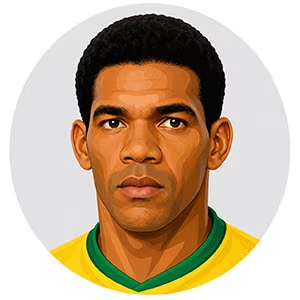
Stockholm, 29 June 1958, the World Cup final. A seventeen-year-old received the ball in the Swedish box with his back to goal, lifted it over the head of the defender marking him, ran around the other side, and volleyed it in before it touched the ground. He scored again twenty minutes later, then wept on the shoulder of his goalkeeper and had to be held upright. Edson Arantes do Nascimento had been a professional for two years. He would spend the following sixteen being the most famous human being on the planet, and never once produced a season that could be called ordinary.
Born in Três Corações in 1940 into severe poverty, the son of a footballer whose own career was ended by injury, Pelé joined Santos at fifteen and stayed for eighteen years. He was tactically far more sophisticated than the highlight reels suggest: he began as a left-sided inside forward, essentially a modern second striker, operating between the attacking midfield line and the forward line, and he never functioned as a traditional number nine, preferring to play alongside a more orthodox centre-forward — Coutinho at Santos, Vavá with Brazil. Over the years he dropped progressively deeper, and by 1970 he was closer to a playmaker, at times operating as a deep-lying midfielder to escape man-marking, as he did against Uruguay in the semi-final. Physically he was extraordinary — explosive, exceptionally strong for 1.73m, and a superb header despite his height — and he combined that athleticism with a technical range and a training discipline that was closer to European professionalism than to the improvisational culture around him. He scored more than 600 official goals for Santos, winning six Brazilian championships, two Copas Libertadores and two Intercontinental Cups, including the 1962 demolition of Benfica in Lisbon. With Brazil he won three World Cups, in 1958, 1962 and 1970 — the only player to do so — and finished with 77 goals in 92 caps. Declared a national treasure by the Brazilian government, he was effectively prevented from moving to Europe despite repeated offers, most persistently from Italy.
The vulnerabilities were physical and contextual rather than technical. Pelé missed almost all of the 1962 World Cup after a muscle tear in the second group match, and he was kicked out of the 1966 tournament entirely, brutalised by Bulgaria and then by Portugal in an era with no protection for attacking players — two of his four World Cups were effectively lost to his own fragility under sustained violence. On European tours he was frequently played in poor condition, in unfamiliar cold, and against defences designed specifically to contain him, and his performances in those matches fluctuated far more than his reputation allows. He also depended on a functioning structure around him: the Santos and Brazil sides that framed him were exceptional, and his individual output was noticeably lower in the weaker Brazil teams of the mid-sixties. He was not a natural organiser of poor teams, and never had to be.
Driven by intense competitive ambition, he thrived under maximum pressure and delivered his peak performances in the largest matches — the two goals in the 1958 final at seventeen, the goal and two assists against Italy in 1970. On the pitch he exercised a quiet, dignified leadership rooted in technical authority, setting an example through obsessive conditioning, punctual attendance and total tactical compliance under Feola and Zagallo. Towards teammates he was inclusive and protective, publicly crediting Coutinho and Tostão for his own scoring returns and deflecting glory onto the collective. His dealings with defenders and officials reflected a pragmatic toughness: despite suffering targeted, severe violence throughout his career, he almost never retaliated, preferring to absorb the tackle, rise immediately and answer with a goal. His disciplinary record was close to spotless, and he treated physical intimidation as a tactical problem to be solved through timing and movement rather than as a provocation. That same equanimity had a less flattering side. Pelé was accommodating to power in a way that Brazilian intellectuals never forgave: he stayed publicly silent during the military dictatorship, appeared alongside the regime that used his 1970 triumph as propaganda, and spent decades avoiding controversy of any kind, which made him a diplomat of extraordinary effectiveness and a conspicuously safe public figure. He was courteous, guarded, permanently on-message, and rarely gave anything unscripted away in sixty years of public life. Immaculate, unflappable and endlessly composed, Pelé carried global expectation from seventeen to eighty without ever visibly buckling under it.