We use Google Analytics to understand how visitors use this site. Analytics cookies are only activated with your consent. For details, read our Privacy Policy.
Profile lensThe same player, read from a different angle.
Athletic87
Acceleration
91
Pace
93
Agility
85
Strength
87
Balance
87
Jumping
87
Stamina
83
Fitness
85
Technical90
Dribbling
90
Short Passing
78
Long Passing
77
Finishing
97
Shot Accuracy
94
Shot Power
95
Shooting Technique
88
Heading
88
Tackling
48
Crossing
72
Free Kick
82
Penalties
93
First Touch
88
Mental85
Composure
86
Aggression
88
Consistency
87
Creativity
81
Leadership
85
Work Rate
78
Tactical85
Vision
81
Off the Ball
95
Defensive Positioning
44
Teamwork
78
Anticipation
86
Marking
38
Player Traits
Attacking89
Crossing
72
Finishing
97
Heading Accuracy
88
Shot Accuracy
94
Off the Ball
95
Technique84
Dribbling
90
Free Kick
82
Short Passing
78
Long Passing
77
First Touch
88
Shot Technique
88
Movement89
Acceleration
91
Pace
93
Agility
85
Balance
87
Physicality87
Shot Power
95
Jumping
87
Stamina
83
Strength
87
Fitness
85
Defending43
Marking
38
Tackling
48
Def. Positioning
44
Mentality & Game Reading84
Aggression
88
Composure
86
Penalties
93
Vision
81
Leadership
85
Work Rate
78
Teamwork
78
Anticipation
86
Consistency
87
Creativity
81
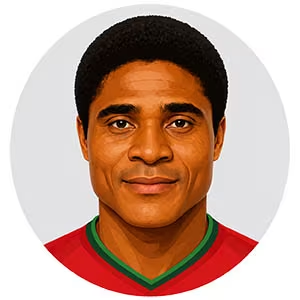
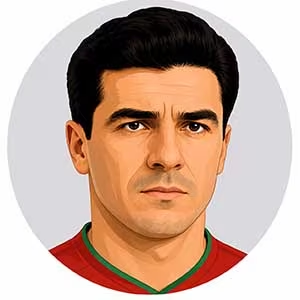
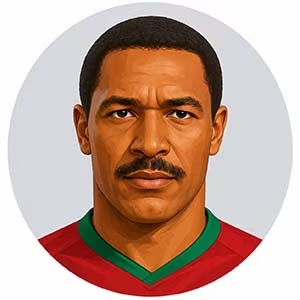
Portugal - StrikerEusébio
Wembley, 25 July 1966, the quarter-final. Portugal were 3–0 down to North Korea after twenty-five minutes, in front of a stadium that had arrived expecting a formality and was now watching one of the great World Cup shocks unfold. Eusébio scored four goals in forty-two minutes. Portugal won 5–3. He collected the ball from the net himself after each North Korean goal and carried it back to the centre circle, and when the tournament ended he was seen weeping openly after the semi-final defeat to England, a photograph that became the defining image of his career. He was twenty-four years old and had just announced himself as the most explosive footballer alive.
Born in Lourenço Marques — now Maputo — in 1942, in a poor neighbourhood of what was then Portuguese Mozambique, Eusébio da Silva Ferreira was brought to Lisbon at nineteen in a transfer so contested that Benfica hid him in the Algarve while Sporting pursued their claim. He was a combination of raw athletic power and technical precision that European football had not encountered: terrifying acceleration off the mark, exceptional balance at speed, and a right-footed shot of devastating velocity that beat goalkeepers from distances they did not defend. He operated as a second striker or central forward, moving directly and vertically, driving through defensive structures rather than around them. Across fifteen seasons at Benfica he scored 473 goals in 440 matches, won eleven Primeira Liga titles and five Portuguese Cups, and led the club to the 1962 European Cup, scoring twice in the final against a Real Madrid side containing Di Stéfano and Puskás. He reached three further European Cup finals and lost all three. He won the 1965 Ballon d'Or, the European Golden Boot twice, and with Portugal scored 41 goals in 64 caps, taking the Golden Boot at the 1966 World Cup with nine goals and a third-place finish.
The limitations were structural and physical. Eusébio played his entire prime in Portugal, since the Salazar regime restricted the movement of its stars abroad, which meant he faced elite opposition only in European competition and international tournaments — a narrower test than his contemporaries received weekly. His game was individual rather than combinative: he offered little defensively, limited link play, and his instinct was to shoot from range even when a pass was available, a habit that inflated his volume and cost his teams possession. Most decisively, chronic knee problems from the late 1960s progressively destroyed the acceleration on which everything depended; by thirty he had undergone multiple operations, and the final years of his career were spent in North American and Mexican football as a diminished player.
He led through technical brilliance, matchday work ethic, and an inclusive warmth that made him the beloved heart of both Benfica and Portugal. His response to pressure was intensification: when his team was behind in a decisive tie, he did not withdraw or panic but demanded the ball directly and tried to engineer the comeback himself through relentless shooting and individual effort. Towards opponents and officials he was impeccably fair — subjected to brutal target-marking across Europe, he consistently refused to retaliate, picking himself up, offering a hand to the defender who had fouled him, and answering with goals. With managers, including Béla Guttmann and Otto Glória, he displayed total tactical compliance and genuine humility, and his training discipline was exemplary throughout. That deference extended beyond football: he was made a national symbol by a regime that used him, accepted the role without public complaint, and never spoke against the political system that had both restricted his career and celebrated him — a silence that historians have discussed more than he ever did. He remained bound to Benfica for the rest of his life, attributed his individual honours to the collective, and carried global fame with a modesty that never wavered across fifty years. Explosive, gracious and permanently loyal, Eusébio remains the only footballer in history whose statue stands outside the stadium he filled.