We use Google Analytics to understand how visitors use this site. Analytics cookies are only activated with your consent. For details, read our Privacy Policy.
Profile lensThe same player, read from a different angle.
Athletic80
Acceleration
92
Pace
85
Agility
93
Strength
71
Balance
78
Jumping
68
Stamina
80
Fitness
70
Technical83
Dribbling
93
Short Passing
82
Long Passing
78
Finishing
79
Shot Accuracy
77
Shot Power
83
Shooting Technique
85
Heading
68
Tackling
44
Crossing
76
Free Kick
78
Penalties
77
First Touch
90
Mental76
Composure
79
Aggression
76
Consistency
77
Creativity
92
Leadership
71
Work Rate
74
Tactical75
Vision
80
Off the Ball
82
Defensive Positioning
45
Teamwork
68
Anticipation
76
Marking
38
Player Traits
Attacking76
Crossing
76
Finishing
79
Heading Accuracy
68
Shot Accuracy
77
Off the Ball
82
Technique84
Dribbling
93
Free Kick
78
Short Passing
82
Long Passing
78
First Touch
90
Shot Technique
85
Movement87
Acceleration
92
Pace
85
Agility
93
Balance
78
Physicality74
Shot Power
83
Jumping
68
Stamina
80
Strength
71
Fitness
70
Defending42
Marking
38
Tackling
44
Def. Positioning
45
Mentality & Game Reading77
Aggression
76
Composure
79
Penalties
77
Vision
80
Leadership
71
Work Rate
74
Teamwork
68
Anticipation
76
Consistency
77
Creativity
92
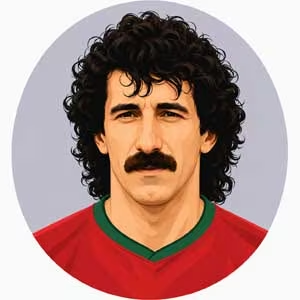
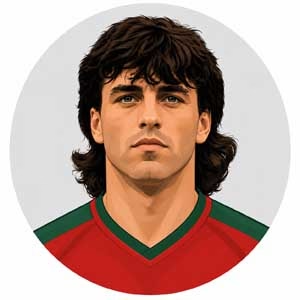
Portugal - Left WingerFutre, Paulo
The Praterstadion in Vienna on May 27, 1987, served as the global stage where Artur Jorge’s FC Porto dismantled Bayern Munich, orchestrated by a 21-year-old Portuguese prodigy who treated the left flank as a private running track. Developed at Sporting CP before making a controversial switch to the Estádio das Antas, Paulo Jorge dos Santos Futre was the definitive European winger of the late 1980s. He specialized in sudden, lateral shifts of momentum from a dead stop, tearing past full-backs with blistering acceleration, adhesive close control with his left boot, and an uncanny ability to cross accurately at maximum sprinting speed. His masterclass in the 1987 European Cup final earned him the Silver Ball in the 1987 Ballon d'Or behind Ruud Gullit, preceding a blockbuster transfer to Jesús Gil’s Atlético Madrid. In the Spanish capital, he became an immortal folk hero and club captain, carrying Los Colchoneros to back-to-back Copa del Rey triumphs in 1991 and 1992 (scoring in the final against Real Madrid at the Santiago Bernabéu). Across 41 caps and six goals for Portugal, he was the lone world-class light of a transitional international generation.
However, Futre's explosive athletic game carried severe biological vulnerabilities. His reliance on sudden deceleration and violent knee torques took a catastrophic toll: a series of severe knee ligament and meniscus injuries beginning in 1993 stripped him of his razor-sharp first step before he turned 28. Subsequent nomadic spells with Benfica, Reggiana, Milan, West Ham, and Yokohama Flügels were heavily compromised by physical breakdowns. Tactically, he was virtually incapable of operating in tight central pockets, offered negligible defensive support, and lacked physical presence in aerial duels.
Artistic, proud, and intensely emotional, Futre carried the entire creative burden of Atlético Madrid on his shoulders during one of the most chaotic administrative eras in Spanish football history. He thrived on the visceral love of the Vicente Calderón faithful, responding to high-pressure derbies with fearless individual initiative and relentless touchline dribbles. On the pitch, his body language was dynamic and expressive; when hacked by cynical defenders, he picked himself up immediately to isolate the same marker on the next possession, using psychological momentum to break his opponent's confidence. Inside the dressing room, he was a charismatic, highly respected captain who acted as a crucial buffer between the squad and the erratic presidency of Jesús Gil. Opponents universally feared his uncontainable wide bursts, leaving behind an enduring legacy as one of the most electrifying, technically dazzling, yet tragically fragile wingers in Iberian football history.


 All Time PortugalNT