We use Google Analytics to understand how visitors use this site. Analytics cookies are only activated with your consent. For details, read our Privacy Policy.
Profile lensThe same player, read from a different angle.
Athletic80
Acceleration
83
Pace
82
Agility
87
Strength
76
Balance
88
Jumping
70
Stamina
77
Fitness
74
Technical86
Dribbling
92
Short Passing
87
Long Passing
87
Finishing
82
Shot Accuracy
77
Shot Power
84
Shooting Technique
85
Heading
66
Tackling
41
Crossing
82
Free Kick
85
Penalties
79
First Touch
92
Mental76
Composure
82
Aggression
84
Consistency
74
Creativity
90
Leadership
74
Work Rate
70
Tactical74
Vision
84
Off the Ball
82
Defensive Positioning
38
Teamwork
65
Anticipation
72
Marking
38
Player Traits
Attacking78
Crossing
82
Finishing
82
Heading Accuracy
66
Shot Accuracy
77
Off the Ball
82
Technique88
Dribbling
92
Free Kick
85
Short Passing
87
Long Passing
87
First Touch
92
Shot Technique
85
Movement85
Acceleration
83
Pace
82
Agility
87
Balance
88
Physicality76
Shot Power
84
Jumping
70
Stamina
77
Strength
76
Fitness
74
Defending39
Marking
38
Tackling
41
Def. Positioning
38
Mentality & Game Reading77
Aggression
84
Composure
82
Penalties
79
Vision
84
Leadership
74
Work Rate
70
Teamwork
65
Anticipation
72
Consistency
74
Creativity
90
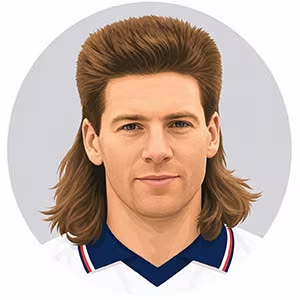
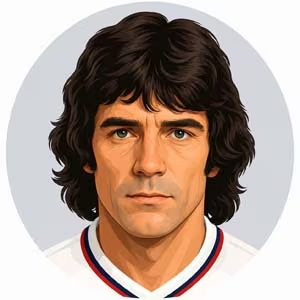
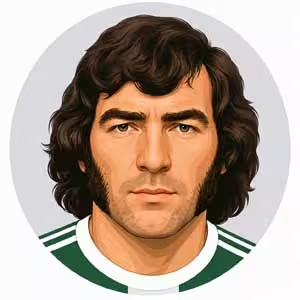
England - Left WingerWaddle, Chris
The Stade Vélodrome in the late 1980s and early 1990s fell hopelessly in love with a mullet-haired English maverick who turned the right flank into a personal playground of hip-feints and shoulder-drops, earning the immortal French nickname Magic Chris. Christopher Roland Waddle was one of the most mesmerizing, technically gifted wide dribblers European football has ever produced, enjoying iconic spells at Newcastle United, Tottenham Hotspur, Olympique de Marseille, and Sheffield Wednesday. Operating primarily as an inverted right winger who loved cutting onto his favored left foot, Waddle possessed a languid, rolling dribbling style: freezing defenders with bewildering stepovers, drifting past double-teams from a standing start, and whipping laser-accurate crosses or curling shots into the top corner. At Marseille between 1989 and 1992, he became a global superstar, capturing three consecutive Division 1 championships, reaching the 1991 European Cup final in Bari, and being voted the second-best Marseille player of the 20th century behind Jean-Pierre Papin. Back in England, he claimed the 1992–93 FWA Footballer of the Year award with Sheffield Wednesday. For England, across 62 caps and six goals, he was a key creative spark across two World Cups (1986 and 1990), famously starring on the run to the semi-finals in Italy.
The paradox of Waddle’s artistry, however, lay in his total detachment from modern pressing dogfights and defensive tracking. He was an orthodox, expressive attacker who contributed almost nothing to defensive recoveries or physical ball-winning, requiring tireless midfields to supply the defensive platform behind him. Furthermore, his international legacy was permanently shadowed by his heartbreaking penalty miss in the Turin shootout against West Germany at Italia '90, alongside a difficult relationship with manager Graham Taylor that prematurely curtailed his England career in 1991.
Playful, irreverent, and fueled by a pure street-football joy, Waddle played the game strictly to stir the soul of the supporters. He approached hostile away grounds and cynical marking with casual nonchalance, dismantling stoppers with pure skill and laughing off rough tackles with a wink to the crowd. On the pitch, his body language was relaxed and nonchalant: strolling along the touchline with his socks down before exploding into an impossible sequence of feints that left full-backs tackling thin air. Inside the Marseille and Spurs dressing rooms, his humor and warmth made him an indispensable cultural bridge, forming a devastating attacking brotherhood alongside Papin and Abedi Pelé. Referees found him an honest, non-confrontational artist, leaving behind an eternal legacy as one of the most creative, uninhibited, and iconic wingers in British football history.