We use Google Analytics to understand how visitors use this site. Analytics cookies are only activated with your consent. For details, read our Privacy Policy.
Profile lensThe same player, read from a different angle.
Athletic79
Acceleration
85
Pace
81
Agility
85
Strength
69
Balance
75
Jumping
84
Stamina
75
Fitness
80
Technical82
Dribbling
76
Short Passing
70
Long Passing
66
Finishing
95
Shot Accuracy
95
Shot Power
75
Shooting Technique
96
Heading
86
Tackling
34
Crossing
62
Free Kick
68
Penalties
90
First Touch
77
Mental82
Composure
91
Aggression
78
Consistency
80
Creativity
76
Leadership
76
Work Rate
81
Tactical86
Vision
74
Off the Ball
94
Defensive Positioning
30
Teamwork
74
Anticipation
97
Marking
31
Player Traits
Attacking86
Crossing
62
Finishing
95
Heading Accuracy
86
Shot Accuracy
95
Off the Ball
94
Technique76
Dribbling
76
Free Kick
68
Short Passing
70
Long Passing
66
First Touch
77
Shot Technique
96
Movement82
Acceleration
85
Pace
81
Agility
85
Balance
75
Physicality77
Shot Power
75
Jumping
84
Stamina
75
Strength
69
Fitness
80
Defending32
Marking
31
Tackling
34
Def. Positioning
30
Mentality & Game Reading82
Aggression
78
Composure
91
Penalties
90
Vision
74
Leadership
76
Work Rate
81
Teamwork
74
Anticipation
97
Consistency
80
Creativity
76
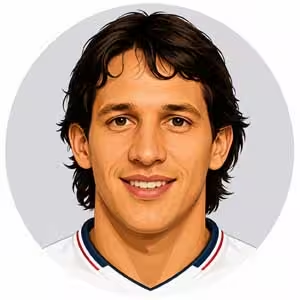
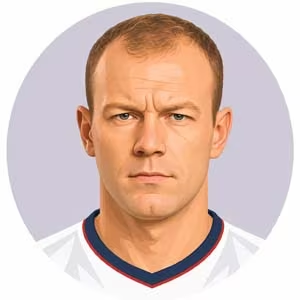
England - StrikerLineker, Gary
Operating inside the penalty box with an almost clairvoyant positional instinct and an absolute economy of movement, Gary Winston Lineker was the quintessential predatory goalscorer of late-20th-century English football. Bursting onto the scene with his hometown club Leicester City before enjoying prolific, high-scoring campaigns with Everton, Terry Venables' Barcelona, and Tottenham Hotspur, Lineker built a world-class reputation on what he did without the ball. Standing at five-foot-ten with sharp short-burst acceleration over five to ten yards, he never wasted energy on aerial tussles or dropping deep to dictate tempo; instead, his entire game was calibrated around gambling on defensive errors, attacking the near post, and finishing with clean, first-time touches inside the six-yard box. His domestic peak with Everton in 1985–86 yielded 40 goals across all competitions, while in Spain he famously netted a Clásico hat-trick against Real Madrid and won the 1989 European Cup Winners' Cup. On the international stage, Lineker was exceptionally clinical, scoring 48 goals in 80 caps for England: claiming the Golden Boot with six goals at the 1986 World Cup in Mexico and scoring four more at Italia '90 to lead England to the semi-finals, establishing himself as one of the most ruthless and intelligent tournament finishers in World Cup history. Psychologically, Lineker was a figure of supreme inner calm, unshakeable mental clarity, and an extraordinary capacity to navigate intense scoring droughts without losing his tactical discipline. He treated goalscoring with the analytical detachment of a master chess player, understanding that missed chances were simply part of the statistical landscape and refusing to allow frustration to compromise his timing. On the pitch, his demeanor was famously spotless and self-contained; he holds the historic, near-mythical distinction of never receiving a single yellow or red card across his entire 16-year professional career. Inside the dressing room, he was an articulate, witty, and grounded presence—unfazed by tabloid hysteria or the immense pressure of carrying the hopes of the English nation, serving as a cheerful and reassuring figure alongside more mercurial characters like Paul Gascoigne. Under the scorching heat of World Cup knockout ties or hostile Spanish away grounds, his heart rate remained remarkably low, converting high-stakes opportunities with cold-blooded efficiency. Toward referees and aggressive central defenders who subjected him to constant physical jostling, Lineker maintained impeccable, old-school sportsmanship: accepting hard contact without rolling on the turf, never engaging in petulant dissent, and letting his devastating penalty-box movement serve as his only argument.