We use Google Analytics to understand how visitors use this site. Analytics cookies are only activated with your consent. For details, read our Privacy Policy.
Profile lensThe same player, read from a different angle.
Athletic82
Acceleration
87
Pace
83
Agility
85
Strength
77
Balance
85
Jumping
87
Stamina
77
Fitness
75
Technical86
Dribbling
81
Short Passing
79
Long Passing
79
Finishing
96
Shot Accuracy
93
Shot Power
81
Shooting Technique
91
Heading
85
Tackling
33
Crossing
72
Free Kick
77
Penalties
80
First Touch
83
Mental81
Composure
89
Aggression
85
Consistency
78
Creativity
76
Leadership
79
Work Rate
77
Tactical85
Vision
74
Off the Ball
95
Defensive Positioning
35
Teamwork
72
Anticipation
94
Marking
38
Player Traits
Attacking88
Crossing
72
Finishing
96
Heading Accuracy
85
Shot Accuracy
93
Off the Ball
95
Technique82
Dribbling
81
Free Kick
77
Short Passing
79
Long Passing
79
First Touch
83
Shot Technique
91
Movement85
Acceleration
87
Pace
83
Agility
85
Balance
85
Physicality79
Shot Power
81
Jumping
87
Stamina
77
Strength
77
Fitness
75
Defending35
Marking
38
Tackling
33
Def. Positioning
35
Mentality & Game Reading80
Aggression
85
Composure
89
Penalties
80
Vision
74
Leadership
79
Work Rate
77
Teamwork
72
Anticipation
94
Consistency
78
Creativity
76
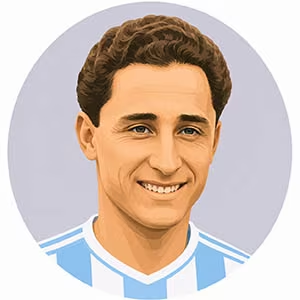
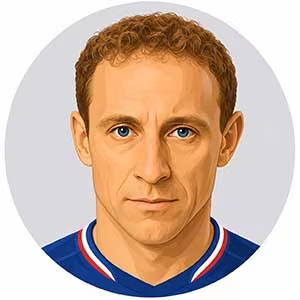
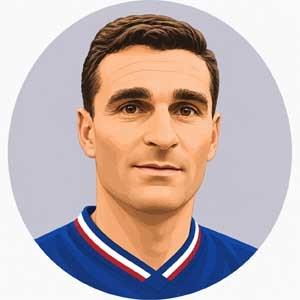
France - StrikerFontaine, Just
Instinctive three-yard bursts, razor-sharp execution on bouncing loose balls, and an unmatched predatory sense inside the eighteen-yard box made Just Louis Fontaine the most explosive tournament goalscorer the World Cup has ever witnessed. Born in Marrakech and developed at USM Casablanca and OGC Nice—where he won the 1955–56 French Division 1 title—Justo became the crown jewel of Albert Batteux’s champagne-football era at Stade de Reims, brought in to replace the departed Raymond Kopa. Built with a low, sturdy center of gravity, spring-loaded acceleration over the first five yards, and clean two-footed finishing power, Fontaine was the ultimate direct spearhead: he did not waste touches on superfluous dribbles, specialized in diagonal runs between center-halves, and struck first-time half-volleys with pinpoint placement into the side netting. At Reims, he captured three Division 1 championships (1958, 1960, 1962), two Coupes de France, two Pichichi-equivalent French top-scorer titles, and scored ten goals during their run to the 1959 European Cup Final against Real Madrid. His global peak arrived at the 1958 World Cup in Sweden: playing in borrowed boots from teammate Stéphane Bruey, he shattered the tournament record by netting an astonishing 13 goals in six matches—including four against West Germany in the third-place playoff—a single-tournament scoring record that remains untouched. Across just 21 caps for France, he amassed a staggering 30 goals.
Yet Fontaine’s high-octane game had cruel, unforgiving physical boundaries. His technical contribution outside the penalty area was minimal; he struggled if forced into prolonged horizontal build-up play, lacked the aerial dominance to win static aerial duels against towering defenders, and offered little utility in defensive containment schemes. Catastrophically, his relentless physical commitment to contested loose balls brought his peak to a brutal, premature end: two major double leg fractures (tibia and fibula) suffered in 1960 and 1961 completely dismantled his lower-leg stability, forcing his definitive retirement at only 28 years old.
Joyful, generous, and completely free of prima-donna posturing, Fontaine approached the penalty area with pure attacking passion. He was an unselfish finisher who formed a seamless, telepathic partnership with playmakers like Kopa and Maryan Wisnieski, happily dragging markers away to open channels when not finishing moves himself. On the pitch, his body language radiated boundless enthusiasm: he celebrated every goal with exuberant boyish joy, never seeking individual glory at the expense of squad harmony. Inside the French and Reims locker rooms, he was an infectious, beloved personality—witty, warm-hearted, and instrumental in keeping squad morale high during grueling tournament campaigns in Scandinavia. When center-backs tried to intimidate him with brutal physical contact, Fontaine never shrank back or feigned injury; he dusted himself down, read the next flight of the ball, and punished defensive errors with clinical efficiency. Referees admired his spotless sportsmanship and complete absence of diving, cementing his legacy as one of the most prolific, explosive, and tragically short-lived attacking titans in global football history.

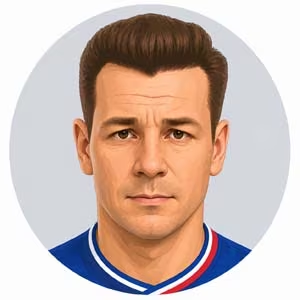

 All Time FranceNT