We use Google Analytics to understand how visitors use this site. Analytics cookies are only activated with your consent. For details, read our Privacy Policy.
Profile lensThe same player, read from a different angle.
Athletic84
Acceleration
77
Pace
84
Agility
77
Strength
85
Balance
86
Jumping
85
Stamina
86
Fitness
89
Technical73
Dribbling
71
Short Passing
73
Long Passing
73
Finishing
52
Shot Accuracy
59
Shot Power
74
Shooting Technique
67
Heading
82
Tackling
87
Crossing
70
Free Kick
62
Penalties
65
First Touch
73
Mental84
Composure
77
Aggression
92
Consistency
90
Creativity
63
Leadership
85
Work Rate
93
Tactical79
Vision
71
Off the Ball
66
Defensive Positioning
84
Teamwork
82
Anticipation
84
Marking
89
Player Traits
Attacking66
Crossing
70
Finishing
52
Heading Accuracy
82
Shot Accuracy
59
Off the Ball
66
Technique70
Dribbling
71
Free Kick
62
Short Passing
73
Long Passing
73
First Touch
73
Shot Technique
67
Movement81
Acceleration
77
Pace
84
Agility
77
Balance
86
Physicality84
Shot Power
74
Jumping
85
Stamina
86
Strength
85
Fitness
89
Defending87
Marking
89
Tackling
87
Def. Positioning
84
Mentality & Game Reading80
Aggression
92
Composure
77
Penalties
65
Vision
71
Leadership
85
Work Rate
93
Teamwork
82
Anticipation
84
Consistency
90
Creativity
63
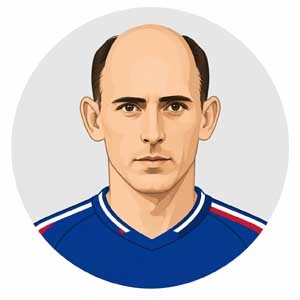
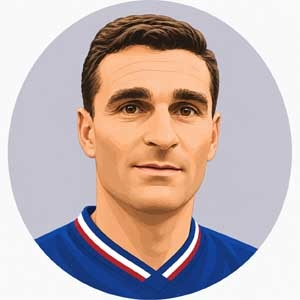
France - Left BackMarche, Roger
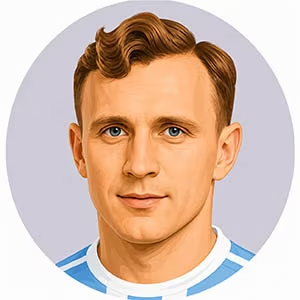
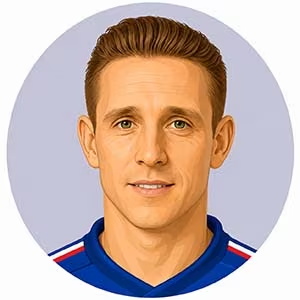
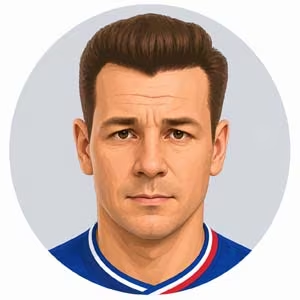
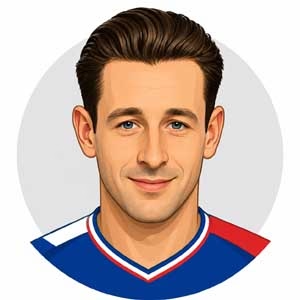
At Colombes on 17 March 1955, France defeated Spain 1–0 in front of more than 60,000 spectators, and Roger Marche walked onto the pitch for his forty-second international appearance. That number mattered: it moved him beyond Étienne Mattler and made him the most capped French footballer to that point. Marche was already thirty-one, had spent almost his entire career far from the glamour associated with Parisian football, and travelled enormous distances simply to represent his country. His nickname, “Le Sanglier des Ardennes” — the Wild Boar of the Ardennes — suggested violent forward momentum, but his international longevity was built on something less picturesque: repeated willingness to return, defend the left side and perform the same physically demanding function regardless of prestige. Three years later, in the third-place match of the 1958 World Cup, the thirty-four-year-old Marche scored France’s final goal in a 6–3 victory over West Germany. It was his only international goal. By then he had reached 63 caps, a national record that would stand until 1983. His career with France was therefore not a brief expression of combative intensity but thirteen years of sustained availability.
Marche was primarily a left full-back in the WM-era sense: a defender expected to mark directly, win physical confrontations and prevent the opposing winger from turning the flank into an attacking route. Contemporary descriptions consistently emphasise his power, tackling and extraordinary physical robustness. He was not elegant in the modern attacking-full-back sense and did not derive his value from overlapping combinations or elaborate possession. His game was built around defensive certainty: closing an opponent, using his body, tackling decisively and clearing danger without unnecessary complication. Yet the image of a purely destructive defender is incomplete. Marche had enough technical security to carry the ball forward when space opened and possessed a powerful strike, qualities visible in the remarkable international goal he scored against West Germany in 1958 after advancing from defence. His club career was divided principally between Reims and Racing Club de Paris. With Reims he won the French championship in 1949 and 1953 and the Coupe de France in 1950; with France he played at the 1954 and 1958 World Cups, becoming captain during part of his international career. His reliability made him unusually durable for a position in which direct physical duels were frequent and substitutions effectively unavailable.
That construction also establishes his limits. Marche’s defensive football belonged to an era of individual marking and more direct attacking structures, and his strengths were maximised when the opponent and the defensive problem were physically identifiable. He was less naturally suited to situations requiring continuous positional interchange, high-frequency short passing or repeated attacking contribution far beyond his defensive zone. His forceful tackling could solve direct confrontations but offered less protection when an attacker avoided the duel entirely through rapid combinations. Nor should durability be mistaken for athletic completeness. Marche was powerful and enduring, but his game did not depend on exceptional agility or sophisticated recovery mechanics; an opponent capable of creating separation before contact could reduce the value of his physical superiority. His lifestyle also produced an unusual structural constraint. Even while playing at the highest domestic and international level, Marche remained strongly attached to the Ardennes and later combined football with work outside the professional game. The enormous travel involved in maintaining his international career was tolerated rather than eliminated. That arrangement suggests exceptional availability but should not be romanticised as optimal preparation: his effectiveness was sustained despite conditions that offered considerably less specialised recovery and training support than those surrounding more fully embedded professional players.
Psychologically, Marche’s clearest distinguishing feature is **competitive hardness without institutional dependency**. His aggression was primarily physical and tactical: the nickname, the direct marking and accounts of uncompromising tackling all indicate willingness to impose contact, but surviving evidence does not justify converting that into emotional volatility. There is little documentation of persistent referee disputes, retaliatory behaviour after provocation or conflict generated by teammates’ errors. More revealing is his relationship with football itself. Marche repeatedly chose to remain connected to his home region rather than organise his life entirely around professional status, even though doing so made international participation inconvenient. He could travel from the Ardennes to Paris, play for France and return without requiring the national-team environment to become the centre of his identity. At Racing, and later after leaving elite football, he maintained work and local attachments outside the sport. This did not produce low competitive commitment: 63 internationals across thirteen years, captaincy and participation at thirty-four in France’s 1958 World Cup run demonstrate the opposite. It indicates that commitment and dependency were separate. Marche could invest heavily in the immediate obligation without needing football to monopolise his social identity. That makes his physical aggression particularly important to classify correctly: he attacked opponents forcefully because the defensive task demanded it, not because the available evidence shows a player who required emotional confrontation. Nor does his captaincy establish vocal dominance; documentation is insufficient to score that confidently. His profile is therefore not “warrior”. It is **bounded competitive investment**: once inside the match or national-team obligation, he accepted substantial physical cost and responsibility, while outside it he preserved a life whose centre of gravity remained remarkably independent of elite football.