We use Google Analytics to understand how visitors use this site. Analytics cookies are only activated with your consent. For details, read our Privacy Policy.
Profile lensThe same player, read from a different angle.
Athletic80
Acceleration
75
Pace
78
Agility
77
Strength
84
Balance
77
Jumping
85
Stamina
82
Fitness
85
Technical81
Dribbling
75
Short Passing
78
Long Passing
83
Finishing
50
Shot Accuracy
59
Shot Power
78
Shooting Technique
69
Heading
88
Tackling
92
Crossing
78
Free Kick
60
Penalties
58
First Touch
78
Mental90
Composure
92
Aggression
78
Consistency
90
Creativity
68
Leadership
89
Work Rate
91
Tactical86
Vision
72
Off the Ball
60
Defensive Positioning
95
Teamwork
87
Anticipation
88
Marking
93
Player Traits
Attacking67
Crossing
78
Finishing
50
Heading Accuracy
88
Shot Accuracy
59
Off the Ball
60
Technique74
Dribbling
75
Free Kick
60
Short Passing
78
Long Passing
83
First Touch
78
Shot Technique
69
Movement77
Acceleration
75
Pace
78
Agility
77
Balance
77
Physicality83
Shot Power
78
Jumping
85
Stamina
82
Strength
84
Fitness
85
Defending93
Marking
93
Tackling
92
Def. Positioning
95
Mentality & Game Reading81
Aggression
78
Composure
92
Penalties
58
Vision
72
Leadership
89
Work Rate
91
Teamwork
87
Anticipation
88
Consistency
90
Creativity
68
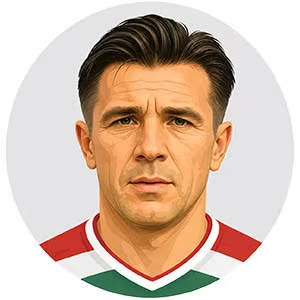
Uruguay - Centre-backSantamaria, José
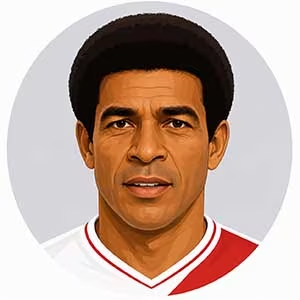
Born in Montevideo and naturalized in Madrid, José Emilio Santamaría was the impenetrable defensive architect who provided the structural balance behind the flamboyant attacking genius of Alfredo Di Stéfano and Ferenc Puskás at Real Madrid. Having established his reputation with Nacional and anchoring Uruguay to the 1954 World Cup semi-finals as a pure center-half, Santamaría arrived in Spain in 1957, bringing the uncompromising grit of South American garra to the European game. Standing at five-foot-eleven with an athletic, powerful frame, he was the master of positional anticipation: rather than lunging into reckless tackles, he read the flight of the ball early, stepped in front of opposing inside-forwards to intercept cleanly, and cleared danger with decisive aerial dominance. Over an iconic nine-year spell with Real Madrid spanning over 330 appearances, he served as the undisputed defensive cornerstone of four European Cups (including the famous 1960 7–3 triumph over Eintracht Frankfurt at Hampden Park) and six La Liga titles. Earning 20 caps for Uruguay and later 16 for Spain—culminating in an appearance at the 1962 World Cup—he stood out as the rare defender of his era capable of handling elite forward lines across two different continents.
Psychologically, Santamaría was a figure of cold stoicism, iron discipline, and an absolute commitment to tactical order. Surrounded by massive egos and attacking superstars in Madrid, he embraced the unglamorous burden of defensive containment with zero personal vanity, understanding that their attacking freedom depended entirely on his defensive vigilance. On the pitch, his leadership was sober, authoritative, and deeply organized; he directed his full-backs with precise, functional commands, maintaining a compact defensive unit even when matches turned into open, end-to-end chaos. In the locker room, he commanded immense respect across generations—earning the nickname The Wall not just for his defensive resilience, but for an unshakeable emotional baseline that remained completely flat in the face of hostile European away grounds. Under tournament pressure, his focus was spotless; he treated world-class dribblers like Just Fontaine or Raymond Kopa with analytical detachment, never diving into tackles or losing his positional footing. Toward match officials and aggressive center-forwards, Santamaría was an old-school gentleman of the penalty box: physical, uncompromising, and relentless in the duel, but entirely free of malicious fouls, diving, or theatrical gamesmanship.